

Mount Etna Sicily Lava Tours Restricted, Guides Strike
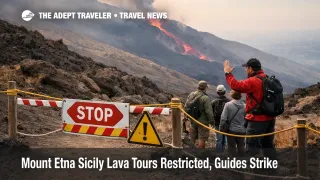
Mount Etna tour restrictions are tightening on Sicily's east slopes as authorities curb lava viewing excursions near the active flow in Valle del Bove. Travelers booked on guided hikes, photography outings, and last minute day trips from Catania and Taormina are seeing cancellations, shorter routes, and earlier turnarounds. Reconfirm your operator's permitted route and cutoff time, plan a backup viewpoint day, and build extra transfer buffer if your itinerary chains Etna into flights, ferries, or fixed check ins.
The immediate change is that lava front excursions are being treated like a controlled access operation, not a free flowing attraction. The practical headline for travelers is that excursions are limited to daylight, groups are being held to small numbers, and the closest approach to the active flow is being pushed back, which combines to reduce tour availability and compress demand into fewer permitted viewing spots.
Local authorities have reinforced rules that keep visitors away from the active lava, including a minimum distance from the flow, strict small group limits, and a cutoff at dusk rather than the after dark glow window that many travelers book specifically to see. Reporting from Sicily indicates that enforcement is being tightened with patrols and monitoring, including drone use, which increases the odds that informal, do it yourself approaches get turned back.
At the same time, multiple access points are being managed through municipal ordinances, which is why your experience can differ sharply depending on the approach road your operator uses. Sicily's regional civil protection reporting highlights an ordinance by the Comune di Milo that closes access from the Pietracannone road, a branch of SP Mareneve, while still allowing access only with qualified alpine and volcano guides, in groups of up to 10, with appropriate technical gear, radio communications, and a ban starting at dusk.
Those restrictions have collided with guide operations. Tour guides and licensed volcano and alpine professionals have protested what they describe as overly rigid limits, and news reporting indicates a rare strike that is pulling additional capacity out of the market just as traveler demand spikes to see the eruption. Even if a zone is technically open, a strike or a partial work stoppage can mean your operator cannot legally staff the trip, which is why some travelers are hearing "canceled" even when photos show lava still visible from the area.
Who Is Affected
Travelers most affected are those whose Sicily itinerary is built around a specific lava viewing product, especially sunset or night focused excursions, and those staying in Catania, Taormina, or the broader east coast corridor who planned a single day trip that cannot easily move. Cruise passengers with a shore excursion to Etna are also exposed because port days have hard return times, and earlier cutoffs reduce the usable window.
Independent travelers driving up for a self guided look are at higher risk of wasted time and abrupt turnarounds. The combination of closures on specific access roads, dusk restrictions, and tight definitions of "authorized" accompaniment means your plan can fail even if you arrive early, have good weather, and see activity on the mountain. CAI Sicilia has publicly asked for clearer wording around who counts as authorized to accompany visitors to the lava front, which is a signal that access definitions are actively contested and can change quickly.
The first order disruption is at the volcano itself, fewer legal routes, fewer guided departures, and a hard stop that removes the most dramatic after dark lava visibility. The second order ripple is that tourists rebook into the same limited daytime slots, which crowds parking and access roads, pushes tour operators into rescheduling waves, and increases hotel front desk friction as guests shift checkout and check in times around an earlier return from the mountain.
A third layer of knock on effects shows up in how people move around the island. When Etna access becomes time boxed, travelers often try to "do Etna and transfer" on the same day, which is when buffers get crushed. If you are flying in or out through eastern Sicily, treat your Etna day as a standalone block, and keep an eye on aviation conditions as well, since Etna activity can also translate into short notice operational changes at Vincenzo Bellini Catania Airport (CTA). For context on the gateway and transfer planning, see Vincenzo Bellini Catania Airport (CTA). For recent flight specific risk framing tied to Etna activity, see Etna Ash Near Catania Airport Could Disrupt Flights and Etna Ash Catania Airport Sector Closures Delay Flights.
What Travelers Should Do
Start by treating any lava front excursion as provisional until you have same day confirmation. Message your operator for the permitted route, the turnaround time, and whether the trip depends on municipal access that can be suspended. If you are self driving, plan to arrive earlier than you normally would, and do not assume you can "wait for sunset," because the dusk cutoff is the rule that is breaking the most itineraries.
If your booking is for a sunset or night lava experience, your decision threshold is simple: if the operator cannot guarantee a legal post sunset component, rebook to a daytime alternative now rather than hoping enforcement loosens. If you are already on the island and your trip is within 24 hours, prioritize refundable or easily rebookable options, and avoid stacking Etna with a long cross island transfer or a flight, because your return time is now constrained by regulation, not just by personal stamina.
Over the next 24 to 72 hours, monitor two streams, the volcanic activity updates and the access and enforcement posture. INGV reporting indicates the eruption that began December 24, 2025, included a new fissure opening around January 1, 2026, and has emphasized modeling that can keep lava confined within Valle del Bove under steady conditions, but that does not automatically translate into permissive visitor access. Meanwhile, Sicily's civil protection messaging and municipal rules can tighten quickly in response to crowding, road safety, and rescue capacity.
How It Works
Volcano access management is not only about whether lava is threatening towns. It is also about terrain stability, visibility, gas exposure, and whether rescue teams can safely reach people who slip, become disoriented, or approach unstable ground near a flow. Dusk and darkness raise the stakes because hikers lose contrast and landmarks, and because the same crowd that wants the "lava glow" tends to cluster into narrow vantage corridors, which increases trampling, fall risk, and bottlenecks for responders.
On Etna, the system is layered. INGV monitors activity and publishes technical updates, while the regional civil protection system and local municipalities translate that risk into practical access rules, road closures, and permitted guide frameworks. That is why rules can be highly specific, for example closing a named access road while still allowing guided entry under strict conditions elsewhere, and why enforcement can include checkpoints and aerial monitoring when visitor volume surges.
The travel system ripple is predictable. When the most iconic product is constrained, demand shifts into whatever remains legal, which concentrates people into fewer tours and viewpoints, raises prices, and increases last minute rescheduling. Those shifts then spill into rental car logistics, coach timing, and hotel planning, and they can collide with flight reliability at the island's gateways when travelers compress multiple critical steps into the same day.