

Qatar Airways Starlink Wi-Fi Expands to 787 and A350
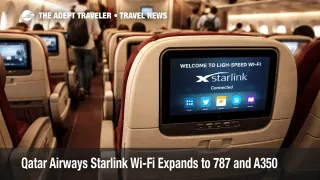
Qatar Airways has begun operating Boeing 787-8 Dreamliners with Starlink internet, extending its high speed connectivity push beyond the Boeing 777 and Airbus A350 fleets. Passengers on long haul and ultra long haul itineraries that connect through Doha, Qatar, especially on 787, A350, and 777 flights, are the most likely to notice the change first. If onboard connectivity is important for work, messaging, or trip management, travelers should verify the assigned aircraft close to departure, plan a backup for critical tasks, and assume availability can still vary by route and airport rules.
The Qatar Airways Starlink Wi-Fi expansion adds more Dreamliner departures to the pool of flights that can offer free, high speed internet, but the experience still depends on the specific aircraft operating your flight.
In its January 7, 2026, statement, Qatar Airways said it became the first airline to enable Starlink on the Boeing 787-8, and that three Dreamliners are already flying with the service. The airline also said it finished equipping its entire Airbus A350 fleet in December 2025, describing the A350 effort as completed in eight months. Qatar Airways said nearly 120 of its widebody aircraft now have Starlink, which it described as more than 58% of its widebody fleet across the A350, 777, and 787 families.
For travelers, the key promise is performance. Qatar Airways is marketing speeds "up to 500 Mbps," and positioning the product as free, gate to gate connectivity that can support streaming and video calls. In practice, "up to" is the operative phrase because onboard bandwidth is shared, and real world performance will vary by flight load, routing, and operational conditions.
Who Is Affected
The biggest impact is on passengers booking long haul itineraries that transit Hamad International Airport (DOH), where Qatar's network design creates large connection banks that can turn a single product change into a meaningful planning lever for business travel. If you routinely work in the air, the difference between a well performing onboard connection and a weak one often shows up as missed opportunities to clear email, rebook during irregular operations, or coordinate ground pickups before landing.
Travelers should also read the fine print. Qatar Airways notes that gate to gate access may be unavailable at certain airports due to local regulatory requirements, and it also flags that aircraft can be swapped for operational reasons. That matters because even if a route is commonly operated by an equipped aircraft type, a substitution can change the Wi-Fi experience on the day of travel.
This rollout also lands in a broader competitive moment where airlines are using connectivity as a differentiator rather than a premium add on. For comparison on how another large carrier is approaching free access and eligibility constraints, see American Airlines Free WiFi Expands For AAdvantage Members.
What Travelers Should Do
If you need onboard internet, check your flight's aircraft type as close to departure as you can, then treat connectivity as a helpful bonus, not a guarantee. Bring a power bank, download critical files, maps, and entertainment in advance, and screenshot any hotel, rail, or tour confirmations you might need if the connection underperforms.
If connectivity is truly mission critical, your decision threshold should be simple, rebook only when you can move to a flight that is more likely to be operated by a Starlink equipped widebody and when the cost of being offline is higher than the change fee or fare difference. Even then, keep slack in your plan because aircraft swaps can still happen, and some airports can limit gate to gate use.
Over the next 24 to 72 hours, monitor Qatar Airways updates for how quickly additional 787 aircraft are retrofitted, and whether the airline expands any public guidance on which routes and destinations most consistently see Starlink equipped aircraft. Also watch for airport specific constraints that could affect gate to gate usage on your particular departure or arrival.
How It Works
Starlink is a low Earth orbit satellite network, which generally means lower latency and more responsive connections than older geostationary systems, particularly useful for interactive tasks like video calls, collaboration tools, and real time messaging. In aviation use, the system relies on aircraft hardware and certifications that can differ by airframe, which is why airlines talk about "first" installs and type specific approvals when they expand from one fleet family to another.
The travel system ripple is not just passenger convenience. Qatar Airways is also pitching operational benefits, including faster crew roster updates, real time coordination with ground teams, and the ability for engineering teams to monitor systems in flight and prepare fixes before the aircraft lands. If those process claims hold up at scale, the second order effects can include smoother turnarounds and fewer compounding delays when aircraft rotations get tight, which matters most in connection heavy hubs like Doha where small time savings propagate across multiple onward banks.
The remaining constraint is predictability. Until Starlink is installed across a larger share of the 787 fleet and travelers have clearer, route level expectations, the practical planning rule is to assume variability, verify the aircraft, and keep an offline fallback for anything you cannot afford to lose mid trip.
Sources
- Qatar Airways Launches World's First Starlink-Equipped Boeing 787 and Completes Airbus A350 Starlink Rollout, Connecting Over 11 million Passengers with the Fastest Wi-Fi in the Sky
- Starlink. The fastest on-board Wi-Fi in the sky
- Starlink Business, Aviation
- Qatar Airways Installs Starlink IFC on Nearly 120 Aircraft, Including Boeing Dreamliner
- Qatar Airways becomes first in the world to bring Starlink to 787s