

Spirit Exits MKE, PHX, ROC, STL on January 8, 2026
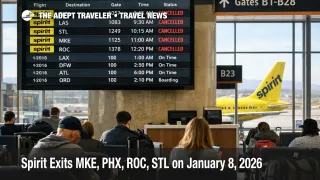
Spirit Airlines is discontinuing service at Milwaukee Mitchell International Airport (MKE), Phoenix Sky Harbor International Airport (PHX), Frederick Douglass Greater Rochester International Airport (ROC), and St. Louis Lambert International Airport (STL) as part of its restructuring and network downsizing. For travelers, the practical outcome is simple: if you are ticketed on Spirit flights that depart from, arrive into, or connect through those airports after the cutoff, you should plan for cancellations and forced itinerary changes rather than routine schedule tweaks.
Public reporting quotes Spirit describing the move as a 2026 schedule adjustment to match a smaller operating fleet and to focus on stronger markets, with the airline saying it will contact affected customers about options including refunds. Reuters has also linked these airport exits to a broader turnaround plan that includes staffing cuts and additional pilot actions tied to the 2026 network reduction.
One detail matters for timing. Multiple reports describe January 8, 2026 as the effective date for the exits, meaning flights may cease on that date and later. In Rochester, local reporting cites the airport director saying the last day of Spirit service is January 7, 2026, which effectively leaves no Spirit operations there from January 8 onward.
Who Is Affected
The most exposed passengers are those holding Spirit itineraries that rely on a nonstop from one of the four airports, especially leisure heavy routes where Spirit often carried meaningful price sensitive demand and where competing nonstop capacity can be limited on short notice. Travelers on separate tickets are at higher risk because even a small change, like a forced hub connection instead of a nonstop, can break onward flights, cruises, tours, or hotel check in timing with no automatic protection.
Phoenix travelers are likely to feel the shock through fare and routing changes because PHX is a major connection and tourism gateway, and shifting demand can quickly reprice remaining seats on competing carriers. Milwaukee travelers may see spillover into nearby regional options because many itineraries can be substituted by driving to larger airports, but that substitution adds time, winter road risk, parking costs, and rental car one way constraints. Rochester travelers face a classic small airport problem: when one carrier exits, the remaining nonstop menu can narrow fast, and the new "best" plan often becomes a drive to another upstate airport, or a connection through a larger hub, both of which increase misconnect risk. St. Louis travelers in the same situation should expect the largest impact on specific city pairs Spirit served nonstop, because replacements may exist only as connections, or not at all at competitive prices.
Beyond the airport boundary, the disruption propagates through the travel system in predictable ways. First, seat supply drops in each market, so last minute fares can rise, and availability for party size two and above can evaporate faster than travelers expect. Second, more itineraries become multi stop, which increases minimum connection time sensitivity and creates knock on risk for bags, crew legality, and missed last flights of the day. Third, when travelers shift to alternate departure airports, hotels near those alternates can tighten for early departures, and ground transport, including rideshare and parking, becomes part of the failure chain rather than an afterthought.
What Travelers Should Do
Start by verifying exactly what you have booked: check your Spirit reservation, your email, and the flight status page for your flight number, because effective date language can translate into different last operating days by market. If your flight is canceled or materially changed, decide whether you can tolerate a longer routing, an extra connection, or a different day, then add buffer time immediately, especially if your trip includes a cruise embarkation, a wedding, or a first night hotel that you cannot shift.
Use a clear decision threshold for refund versus rebooking. If you must travel on the same day and the rebooked option adds a connection you would not normally accept, or pushes arrival late enough to break your downstream plans, a refund and a self rebook on another carrier can be the cleaner option even if it costs more. If your plans are flexible and Spirit offers a comparable routing within your acceptable time window, taking the rebook can be rational, but only after you confirm the new itinerary is protectable, including minimum connection times and realistic winter weather buffers.
Over the next 24 to 72 hours, monitor three things: whether your itinerary is formally canceled or re timed, whether Spirit presents an acceptance deadline for alternative transportation, and how quickly remaining seats are repriced on competitors. Also watch nearby airport options, because the cheapest salvage plan is often a short drive to an alternate airport paired with an earlier departure, but that only works if you can secure ground transport, parking, and a workable connection without turning one disruption into two.
Background
Airline airport exits happen when a carrier no longer wants to dedicate aircraft, crews, and station costs to a market that is underperforming relative to alternatives. For ultra low cost carriers, the economics are especially sensitive to fleet size and utilization, because a single aircraft reassignment can reshape the whole schedule. When an airline restructures and shrinks, it often consolidates flying into fewer, stronger markets where aircraft turn times are efficient and demand is less seasonal.
For travelers, the key operational consequence is that reaccommodation options can be narrower than during a one off weather event. When service is discontinued, the next available Spirit flight from the same airport may not exist, so rebooking can mean a different airport, a different day, or a connection that did not previously apply. That is why spillover effects, including higher last minute fares, fuller flights on competitors, and more complex itineraries, tend to persist longer than a typical irregular operations day.
Sources
- Spirit Airlines to cut about 150 jobs in turnaround effort | Reuters
- Refund Policy for Flight Disruptions | Spirit Airlines Support
- Refunds | US Department of Transportation
- Spirit Airlines will discontinue Milwaukee service in 2026 | WPR
- Spirit Airlines to leave Phoenix in 2026 | KOLD
- Spirit Airlines discontinuing Rochester service | 13WHAM
- Spirit Airlines to discontinue flights from St. Louis in 2026 | First Alert 4