

Carnival Cruise Underage Curfew Fine, $500 Warning
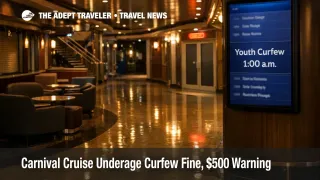
Carnival youth curfew fine talk is spreading again after a passenger shared a shipboard warning letter tied to a teen's late-night curfew violation on Carnival Elation. Families traveling with kids and teens are the ones directly affected, because the rule applies to guests 17 and under who are not with a 21 and older adult from their travel party. The practical next step is to treat the curfew as a real financial and trip-continuity risk, then build simple supervision buffers so a warning does not escalate mid-sailing.
The core policy is not new, but the consequences are getting more attention because the letter language is specific, and it puts a dollar figure and an escalation ladder on what many families assume is a soft guideline. Carnival's published youth curfew states that guests 17 and under must be clear of public areas by 1:00 a.m. unless accompanied by an adult in their traveling party who is 21 or older.
Who Is Affected
The highest-risk group is families sailing with teens who can move independently around the ship late at night, especially when adults assume older cousins, siblings, or young-adult relatives count as supervision. Multiple reports about the viral incident describe the teen as 14, and the parent's post suggests the child was with cousins who were 19, which does not meet Carnival's 21 and older accompaniment requirement for the 1:00 a.m. rule.
The second group is multigenerational and group bookings where kids are spread across multiple staterooms. Carnival's minor policies can allow teens to be booked a few staterooms away from their guardian depending on age, which is convenient, but it also makes informal supervision easier to lose after midnight when venues thin out and staff focus shifts toward security and late-night operations.
The third group is anyone flying in for a short cruise, or stacking a cruise with tight pre or post nights. A removal-from-ship outcome is rare, but the consequence, if it happens, propagates fast: the family may have to arrange last-minute lodging, transport, documentation handling in a port environment, and rebooked flights, all at their own expense. Carnival's Code of Conduct is explicit that violations can lead to disembarkation at the guest's expense, future sailing bans, and a $500.00 (USD) fine exposure.
What Travelers Should Do
In the first hour after boarding, families should align on a single rule that is easy to follow: minors are either back in the cabin before 100 a.m., or they are physically with a named 21 and older adult from the travel party. A practical buffer is to set a 1230 a.m. meetup, because it gives time to find a teen who is eating, wandering the promenade, or lingering near late-night food without turning it into a shipwide search.
If a warning is issued, treat it as a decision point, not a debate. If the teen cannot reliably comply on the current sailing, the safer move is to stop all unsupervised late-night roaming immediately, even if the teen insists they were "just with family." The letter language being shared publicly describes a progression from warning, to a fine of up to $500.00 (USD), then to disembarkation for the travel group and placement on a no-sail list after another violation.
Over the next 24 to 72 hours onboard, monitor three things: whether the teen's friend group is planning late-night meetups, whether adults are actually willing to stay up and accompany them, and whether the ship's venues create predictable temptation points such as pizza counters, the promenade, and music areas. If the plan depends on a 19 or 20 year old cousin being "the adult," assume that does not count for the curfew rule, and adjust the plan before security has to.
Background
Carnival's youth curfew is a simple operational control in a complex environment. Late-night ship operations run on thinner staffing, and youth programming is not designed to supervise minors in public spaces after midnight, which shifts the burden back to parents and guardians. Carnival codifies that expectation through an age-based curfew for public areas, and it reinforces broader behavioral expectations through its Code of Conduct, which warns that violations may lead to a $500.00 (USD) fine, stateroom confinement, and removal from the ship.
This is also why a curfew issue can ripple beyond the immediate behavior. First order effects happen onboard: security involvement, written warnings, and potential charges to the onboard account, which can sour the trip and create disputes at Guest Services. Second order ripples spread into the travel system around the cruise: families may change future bookings, choose different sailing dates, buy different insurance products, or shift toward ships with stronger teen programming and clearer supervised late-night options. For travel advisors, it changes pre-cruise counseling, because "family-friendly" does not mean "unsupervised after midnight," and a misread of that gap can become a costly mid-sailing problem.