

Venezuela Flight Cuts Hit Caribbean Cruise Embarkations
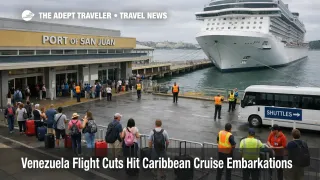
Caribbean cruise operations absorbed missed embarkations after Venezuela linked airspace curbs triggered widespread flight cancellations into turnaround ports such as San Juan, Puerto Rico, Bridgetown, Barbados, and St. Maarten. Passengers flying in on same day plans were most exposed, with disruptions hitting gateways like Luis Muñoz Marín International Airport (SJU) and Grantley Adams International Airport (BGI). Travelers with sailings in the next week should add a hotel buffer where possible, use cruise line travel updates to understand boarding cutoffs, and rebook early when inbound flights start canceling.
The Caribbean cruise missed embarkations surge is a direct consequence of flight network seizures, which can force ships to delay departures, skip early calls, or depart without late arriving guests.
Cruise lines responded with a mix of delay tactics and passenger remedies. Norwegian Cruise Line pushed Norwegian Epic's departure from San Juan later into the evening on January 4, 2026, and Princess Cruises held Grand Princess in San Juan overnight, departing a day late and dropping a St. Thomas call to recover the schedule.
Other operators leaned on port berths and charter capacity rather than itinerary wide cancellations. Windstar said temporary airport closures in St. Maarten and Barbados affected guest turnarounds, and it secured a berth to delay two sailings until late on January 5, 2026. P&O Cruises, facing charter disruptions tied to Barbados turnarounds, reported arranging replacement flights for thousands of Arvia guests so the sailing could continue.
Who Is Affected
The highest risk group is anyone flying to the ship on embarkation morning, especially travelers connecting through U.S. carrier banks that were canceled or throttled under the airspace curbs. Even after restrictions eased, aircraft, crews, and inbound rotations had to be repositioned, which meant delays could persist beyond the initial closure window and could still break tight flight to pier plans.
Homeport heavy itineraries magnify the impact because thousands of guests need to swap simultaneously between airport arrivals, hotel check ins, and pier processing. San Juan and Bridgetown are particularly exposed in winter because they support frequent Southern and Eastern Caribbean turnarounds, and they also act as connection nodes for smaller island flights that can be disrupted when the mainline trunk cancels.
Itinerary geography also matters. Seatrade reported Virgin Voyages substituted calls away from the ABC Islands corridor, which shows how ships may re route when a Venezuela adjacent operating picture changes, even when the ship itself can keep sailing.
What Travelers Should Do
If you are sailing within the next 72 hours, treat your flight plan as the critical path and move it earlier, even if it means adding a hotel night near the pier. Check your airline for waiver eligibility and rebook while inventory still exists, then confirm your new arrival time against the cruise line's latest boarding guidance and any port advisory. If you are already in the region, protect your spot by getting to the airport as scheduled and staying reachable, cruise lines have repeatedly noted that airlines must account for all passengers before they can finalize options.
Use a hard decision threshold on embarkation day. If your inbound flight is canceled and the best alternative lands after the ship's stated final boarding time, assume you may miss the sailing unless the cruise line explicitly confirms a delayed departure or an approved join in later port plan. When a line is delaying, it is usually because it has berth clearance and a realistic flow of late guests, and when it is not delaying, the safest financial move is often to accept the line's remediation, then rebook instead of self funding a chaotic same day chase across islands.
Over the next 24 to 72 hours, monitor three channels: FAA updates and related operational advisories, airline waiver pages for your specific airport pair, and your cruise line's travel advisory feed. Travelers should also watch for port call substitutions, and shortened first calls, because late departures can compress the early part of the itinerary and change shore excursion meeting times. For a recent example of how fast a non weather disruption can overwhelm rebooking and communications, compare how Dubai Iran Flights Canceled Amid Protests and Blackout shifted traveler priorities toward early decisions and verified status checks.
How It Works
Airspace curbs create cruise disruption through timing, not geography. When regulators restrict or caution operations across a flight information region, airlines preemptively cancel banks, then spend the next one to three days re positioning aircraft and crews while working through a backlog of stranded passengers. That pushes late arrivals into ports that are designed for tightly timed turnarounds, luggage flows, provisioning windows, and pilot schedules, all of which are hard to stretch without knocking the entire itinerary out of position.
Cruise lines have only a few levers. They can hold departure if the ship has a berth and clearance, and if the late arriving guest volume is high enough to justify the operational cost. They can also sail but offer future voyage credit or similar remedies for guests who cannot embark, which is what Virgin Voyages told affected San Juan sailors it would do. Each choice ripples into hotels near the port, because stranded guests extend stays, and into shore excursions, because a delayed sail out often means a delayed first arrival and a re timed tour program.
For travelers, the practical takeaway is that cruise reliability on embarkation day is only as strong as the flight network feeding the pier. Broader aviation policy debates rarely feel personal until they compress into a single decision at check in, and that is why explainers like U.S. Air Traffic Control Privatization: Reality Check matter for understanding how constraints propagate into cancellations, missed connections, and downstream schedule instability.
Sources
- US lifts Caribbean airspace curbs after attack on Venezuela | Reuters
- How Caribbean Flights Have Been Impacted By Venezuela Airspace Closures | Condé Nast Traveler
- US military operation in Venezuela disrupts Caribbean holiday travel, hundreds of flights canceled | AP News
- Caribbean cruises sail on despite Venezuela turmoil | Seatrade Cruise
- Caribbean Travel Disrupted Following Venezuela Attacks | Cruise Critic
- Important Travel Update for San Juan Disembarkation | Virgin Voyages
- 2025, 2026, 2027 Caribbean Cruises | Caribbean Vacations | Windstar Cruises