

Belgium Rail Strike SNCB Trains, Minimum Service Rules
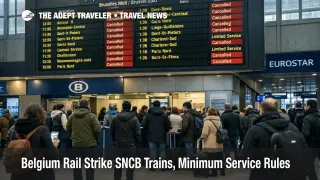
A multi-day rail strike in Belgium is set to cut SNCB, also known as NMBS, services nationwide, and the operator is emphasizing that travelers will only see a limited alternative timetable. The disruption window runs from 1000 p.m. on Sunday, January 25, 2026, through 1000 p.m. on Friday, January 30, 2026, which matters because late evening services and early morning positioning can be affected at both ends of the week.
Travelers are most exposed if they rely on Belgian trains for airport positioning, cross city moves between hotel bases, or Brussels hub transfers where missing one feeder train can strand a whole itinerary. The practical change versus the initial strike notice is execution timing, SNCB says the strike day transport plan is built from staffing declarations and is usually only communicated close to departure, so the journey planner becomes the decision tool, not the normal timetable.
The Belgium rail strike SNCB minimum service pattern is that confirmed trains typically show up in the SNCB app and journey planner about 24 hours before travel, after a 72 hour declaration requirement and a roughly 48 hour process to build and load the alternative plan. That cadence is why you can have a valid ticket, but still not know which exact departures run until the evening before.
Who Is Affected
Passengers traveling within Belgium during the strike window are affected first, especially on corridors where frequency normally acts as the buffer, such as Brussels to Antwerp, Brussels to Bruges, and Brussels to Ghent. When service shifts to minimum operation, the system impact is not only fewer trains, it is uneven coverage by line and time of day, which concentrates demand onto the departures that do run and raises the chance of long station dwell times and missed hotel check ins.
Brussels Airport (BRU) is a high sensitivity node because the airport's default access model for many travelers is rail, with frequent direct trains under normal conditions connecting the terminal to Brussels Central, Brussels North, and Brussels South. Minimum service turns that predictable pattern into a risk, because one missing departure can remove the slack that makes a same day flight positioning plan feel safe, and road options can tighten quickly once travelers pivot away from trains.
International and cross border travelers are affected in a second layer. Even if an international operator runs a reduced timetable, Belgium domestic segments can fail around it, especially at Bruxelles Midi, also called Brussel Zuid, where most London and Paris connections funnel. The propagation mechanism is straightforward, fewer domestic trains create broken feeder chains into international departures, and the crowding and customer service load at key hubs rises because passengers are forced to replan on the day.
What Travelers Should Do
Start with a plan that assumes the journey planner is the source of truth. Check your specific train in the SNCB app or journey planner the evening before, and again on the day of travel, then lock in a backup transfer while inventory still exists, especially if you need to reach Brussels Airport (BRU) for a morning departure or you have a fixed event start time.
Use decision thresholds that protect the whole chain. If missing your train would cause a missed flight, a missed Eurostar departure, or a same day hotel arrival after front desk hours, treat that as a rebook trigger, and shift to travel outside the strike window or switch to a road based transfer even if the planner shows a train, because minimum service can remove your buffer even when something technically runs. If the consequence is only arriving later, waiting can make sense, but only after your train is explicitly shown as operating under the strike day plan.
Over the next 24 to 72 hours before your travel day, monitor three things, the SNCB planner for the minimum service timetable, your international operator's disruption page if you are crossing borders, and airport access pages if you are positioning for a flight. If you end up with a cancellation or a 60 minute or longer expected delay, EU rules require the railway to offer a choice between rerouting and reimbursement, and compensation rules are not automatically excused for railway staff strikes, so it is worth documenting the disruption and submitting claims through the operator channels once your travel outcome is clear.
Background
Belgium's minimum service approach is built around pre declarations and a late binding operational plan. SNCB says essential staff must indicate whether they will work at least 72 hours before strike action, then the operator uses the declared staffing pool to build an alternative transport plan, which takes about 48 hours to prepare and load, and is typically communicated about 24 hours before travel, often the evening before. That process design is why travelers should expect late clarity, even when the strike dates are known well in advance.
The knock on effects spread beyond the rail network itself. First order, fewer trains reduce corridor capacity and can break intercity links that normally support day trips and same day hotel moves. Second order, passengers substitute into buses, taxis, rideshare, and one way car rentals, tightening last mile supply around major stations and creating hotel compression when travelers cannot reposition and must add an unplanned night in Brussels, Antwerp, or Bruges. Third order, the international layer becomes more fragile because many Brussels connections are effectively two journeys, a domestic feeder plus an international departure, and minimum service increases the chance that those pieces desynchronize even when one of them still operates.
Passenger rights sit on top of that operational reality. Under EU rail passenger rights, when a delay of 60 minutes or more is reasonably expected, the railway must offer rerouting or reimbursement options, and the regulation's compensation exemption language does not treat railway undertaking staff strikes as a blanket escape hatch. In practical terms, travelers should focus first on getting to their destination or choosing not to travel, then keep records so reimbursement, rerouting costs, and compensation claims can be pursued through the operator processes after the disruption.
For related Belgium disruption planning, see Belgium Rail Strike Cuts Trains Jan 25 to Jan 30 and Belgium Strikes Disrupt Flights, Trains, And Airports.
Sources
- Strike notice for 25 to 30 January 2026 (SNCB)
- Train to and from Brussels Airport (Brussels Airport)
- De Lijn buses to and from Brussels Airport (Brussels Airport)
- Traffic disruptions and works (SNCB International)
- Regulation (EU) 2021/782 on rail passengers' rights (EUR Lex)
- Shuttle bus Brussels to Charleroi Airport (Flibco)
- Access and parking, public transport (Brussels South Charleroi Airport)