

EES Delays At EU Airports As Biometric Checks Expand
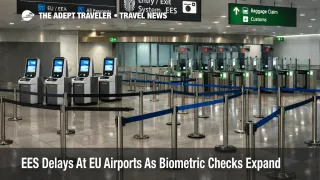
EES delays EU airports are set to become more common as the European Union increases biometric entry processing at more airports and ports starting January 9, 2026. Visa exempt travelers from the United States, the United Kingdom, and other non EU countries entering the Schengen Area are the ones most likely to be routed into new registration steps. The practical move is to plan extra time for passport control, pad connections, and treat same day onward travel plans as fragile until your specific gateway shows stable performance.
The immediate change is the scale. After an initial phase where only a smaller share of eligible arrivals were registered, the rollout calendar moved to a higher processing threshold, which increases the number of people being funneled through kiosks and manual oversight at the same time. Airport operators have warned that even at lower thresholds, peak waits have reached hours at some locations, and that scaling up without fixes risks broader congestion.
Who Is Affected
If you are a third country national entering the Schengen Area for a short stay, you can be selected for EES registration during the transition, even if your trip is visa free. The European Commission describes EES as a system that records entry and exit events and collects biometric data, including fingerprints and a facial image, as part of those checks across 29 participating European countries.
Air travel takes the brunt because the delay is concentrated at a single choke point, passport control, and it tends to spike when multiple widebody and short haul arrivals land into the same bank. ACI Europe has said processing times at airports have increased by up to 70%, with waits up to three hours at peak periods, and it pointed to recurring outages, partial kiosk deployment, limited automated gate availability, and staffing gaps as root causes.
Departing passengers can be affected too, because inbound delays cascade. When arriving passengers miss onward flights, airlines must rebook them into later departures, crews and aircraft can end up out of position, and airport concourses see more dwell time as stranded travelers wait for solutions. That congestion then feeds back into security, gate turnover, and ground handling timing, which can degrade the rest of the day's schedule even for travelers who never touch passport control.
What Travelers Should Do
Build time where it actually fails. If you are arriving into Schengen and connecting onward the same day, treat your arrival airport as the critical risk node, and add buffer hours that match peak EES queue scenarios rather than normal day performance. If you are departing the EU, ABTA's practical advice is to go to passport control as soon as you clear check in and security, so you complete any EES related checks as early as possible.
Decide when to rebook versus when to wait. If your itinerary depends on a tight connection, a last train, a same day cruise embarkation, or a non refundable transfer, you should proactively shift to an earlier arrival or a later departure even if your airline has not issued a blanket waiver yet, because the consequence of one bad queue is disproportionate. If your plans have slack, you can sometimes ride it out, but only if you can tolerate landing, waiting, and then continuing hours later without breaking a hard deadline.
Over the next 24 to 72 hours, monitor the specific airport and border context, not just the headline about EES. Look for airport operator advisories, airline rebooking guidance, and credible reporting of outages or staffing reinforcements, because ACI Europe has emphasized that kiosk uptime, automated gate availability, and border guard capacity drive the worst spikes. Also pay attention to signs that authorities are using contingency measures, because ABTA has pressed for tools like limiting checks or standing down the system when queues become unmanageable, and those choices can quickly change the on the ground reality.
How It Works
EES is replacing the old model where a passport stamp was the primary visible record of entry and exit. Under the European Commission's description, the system records the traveler's identity and travel document data, and it captures biometric identifiers, then it logs the date and place of entry and exit so overstays can be detected automatically once the transition completes.
Operationally, the friction comes from first time enrollment and from the transition itself. Many airports are still running mixed flows where some travelers are processed traditionally while others are routed to self service kiosks and additional officer interaction, which creates stop start surges. eu LISA, the agency that develops and manages the system, has described a progressive deployment where some countries went live fully from day one while others roll it out across airports, seaports, and land borders over a transition period.
Contingency measures are already part of the real world rollout, not just theory. In Portugal, Euronews reported that the government suspended EES for non EU citizens for three months at Lisbon Humberto Delgado Airport (LIS) to avoid longer waits, alongside other steps to reinforce border control resources. That is a concrete example of the kind of flexibility ABTA is urging authorities to use when queues threaten to become systemic.
Sources
- As EES rollout expands, travel association urges use of contingency measures to ease delays
- ABTA urges greater use of contingency measures by EU border officials as EES rollout expands
- Review of Schengen Entry-Exit System urgently needed to avoid systemic disruptions impacting passengers
- Entry/Exit System (EES)
- The Entry/Exit System Successfully Connected Across Europe
- 'Serious deficiencies' in security and long queues see soldiers stationed at Lisbon airport
- EU begins gradual rollout of digital border system