

Freezing Rain Germany Cuts ICE Routes January 12, 2026
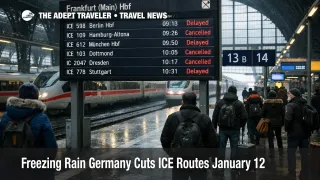
Deutsche Bahn warned that freezing rain and ice could cut long distance service and drive major delays across parts of Germany on January 12, 2026, with disruptions spilling into core ICE corridors. Travelers on intercity itineraries, plus anyone using rail as an airport transfer for flight positioning, are the most exposed because one late long distance train can collapse an entire same day chain. If you have a tight connection, the practical move is to recheck your specific train before you leave, widen buffers, and shift critical travel to a different day when you have flexibility.
The most actionable route level changes in Deutsche Bahn's long distance update are specific. ICE trains between Berlin and Frankfurt (Main) are running but are not stopping in Braunschweig or Hildesheim, IC trains between Dresden and Dortmund are canceled across the entire route, and the Cologne to Frankfurt high speed line is operating with reduced maximum speeds that can add time and trigger missed connections.
Who Is Affected
You are most affected if your plan depends on a single ICE or IC leg to arrive on time for a flight, a meeting, or a paid reservation in another city. The risk is higher than a normal winter delay day because freezing rain tends to create uneven performance, with trains running, then losing time in clusters when speed restrictions, platform changes, or equipment issues stack up.
Airport bound travelers should treat rail transfers as fragile on January 12, 2026, especially into Frankfurt Airport (FRA), Cologne Bonn Airport (CGN), Berlin Brandenburg Airport (BER), and Munich Airport (MUC) when your itinerary requires arriving the same day. The failure mode is rarely just arriving late, it is also losing your reserved seat, missing a timed check in deadline, or being forced into a last minute overnight when the next usable train is full.
Travelers on intermediate cities that are skipped by affected trains should assume extra complexity even if a train still appears to be operating. If your planned boarding or transfer station is one of the skipped stops on the Berlin to Frankfurt (Main) corridor, you may be forced into a regional rail detour that is slower, less frequent, and more crowded during a disruption wave.
What Travelers Should Do
Start with immediate triage. Check your exact train number in DB Navigator or on bahn.de before you leave for the station, then recheck again right before departure because freezing rain impacts can shift quickly. If you are traveling to an airport for an international flight, build a bigger buffer than usual, and consider moving your rail arrival to the night before if the flight is high consequence.
Use a clear decision threshold for rebooking versus waiting. If your plan needs you at the airport or a fixed appointment within a narrow window, do not continue to "wait and see" once you lose your first meaningful buffer, rebook to a later train the same day only if the new itinerary still preserves a workable cushion. If your remaining cushion is too small, shift to traveling on January 13, 2026, or reroute through a larger node where you have more fallback options, including a hotel night.
Over the next 24 to 72 hours, monitor two signals in parallel, weather warnings and Deutsche Bahn's corridor specific notices. The German Weather Service has continued to flag periods of freezing rain and glaze risk into Tuesday in some areas, which matters because a second round can slow recovery even after conditions improve in your departure city. Watch for updates that change stopping patterns, speed restrictions, or cancellations, because those are the details that determine whether a same day connection is protectable.
How It Works
Freezing rain is operationally disruptive because it deposits a layer of glaze ice on surfaces that rail systems depend on for safe, predictable movement. On high speed lines, Deutsche Bahn can reduce maximum speeds as a precaution, which increases trip times and then pushes trains out of their planned path slots, creating downstream conflicts as more services converge on the same junctions and platforms.
The first order effect is fewer reliably on time trains, plus more short notice changes such as skipped stops or full route cancellations on specific services. The second order ripple is what travelers feel most, missed connections at hub stations, tighter platform change times, and crowding that makes it harder to recover once you fall off your planned itinerary. When a long distance corridor underperforms, it also strains other layers of the travel system, including airport rail links for hubs like Frankfurt, last minute hotel demand near main stations, and same day car rental demand when travelers abandon rail. If roads are also icy, those substitutes can be slower and more expensive than travelers expect.
Deutsche Bahn's own traveler guidance during this winter disruption window also matters for planning. The company has published a special hotline, and it has allowed travelers who bought tickets by January 7 for journeys scheduled from January 8 to January 12 to take the trip at a later date, with the train connection treated as canceled and seat reservations cancelable without a fee. That flexibility can be the difference between salvaging a trip and forcing a risky same day chain.