

U.S. Dual Citizenship Bill Could Void Second Passports
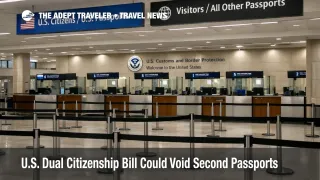
A U.S. Senate proposal would make it illegal for Americans to hold U.S. citizenship and any foreign citizenship at the same time. The change would primarily affect dual nationals who use a second passport for long stays, residency rights, family travel, and simplified border entry abroad. For now, travelers should treat this as a legislative risk to monitor, not a rule change, and avoid making irreversible citizenship decisions based on headlines alone.
The U.S. dual citizenship bill, S.3283, would force dual citizens to choose a single nationality on a fixed timeline if it ever became law.
Senator Bernie Moreno introduced S.3283, titled the Exclusive Citizenship Act of 2025, on December 1, 2025, and it was referred to the Senate Judiciary Committee. The text is direct: it would prohibit being a U.S. citizen or national while "simultaneously possessing any foreign citizenship." It also sets out two pathways that matter to travelers.
First, anyone who is already a dual citizen when the law is enacted would have up to 1 year to submit a written renunciation, either renouncing the foreign citizenship to the Secretary of State, or renouncing U.S. citizenship to the Secretary of Homeland Security. If they do not comply on time, the bill says they would be "deemed to have voluntarily relinquished" U.S. citizenship for purposes of the Immigration and Nationality Act's loss of nationality provisions.
Second, the bill would treat "voluntarily" acquiring a foreign citizenship after enactment as an automatic relinquishment of U.S. citizenship. The prohibition itself would not kick in immediately, it would take effect 180 days after enactment, and the bill directs the State Department and the Department of Homeland Security to publish implementing regulations and notifications on a similar 180 day clock.
Politically, this is still at the introduction stage. It has not passed either chamber, and it does not change any traveler's legal situation today. The sponsor's office framed the proposal as a loyalty and conflict of interest issue, and Senator Moreno argued it should be "all or nothing" when it comes to citizenship.
Who Is Affected
The most exposed group is Americans who already hold two nationalities, whether by birth abroad, by having foreign born parents, through marriage pathways, or through later naturalization in another country. For many of these travelers, the second citizenship is not just a second booklet, it is the legal basis for working without sponsorship, staying beyond tourist limits, buying property more easily in some jurisdictions, and entering certain countries with fewer bureaucratic steps.
A second group is U.S. citizens who plan to naturalize elsewhere in the future, for example permanent residents abroad who are nearing eligibility for citizenship in their country of residence. Under the bill's text, voluntarily acquiring that new citizenship after enactment would be treated as relinquishing U.S. citizenship, which would be a fundamental change from today's practical norm.
There is also an operational travel layer that hits families. Dual nationality often shows up in households where one parent is foreign born, where children have a claim to another citizenship, or where families routinely cross borders for school breaks and caregiving. Even if the bill never becomes law, it can change planning behavior, because renunciation processes, documentation rules, and legal advice are slow, expensive, and country specific.
Travel advisors, corporate travel teams, and mobility managers are indirectly affected because dual citizenship is a quiet risk reducer in disrupted travel. When flights cancel, visas expire, or local entry rules shift, holding an alternate nationality can give a traveler more rerouting options, more legal stay time, or faster re entry to the place they actually live. Removing that flexibility forces more people into the standard visa and residency pipeline, which can amplify delays and paperwork when plans change.
What Travelers Should Do
If you are a dual national, take a documentation inventory now, not because a rule changed, but because fast clarity matters if this bill starts moving. Know exactly which citizenships you hold, whether your foreign citizenship can be renounced under that country's law, and what the practical consequences would be for residency, inheritance, taxes, and family sponsorship. Do not submit renunciations or sign legal statements based solely on media coverage.
Use a decision threshold that matches how dependent your life is on the second citizenship. If your ability to live or work abroad depends on it, or if your spouse and children rely on the same status for stability, your planning should assume long lead times for legal advice, consular appointments, and local government processing. If the second citizenship is mainly a convenience for easier entry, weigh whether a long term visa or residency permit would be a viable backup, and price in the risk of paperwork backlogs if many people act at once.
Over the next 24 to 72 hours, monitor whether the bill gets a hearing, attracts cosponsors, or is bundled into a broader immigration or national security package, because that is when "introduced" bills can turn into near term planning problems. Also watch for clarifying guidance from the U.S. Department of State about dual nationality travel rules, because regardless of this bill, the department already requires U.S. dual nationals to enter and leave the United States on a U.S. passport.
Background
The United States has long tolerated dual nationality in practice, even though it does not "encourage" it as a policy preference in some official language. Today, the key travel rule is straightforward: U.S. nationals, including dual nationals, must use a U.S. passport to enter and leave the United States, and they may be required by their other country of nationality to use that country's passport to enter and leave that country. Federal public guidance also notes that Americans generally do not have to choose one nationality over another under current law.
If the Exclusive Citizenship Act framework were enacted, the first order disruption would be legal status churn, with travelers needing to align their passport use, immigration status, and long stay permissions with a single citizenship. That would quickly propagate into the travel system in at least two ways.
One ripple would show up at check in and border processing. Airlines are responsible for verifying travel document compliance before boarding, and border officers rely on databases that must reflect a traveler's citizenship status accurately. A surge of renunciations, noncompliance determinations, or delayed record updates could increase secondary screening, missed flights, and "document not valid" disputes, especially for travelers who routinely transit multiple jurisdictions on one trip.
A second ripple would land in consular capacity and appointment availability. The bill's own timeline contemplates new regulations, notifications, and recordkeeping coordination between State, Homeland Security, and the Attorney General. If large numbers of people tried to renounce foreign citizenship, or tried to renounce U.S. citizenship to keep another nationality, they would run into country specific legal barriers and constrained consular throughput. Some countries make renunciation difficult or slow, and some require proof of another nationality to avoid statelessness, which could create circular delays that trap travelers in limbo while their life, work, and travel depend on clean status.
For now, reporting about the proposal is also driving attention from travelers who had not previously looked up dual nationality rules. That can be useful, but the practical takeaway is simple: nothing changes unless the bill advances, and the most concrete rule you must follow today is still the U.S. passport requirement for U.S. entry and exit.
Sources
- Text - S.3283 - 119th Congress (2025-2026): Exclusive Citizenship Act of 2025 | Congress.gov | Library of Congress
- Cosponsors - S.3283 - 119th Congress (2025-2026)
- New Moreno Bill to Outlaw Dual Citizenship - Senator Bernie Moreno
- Dual Nationality - Travel.gov - U.S. Department of State
- Dual Nationality | Travel.State.gov
- How to get dual citizenship or nationality
- Americans may soon be required to only hold one passport