

U.S. Passports Flagged Lost Can Block Entry Abroad
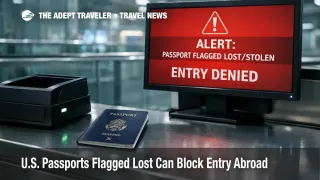
A small wave of U.S. travelers has posted that they only learned their passport was recorded as lost or stolen when they arrived at foreign immigration. In the accounts, airlines allowed boarding after a quick visual document check, but border officers later found a database "hit," and treated the passport as invalid. If this happens mid trip, you can be refused entry, detained while officials decide next steps, and forced into emergency paperwork that turns a vacation into a logistics and cost spiral.
The core issue is that once a passport is declared lost or stolen, it is supposed to be treated as invalid for travel. INTERPOL advises travelers not to attempt to travel with a document that has been reported lost or stolen, warning that boarding or entry can be denied and the document can be seized.
Who Is Affected
Any U.S. citizen traveling internationally can be affected, but the risk is most acute for travelers with tight connections, prepaid hotel and tour stacks, cruises with fixed embarkation cutoffs, and trips that rely on onward low cost flights that are hard to change. The stories circulating involve long haul routings into major gateways where immigration checks are strict, such as arrivals through Suvarnabhumi Airport (BKK), and European Schengen entry points, where a single database flag can halt entry processing.
This is not just a border control problem, it is also an airline operations problem. IATA notes that airlines face meaningful costs when passengers are refused admission, including care, custody, and return transport obligations, and carriers use tools and processes to reduce "inadmissible passenger" cases. But not every check in flow is the same, and a passport can look perfectly normal while its status is compromised in a system the airline is not querying.
What Travelers Should Do
Build an immediate buffer plan before you fly. Carry a printed copy and a secure digital copy of your passport identity page, plus a second government photo ID, and a proof of citizenship document where practical, because embassy staff may ask for identity and citizenship evidence if you need an emergency replacement. If you arrive and are told your passport is flagged, stay calm, ask for a supervisor, and request the exact reason code and the agency path used, then contact the nearest U.S. embassy or consulate right away to start replacement steps.
Use decision thresholds instead of hope. If you are denied entry or your airline refuses onward boarding, treat it as a same day rebooking problem only if an embassy appointment is realistically available within 24 hours and you have documentation to support an emergency issuance. Otherwise, cancel or postpone the remainder of the trip, because the U.S. Department of State is explicit that after you report a passport lost or stolen, it is no longer valid for international travel, even if you later find it.
Monitor the next 24 to 72 hours with a focus on official channels, not viral clips. If you suspect a false report, contact the National Passport Information Center, document every call and case number, and keep an eye on email accounts you use for travel, because the State Department says online loss reporting cancels a passport quickly and sends a confirmation email after cancellation. Separately, review your credit and identity theft posture, because a fraudulent report implies someone may have access to high value personal data, even if the motive is harassment rather than immediate travel fraud.
Background
The mechanics behind these cases are straightforward, even if the root cause in any one traveler's story is not. INTERPOL runs the Stolen and Lost Travel Documents database, commonly referenced as SLTD, which stores records of travel and identity documents reported as lost, stolen, revoked, or invalid. INTERPOL says only the country that issued the document can add it to the database, and frontline border officers can check passports against SLTD at airports and border crossings.
INTERPOL also describes "I Checkit," an option that lets trusted private sector partners submit travel documents for screening against SLTD at the time of booking, with a positive hit relayed to law enforcement. That framework explains why a traveler might fly without any obvious interruption, then get stopped at immigration, because screening touchpoints vary by carrier, routing, system integration, and the timing of when a record is added.
The U.S. Department of State's position is blunt, and it matters for travelers who mistakenly believe a found passport is usable. If you report a valid passport lost or stolen, you cannot use it for international travel even if you find it later, and if you try, you may be delayed and denied entry by a foreign country. That rule is intended to prevent misuse of compromised documents, but it also means a mistaken report, or a fraudulent report filed using your personal details, can instantly become a trip ending event.
Operationally, the disruption propagates fast. First order effects are immediate boarding and entry failures, plus detention time while immigration coordinates next steps. Second order ripples hit connections and crew flows, because missed onward segments can break protected itineraries, and re accommodation queues surge at hubs when multiple passengers need manual handling. The knock on layer reaches hotels, cruises, and tours, because a delayed entry decision can burn the only viable transfer window, and many suppliers treat late arrival as a no show without prior notice. The financial shock is usually not one big charge, it is a chain of smaller losses, including last minute fares, same day rooms, and fees tied to emergency document issuance.
Sources
- "3rd voided passport video I've seen": Americans are landing abroad only to learn their passports were quietly canceled
- SLTD database (travel and identity documents)
- Report Your Passport Lost or Stolen
- Lost or Stolen Passport Abroad
- Understanding the Issue of Inadmissible Passengers (INADs) and Their Impact on Travel
- Strengthening Border Control: Inadmissible Passengers (INADs) from a Government Perspective
- Timatic Solutions