

American Airlines Non Alcoholic Beer And Menus Feb 1
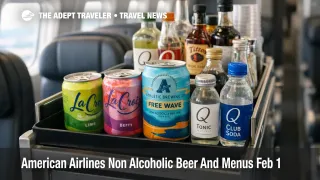
American Airlines says it will begin pouring a new set of inflight food and drink updates starting February 1, 2026. The headline change for many travelers is Athletic Brewing Company's Free Wave Hazy IPA, which American describes as its first inflight non alcoholic beer option. The airline is also expanding its beverage setup with Q Margarita Mix, Q Tonic Water, and Q Club Soda, plus Zing Zang Bloody Mary Mix, and it is adding two LaCroix Sparkling Water flavors, Lime and Berry, for the first time.
The practical traveler takeaway is not that every flight suddenly becomes a craft beverage bar. It is that American is widening the set of reasonable "no buzz" choices, and it is tightening the gap between what you can get in lounges versus what you can get onboard. If you have an early meeting after landing, a long connection day, or you simply want to avoid dehydration and sleep disruption, this is a meaningful menu change in a category that tends to move slowly.
On the food side, American says Main Cabin customers on select flights within the U.S., Canada, the Caribbean, and Mexico will see refreshed recipes starting February 1, 2026, including a chicken salad and Boursin cheese wrap served with coleslaw and a lemon shortbread cookie. The airline priced that buy on board option at $13.00 (USD), or 1,300 AAdvantage miles, on mainline routes where it is offered. For longer international flying, American says Premium Economy and Main Cabin customers on U.S. to international routes will see new entree rotations, and flights to China, Japan, and Korea will get additional region specific dishes.
Who Is Affected
Travelers most likely to notice the beverage additions are those on flights long enough to have full beverage service, and those who routinely fly routes where American stocks a broader cart. American has not framed this as a limited test, it is positioned as an inflight lineup expansion beginning February 1, 2026, but availability can still vary in the real world when aircraft swap, when catering bases differ, or when a flight runs a shortened service due to turbulence or time constraints.
Main Cabin travelers on select North America, Caribbean, and Mexico flights are the target audience for the refreshed buy on board wrap, particularly on mainline aircraft where American can reliably load catered items. If you are connecting and counting on onboard food as your buffer against a short layover, the word "select" matters because it signals route and station limits, not a guaranteed option on every domestic segment.
International travelers in Premium Economy or Main Cabin see the bigger meal shift, especially on routes where American highlights new entree rotations and on flights from the U.S. to China, Japan, and Korea that add additional dish options. If you are flying those Asia routes, the menu refresh matters most when you are choosing between Premium Economy and Main Cabin, or deciding whether to eat before boarding versus planning on the meal service as your primary dinner.
What Travelers Should Do
If you care about the non alcoholic beer or the new mixers, plan for a simple first attempt. Order early in the beverage service, and keep a backup choice in mind in case your cart is provisioned differently after an aircraft swap. If you are using AAdvantage miles to buy food onboard, confirm you are logged in and that your payment method is ready before boarding, because the worst time to troubleshoot is when the cart is already at your row.
For food, use a rebooking threshold based on how critical the meal is to your day. If you have medical, dietary, or timing constraints, treat onboard catering as a bonus rather than a guarantee, and eat in the terminal when you can. If you are simply trying to avoid overpriced airport food, the new buy on board wrap can be a useful option on routes where it is stocked, but you should still assume occasional sell outs on peak departures.
Over the next 24 to 72 hours before departure, watch two things. First, keep an eye on aircraft changes in the app, because a last minute swap can change both catering and the pace of service. Second, monitor your connection timing, because any delay that compresses service can reduce what is offered onboard, even when the menu has expanded. If you are also thinking about inflight water and ice choices, pair any beverage plans with a conservative hydration strategy.
Background
Airline inflight food and beverage is a logistics story as much as a hospitality story. A menu change starts with supplier contracts and product specifications, then moves into catering kitchens, loading plans at each hub, and storage limits on different aircraft types. That first order layer is why early rollout weeks can feel inconsistent, even when a press release describes the offering as broadly available.
Second order effects show up in traveler behavior and network recovery. When a carrier expands non alcoholic options, it can shift what passengers buy in terminals, what they seek in lounges, and how they pace alcohol consumption on long travel days. That can matter for comfort and sleep, but it also matters operationally, because crews manage service speed and passenger issues more easily when consumption is moderate, and when people have appealing alternatives that do not add impairment. American's prior lounge focused beverage partnerships, such as its Lavazza coffee move, show the same pattern of aligning ground and inflight touchpoints so the experience feels more consistent across a full itinerary. American Airlines taps Lavazza for 2026 coffee upgrade
There is also a subtle connection layer. Travelers planning tight same day connections often make tradeoffs about where to eat, how much to drink, and whether to rely on onboard service versus buying food near the gate. A better onboard menu can reduce pressure on short layovers, but only when it is reliably stocked, which is why "select flights" language matters for planning. For travelers thinking about what to drink onboard beyond alcohol, recent attention to onboard water quality is a reminder that the safest choices are not always the most convenient ones, and that sealed options can still be the low risk default when you are trying to minimize variables during a long travel day. U.S. Airline Drinking Water Safety Scores, 2026 Study