

Japan Snow, Flight Waivers, Rail Suspensions Jan 13, 2026
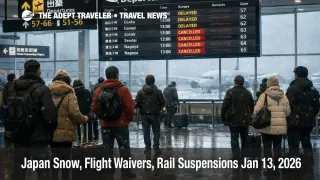
Heavy snow and strong winds are disrupting winter travel across Japan, pushing airlines to publish bad weather alerts and expand fee free change and refund options for specific airports. Travelers moving through northern Japan and Sea of Japan coast corridors are the most exposed, especially anyone combining a domestic positioning flight with an onward international departure. The practical next step is to lock in flexibility now, either by using the waiver to move earlier, shifting to a different gateway, or adding an overnight buffer near your international departure airport.
Japan snow flight waivers matter because the same weather pattern that cancels domestic flights can also interrupt the rail backups travelers rely on when flights sell out or stop operating.
All Nippon Airways said that for listed tickets you can change a reservation or request a refund online without any handling fee, regardless of the actual flight status, across defined airport and date windows. In the current notice, that list includes New Chitose Airport (CTS) for January 13, 2026, and multiple snow exposed regional airports across earlier windows leading into January 13, 2026, including Niigata Airport (KIJ), Noto Airport (NTQ), Toyama Airport (TOY), Komatsu Airport (KMQ), and others.
Japan Airlines separately warned late on January 13, 2026, that delays, cancellations, or diversions were possible on January 13 and January 14, 2026, and flagged New Chitose as the key exposure point for January 13, 2026, with additional northern airports listed for January 14, 2026. Even when only a small set of airports is named in an alert, the knock on effects can still spread because aircraft rotations and crews that start the day in the wrong place tend to produce downstream cancellations later in the schedule.
Who Is Affected
The highest risk group is any traveler using a domestic flight into a major international gateway on the same calendar day, particularly when the domestic segment touches New Chitose Airport (CTS), Niigata Airport (KIJ), Toyama Airport (TOY), Komatsu Airport (KMQ), or nearby regional fields that can lose service quickly in wind and snow. If your long haul departure is out of Tokyo International Airport (HND), Narita International Airport (NRT), Kansai International Airport (KIX), or Chubu Centrair International Airport (NGO), a domestic misconnect can strand you away from the only flights that can move you internationally that night.
Rail travelers are also exposed because the same corridors that feed airports on the Sea of Japan side can see targeted line level suspensions rather than a single systemwide shutdown. JR East posted suspension and all day stop notices in its Shinetsu area reporting, including a Tadami Line all day stoppage segment on January 14, 2026, tied to expected heavy snow, and it noted that substitute transportation may not be provided in affected sections. JR West's Hokuriku area updates also warned of day long delay or suspension risk tied to strong winds on January 13, 2026, and listed specific heavy snow related cancellations for January 14, 2026, including on portions of the Ōito Line and Etsumihoku Line.
A third group to watch is travelers holding tight onward connections after landing in Japan, including ski region transfers, cruises, and tours that start moving on day one. When weather creates a bottleneck, hotels near hub airports fill, buses and limited express trains crowd, and last seat inventory becomes the scarcest resource, not the original flight time.
What Travelers Should Do
Act immediately while waivers are live. If you are ticketed on ANA within the published airport and date windows, use self service tools to move to an earlier departure, shift to a different gateway, or request a refund before airport lines build, and keep screenshots of your itinerary, ticket number, and fare rules. If you are on JAL, monitor the airline's bad weather operation updates and your specific flight status, then rebook as soon as your itinerary becomes marginal.
Use a decision threshold for protecting an international departure. If your domestic flight would land inside a buffer that you cannot stretch, or if your international flight is the last departure of the day, treat that as a rebook now trigger rather than a wait and see situation, because reaccommodation options shrink fast once cancellations hit multiple rotations. If the purpose of travel is time locked, for example a wedding, a cruise embarkation, or a meeting you cannot miss, shifting the international departure to the next day with a planned overnight near the gateway is often safer than gambling on same day recovery.
Over the next 24 to 72 hours, watch three moving pieces. First, watch whether airline advisories keep expanding to new airports or new travel dates, because that usually signals the weather pattern is lingering rather than clearing. Second, watch rail operator line level status pages for wind and snow notices that can remove your backup transfer options in exactly the places you planned to use them. Third, watch whether shinkansen advisories shift from normal operation into day long delay and cancellation warnings on exposed routes, since JR East has already flagged rough weather risk on the Akita Shinkansen in its status guidance.
How It Works
Winter disruption in Japan often cascades because air and rail are coupled through the same geography and timing. When snow and wind reduce airport throughput, cancellations do not only affect the canceled flight, they break the aircraft rotation that was meant to operate later sectors, and they can push crews into duty time limits that turn a delay into a cancellation. That is why airlines publish special handling windows that let travelers move before the flight is formally canceled, and why those windows are defined by airport and date, not by a single flight number.
Rail then becomes the pressure valve, but only when the lines you need are running. In heavy snow regions, operators can suspend segments for safety, and they may not provide substitute transportation on rural lines, which turns a seemingly reasonable rail fallback into a dead end. The second order ripple shows up at gateway hotels, airport transfer capacity, and rebooking seat availability, because once travelers are forced to overnight, they are competing for the same limited inventory at the same time, especially near major hubs.
If you want a useful analogy for how these winter constraints compound, recent Europe disruption coverage shows the same pattern, deicing and winter throughput limits tighten seat inventory, then missed connections and forced overnights become the real traveler cost drivers. Zurich Airport Freezing Weather Cancels SWISS Flights and KLM Deicing Fluid Shortage Disrupted Schiphol Flights are good references for how quickly recovery can stretch beyond the first wave of cancellations.
Sources
- Handling of Airline Tickets, ANA SKY WEB
- JAL Flight Information, Domestic Weather Alerts
- JR East Train Status Information, Shinetsu Area
- JR East Train Status Information, Shinkansen
- JR West Train Status Information, Hokuriku Area
- Heavy Snow, Strong Winds Expected Across Japan
- Heavy Snow Hits Japan, Leading Major Airlines Like ANA to Cancel Flights