

Tour de France 2026 Barcelona Tours Add VIP Access
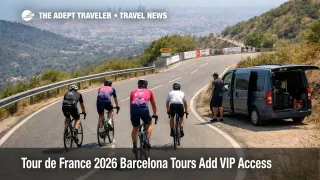
Tour de France 2026 tours from EF Adventures are expanding, with eight itinerary options tied to the men's Tour de France and the Tour de France Femmes avec Zwift, and built around access that is hard to replicate on a self planned trip. The changes matter most for travelers targeting the Barcelona Grand Depart on July 4, 2026, or travelers trying to pair spectating with guided riding on the same roads the peloton will use. With two itineraries already sold out, the practical next step is to treat inventory as stage dependent and decide quickly whether you are traveling primarily to ride, to spectate, or to balance both.
The shift is not just more departures, it is a deeper event integration model. EF says its partnership with EF Pro Cycling unlocks controlled environment experiences that are normally limited to team staff and sponsors, such as access to start area logistics, curated team touchpoints, and structured moments that fit inside the race day rhythm. In plain terms, Tour de France 2026 tours now look more like an event credentialed trip layered onto a supported cycling vacation, rather than a standard guided bike tour with a day of spectating bolted on.
Who Is Affected
Travelers who want to combine spectating with riding are the core audience, especially riders who would rather not manage route research, bike logistics, transfers, and hotel moves while the race is actively reshaping traffic patterns. If you have ever tried to chase a stage finish independently, you already know the friction points, limited road access, delayed shuttles, and lodging that disappears first in small towns near marquee climbs.
Travel advisors and trip planners are also affected because these itineraries are effectively event capacity products. The race calendar concentrates demand into a narrow set of dates and corridors, and the operational cost of vans, guides, and bike support rises when roads are closed and routings are forced onto longer detours. That is why sell outs can happen early even when France has abundant hotel supply in general.
Non riding companions are indirectly affected, too. Even when a tour is designed for mixed abilities, stage days can dictate meal times, meeting points, and how long it takes to get from a scenic village to the next hotel. If your trip includes separate tickets, such as a self booked rail segment, or a separate flight home, your connection risk is driven less by the published timetable and more by race day road reality.
What Travelers Should Do
If you are targeting the Barcelona start, treat arrival planning as part of the product decision. Build buffer on the front end, and avoid landing the same morning as a key access window, because airport delays, hotel check in timing, and city traffic controls can cascade into a missed start village slot that cannot be recreated later.
Use a clear decision threshold for whether to rebook, or to wait. If your preferred itinerary is not yet sold out but your flights are still flexible, lock the tour dates first, then shop air around them, because the tour inventory is the scarce asset on peak stages. If your air is already purchased and nonrefundable, prioritize an itinerary that keeps transfers shorter on stage days, because that is the easiest way to reduce the chance a minor delay turns into a missed experience.
Over the next 24 to 72 hours after you commit, monitor three things as you finalize details. Confirm the bike choice, sizing, and upgrade pathway early, confirm exactly which stage day access items are included versus optional, and confirm how luggage and transfers are handled when roads are closed. That checklist is where most traveler surprises live on event anchored cycling trips, especially for riders who assume race week logistics will feel like a normal touring week.
How It Works
Event anchored cycling tours behave differently from classic point to point bike trips because the race becomes an external force that reorders the transport network around you. First order effects show up at the source, start areas, finish areas, and the roads near marquee climbs, where closures, barriers, and crowd control compress movement and create hard cutoffs for vehicles. That is why tour operators build in support vans, earlier departures, and alternate routing that would feel excessive on a non race week ride.
Second order ripples hit at least two other layers of the travel system. Lodging supply tightens first in small stage towns and along iconic climbs, then it tightens in nearby rail nodes and larger cities as overflow demand spreads outward. Transfers also become less reliable because detours extend drive times, which pushes dinner reservations later, shifts hotel check in patterns, and can complicate any onward rail or flight segment that depends on a precise arrival time. Even if you never step into the official race village, the race can still influence your day because it shapes where vehicles can go, and when.
For 2026, Barcelona's Grand Depart adds another planning dimension because the start concentrates early demand into a major city with a large visitor base that is not traveling solely for cycling. On the women's side, the Tour de France Femmes avec Zwift adds cross border complexity when stages span multiple countries, which can increase transfer time variability and make document and rail planning more sensitive to small delays. Tours that package these moving parts are essentially selling risk reduction, not only convenience, and that is the real reason event based demand is rising.
Sources
- EF Adventures Expands Exclusive Cycling Tour Offerings During the Tour de France and Tour de France Femmes avec Zwift for 2026 (PR Newswire)
- Tour de France and Tour de France Femmes avec Zwift Tours (EF Adventures)
- Grand Depart Barcelone 2026 (Tour de France)
- Grand Depart Suisse 2026 and dates (Tour de France Femmes avec Zwift)
- EF Adventures expands its Tour de France collection (Travel Weekly)