

Baja California Sur Embrace It Tax Rises in 2026
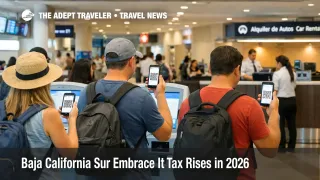
Baja California Sur has increased its Embrace It tourism contribution that applies to international visitors staying in the state. Travelers heading to Los Cabos, La Paz, Todos Santos, and other Baja California Sur destinations are the ones who will feel it, because the fee is charged per person and is tied to entry and stay rules. The practical move is simple: pay online, save the QR code, and keep it available on your phone before you start your airport arrival or land border day.
In plain terms, the Baja California Sur Embrace It tax has risen from 470 Mexican pesos (MXN) to 488 MXN per person, effective January 1, 2026.
Who Is Affected
The program is aimed at international visitors over 12 years of age who enter Baja California Sur by air or land and remain in the state for more than 24 hours. If you are flying into Los Cabos International Airport (SJD) for Cabo San Lucas or San José del Cabo, or you are flying into Manuel Márquez de León International Airport (LAP) for La Paz and the East Cape, you should assume the fee applies unless you have confirmed you fall outside the rule. Travelers headed for Todos Santos typically route through Los Cabos by road, so the fee is still part of the same trip planning stack even if your final stop is a smaller town.
The payment behavior data published with the program's update points to who is most often paying and how they are traveling. From July to December 2025, most payment records were tied to visitors from the United States and Canada, and the most common recorded length of stay was seven days. That matters because it lines up with the typical resort week pattern, which is also when arrivals cluster into banked flight waves, and when any added step at the airport has the highest chance of creating knock on stress for transfers, check in times, and first day activities.
What Travelers Should Do
Handle the payment before you travel whenever you can, and treat the QR code like a boarding pass that you may need to show more than once. The state's guidance is that payment is completed online, and the platform generates an electronic certificate with a QR code that may be requested at points of entry or during the stay, so keep it saved offline, and also screenshot it in case you land with weak data service.
If you are inside 24 to 72 hours of departure and you have not paid yet, decide based on your arrival timing and your transfer buffer. For midday arrivals with private transfers and flexible hotel check in, you can usually complete the process on arrival without breaking the day. For peak arrival banks, group transfers, cruise connections, wedding timelines, or anything with a hard start time, pay before you leave home so you are not relying on airport Wi Fi, roaming, or a last minute login reset.
Over the next 24 to 72 hours, monitor two things: whether your airline arrival bank at Los Cabos or La Paz is running on time, and whether local operators or hotels are messaging guests about document checks for the QR code. Even a small fee can create outsized friction when a lot of people try to complete it at the same time, so the operational win is avoiding the shared bottleneck.
Background
Embrace It is a state level tourism contribution for Baja California Sur that funds projects such as environmental protection, tourism infrastructure, and social and cultural initiatives. It launched in 2025 as a digital payment requirement for foreign visitors staying more than 24 hours, and the 2026 update keeps the same structure while raising the per person amount.
For travelers, the disruption is not that the fee is large, it is that it is a compliance step that can surface at the exact moment when travel days are already constrained. First order effects show up at the source, which is the arrival and entry process, where travelers may be asked to produce the QR certificate during entry, or at another checkpoint during the trip. Second order ripples hit other layers quickly: airport arrivals slowdowns can cascade into missed shared shuttles, longer waits for rental cars, and late hotel arrivals that compress front desk capacity. When those delays happen on peak weekends, they can also push demand toward last minute private transfers and same day room readiness requests, which is how a small administrative requirement can create real costs and stress elsewhere in the travel system.