

EF Go Ahead Food Tours Launch With America's Test Kitchen
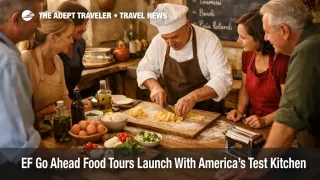
EF Go Ahead Tours has launched a Food Tours collection that packages cooking classes, tastings, and producer visits into small group itineraries across Europe and Asia. It is aimed at travelers who want a trip where restaurants, markets, and local kitchens are the main activity, and it also targets private groups like wine clubs that travel together. Before you book, compare the three tour styles, check what meals and tastings are included, and price out airfare plus extensions so you know whether a guided culinary trip beats building the same experience on your own.
The EF Go Ahead food tours launch matters because it makes culinary focused travel easier to buy as a single product, instead of stitching together reservations, day tours, and hard to book tastings city by city.
EF Go Ahead's January 13, 2026, announcement frames the collection as three related products. "Food Tours" lean into local cuisine and culinary traditions with food walks, markets, farm and producer visits, and cooking classes. "Food and Wine Tours" add more structured time in wine regions alongside regional food experiences. The premium tier is built in partnership with America's Test Kitchen, and EF Go Ahead says those departures add elevated accommodations and multiple cooking classes or demonstrations, plus perks like an annual Essential Membership subscription and on tour gifts.
The company also anchored the launch in demand signals. In the press release, EF Go Ahead said traveler insights developed with Qualtrics Research found 70 percent of surveyed travelers expressed interest in culinary touring, and 55 percent said they are likely to book a culinary tour in the next one to two years.
Who Is Affected
This launch is most relevant for travelers who treat food as the trip's organizing principle, especially people who want guaranteed access to tastings, producers, and small kitchens without doing the advance research and reservations. EF Go Ahead positions the collection for small groups, and its launch materials describe group sizing built around roughly 12 to 22 travelers, which tends to fit the capacity limits of markets, cooking schools, and family run producers better than large coach tours.
Travel advisors and group organizers are also part of the target market. EF Go Ahead highlighted private groups, like clubs and friend groups, as a growing channel for food focused touring, which matters because a cohesive group can justify private demonstrations and set menu experiences that are hard to secure for individuals.
Destinations that appear in the rollout span multiple regions, with several newly announced itineraries focused on Europe and Asia. Examples called out in the press release include Food of Southeast Asia: Vietnam and Thailand, Food of Japan, Food of Italy, Food and Wine: Slovenia, Croatia, and Northeast Italy, and Food and Wine of Sicily, alongside a Food and Wine of Spain itinerary.
What Travelers Should Do
Start by picking the travel style, not the destination list. If you want to learn techniques and cook repeatedly, filter for America's Test Kitchen departures and read the inclusions closely because that tier is marketed as more class heavy and hotel upgraded. If your priority is wine regions and structured tastings, start with Food and Wine itineraries. If you want broad access to markets, producers, and street food without centering vineyards, start with the Food Tours.
Use a simple decision threshold on value. If the itinerary includes multiple cooking classes, tastings, and producer visits you would pay for anyway, and the routing would take significant planning time, a guided product can be cost competitive even at a higher base price. If you mainly want to dine independently, and you are comfortable booking a couple of experiences plus restaurants yourself, you may get more flexibility by planning à la carte, especially in cities where reservations are easier to secure.
Over the next 24 to 72 hours after you shortlist a trip, monitor three things, departure date availability, extension pricing, and air routing. Culinary tours often rely on timed reservations and small venues, so certain departures can fill faster than general sightseeing itineraries. Extensions can also change flight strategy, for example a Galway add on after Dublin, or a Venice add on after the Adriatic route, which can move you from a simple round trip into a multi city ticket that prices differently.
How It Works
Culinary touring puts different constraints on the travel system than a classic highlight reel itinerary. The first order constraint is venue capacity. Cooking schools, small wineries, and producer visits often have hard caps, so tour operators need inventory on specific dates, and that can limit how many departures they can run or how large each group can be.
The second order ripple is accommodation and transport alignment. If a tour builds in countryside stays, boutique properties, or historic lodging, the operator is effectively competing for limited room inventory in smaller markets, and that can make certain seasons more expensive even before airfare is added. Transfers also tighten because market visits and tastings often run on fixed morning windows, so late arrivals can cascade into missed experiences, then into rebooked group meals, which impacts the rest of the day's sightseeing flow.
The third order ripple is traveler behavior and pricing. When a product is sold as an experience bundle, travelers may book earlier to lock a specific departure, and that can pull forward demand for the same peak travel weeks that already carry higher flight prices. For travelers, the practical takeaway is that the value proposition is not only food. It is access and sequencing across multiple reservation constrained experiences, with a schedule that is designed to keep the group moving even when individual venues would be difficult to book independently.
Sources
- EF Go Ahead Tours Launches New Collection of Food Tours to Meet Growing Demand for Culinary Travel
- Food Tours, EF Go Ahead Tours
- Tours with America's Test Kitchen, EF Go Ahead Tours
- Food of Ireland: Dublin, West Cork & County Kerry, EF Go Ahead Tours
- Food & Wine of the Adriatic: Slovenia, Croatia & Northeast Italy, EF Go Ahead Tours
- Ireland Travel Guide, Tips to Plan Your Trip, EF Go Ahead Tours