

Gare du Nord Eurostar Delays Jan 14, 2026
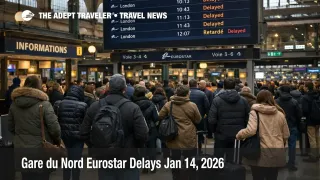
Eurostar warned travelers about same day disruption affecting services on Wednesday, January 14, 2026, after posting multiple delay advisories linked to Paris Gare du Nord operations. Eurostar cited operational restrictions at the station, knock on effects from earlier trains arriving late, and an incident involving a train hitting an animal, all of which can compound into longer waits even when the Channel Tunnel itself is operating normally. Travelers heading between London, England, and Paris, France, should plan for a wider arrival window, protect onward reservations, and be ready to accept later departures if station flow becomes constrained.
The Gare du Nord Eurostar delays matter more this week because the network is already running with reduced slack. Eurostar's own travel updates show planned limited service and cancellation windows across parts of the network in January and early February, which means fewer seats and fewer convenient departures are available as fallbacks when a day of delays hits.
Who Is Affected
The travelers most exposed are those relying on Eurostar as a fixed time anchor, for example same day meetings, timed attraction entries, cruise or tour departures, and flights booked on separate tickets. A 45 minute to 120 minute slip on the rail leg can be survivable when there is spare capacity, but it becomes trip breaking when the next trains are already heavily booked due to the broader timetable cuts.
Paris Gare du Nord is also an interchange point, so delays do not stay contained to the platform. When arrivals run late, the station has to absorb passengers from multiple services at once, which can slow platform turnover, boarding, and corridor movement. That station crowding then ripples outward into missed Metro and regional rail transfers, longer taxi queues for travelers who switch to road transport at the last minute, and more pressure on hotels when late arrivals push check in past practical hours.
On the London side, the knock on effects often show up as later boarding waves, longer dwell times, and more people competing for limited help desk and rebooking attention. Because Eurostar is a closed system with security and border processes, disruption can turn into a throughput problem as well as a train path problem, which is why a day of delays can still feel messy even after the original trigger is cleared.
What Travelers Should Do
If you are traveling on January 14, 2026, act on the parts you can still control. Check your train status in Eurostar's travel updates, and treat any delay advisory as a signal to protect the rest of your itinerary, especially if you have a timed commitment within a narrow arrival window. If your onward plans are separate tickets, add a buffer night on either side of the rail leg if the cost of missing is high, and use Paris Travel Guide: The Ultimate 7-10 Day First-Timer's Itinerary to pick neighborhoods that reduce friction if you end up overnighting unexpectedly.
Use decision thresholds instead of hope. If you must arrive in London or Paris by a hard deadline, a practical trigger is when your expected arrival delay approaches 90 minutes and the next feasible train options would miss the deadline anyway. At that point, check same day flights, and compare the full door to door time, including airport transfers and security lines, against the latest reprotected rail option. If the flight option is only marginally faster, rail may still be the lower risk choice because it avoids airport congestion, but when rail alternatives are sold out or pushed late into the evening, switching modes can be the cleanest save.
Monitor the next 24 to 72 hours for compounding constraints, not just one late train. Because Eurostar is also operating through planned reduced service windows, each new delay can concentrate more passengers into fewer departures, which raises the chance of sellouts and longer rebooking queues. Keep checking for updated advisories, and if you are traveling on additional France rail disruption days nearby, read Paris Rail Strike Disrupts Trains January 13, 2026 so you do not build a fragile station transfer into a day that is already capacity constrained.
Background
Eurostar disruptions tend to break trips in two different ways, and January 14 shows both at once. Planned service cuts remove inventory ahead of time, so the failure mode is sellouts, inconvenient retimes, and fewer acceptable departures. Unplanned day of delays then land on top, and the failure mode shifts to late arrivals, platform crowding, and missed downstream connections because the schedule has less slack to absorb disruption.
For passenger rights, two concepts matter. First, refunds and exchanges are often tied to who sold you the ticket, Eurostar notes that third party bookings generally need to be handled through the original retailer. Second, delay compensation typically depends on the final arrival delay, and Eurostar's compensation guidance starts at 60 minutes, with larger amounts at longer delay bands, and it generally advises waiting for systems to finalize delay data before submitting a claim.