

Grand Half Loop Chicago Cruise: Victory I Oct 2026
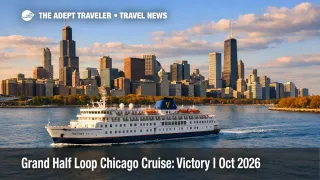
Victory Cruise Lines has added a long, one way itinerary designed to mimic a marquee segment of the legendary Great Loop, without the months of self navigation it usually requires. The cruise line says Victory I will operate a 35 night "Grand Half Loop" sailing from Chicago, Illinois, to Jacksonville, Florida, from October 17 through November 21, 2026. Travelers considering fall Great Lakes and Northeast coastal cruising should treat this as a planning heavy trip, because it combines inland waterways, Canadian ports, and an end point in a different U.S. city, which changes flight, documentation, and contingency math.
The Grand Half Loop Chicago cruise matters because it bundles Great Lakes ports, the St. Lawrence Seaway corridor, and the Atlantic seaboard into one continuous itinerary, which can amplify small operational hiccups into bigger timing shifts once the ship is committed to the next region.
Who Is Affected
This sailing is most relevant for travelers who want a small ship itinerary that stitches together multiple regions in a single trip, especially guests who would otherwise book separate Great Lakes, New England, and Southeast coastal cruises. Victory positions the voyage as a season finale and a bucket list style journey, with the company advertising 24 ports that span the Great Lakes, the St. Lawrence Seaway, Atlantic Canada, and the U.S. East Coast before finishing in Florida.
The itinerary detail published by Victory and covered by trade outlets indicates the early segment is built around Great Lakes classics such as Milwaukee, Wisconsin, Escanaba, Michigan, Mackinac Island, Michigan, Sault Ste. Marie, Michigan, Detroit, Michigan, and Cleveland, Ohio. It then shifts into Canada with stops that can include Toronto, Ontario, Canada, Montréal, Québec, Canada, Québec City, Québec, Canada, and maritime ports such as Charlottetown, Prince Edward Island, Canada, and Halifax, Nova Scotia, Canada, before the ship works down the U.S. coast through New England and the Mid Atlantic and continues south through ports such as Charleston, South Carolina, and Savannah, Georgia.
Because the cruise is one way, anyone who typically relies on closed loop logistics should plan differently. You are not returning to the same embarkation city, and you will be crossing borders by sea, which makes travel documents and end of trip flight availability more consequential than on shorter regional cruises.
What Travelers Should Do
Start by treating this as two trips that must interlock, getting to Chicago for the included pre cruise hotel night, and getting home from Jacksonville after disembarkation. If your schedule is tight, build in at least one buffer night at the end, because a late arrival can cascade into missed flights, limited same day rebooking inventory, and a hotel scramble in peak fall travel weeks.
Decide now what would make you rebook versus wait if the itinerary shifts. For a voyage that runs into November, the practical threshold is often weather driven, if forecasts show sustained gale conditions on the Great Lakes or along the North Atlantic legs, expect port order changes, tender cancellations, or substituted calls. If you have critical commitments at home, the safest decision is to pick flights that are not the first departure window after disembarkation, and to favor refundable fares or flexible change options where possible.
Over the next 24 to 72 hours after booking, monitor three things, your cruise contract details for what happens if ports are substituted, your documentation checklist for Canada calls, and your flight plan into Chicago and out of Jacksonville. The U.S. Department of State recommends cruise passengers carry a passport book even when a cruise line might accept other documents, because a passport book is the cleanest option if you must fly home unexpectedly. Canada also notes that travelers arriving by boat do not need an eTA, but they still need a valid passport, which is a common point of confusion for people used to land border rules.
Background
The "Great Loop," often called the Great Loop or Grand Loop in casual conversation, is a long standing mariner route that circles through connected rivers, canals, lakes, and coastal waters in the eastern half of North America. Victory's "Grand Half Loop" is essentially a curated, commercial slice of that concept, starting on Lake Michigan, threading the Great Lakes system, connecting toward the Atlantic via the St. Lawrence Seaway corridor, and then transitioning into open ocean and coastal routing down the U.S. East Coast.
Operationally, that multi region structure is what makes the trip compelling, and what raises the need for buffers. First order effects happen at the source, weather and waterway constraints. Fall conditions on the Great Lakes can produce high winds, fog, and rough seas, which can force tender cancellations at island ports and compress arrival windows. Once the ship is late leaving a port, second order ripples follow across the rest of the network, shore excursions can be shortened or reshuffled, onboard programming shifts, and the ship may swap ports to preserve clearance windows for locks and channels.
The routing also depends on infrastructure that has its own seasonal rhythms. The Soo Locks at Sault Ste. Marie are a key connector between Lake Superior and the lower lakes, and they close in winter for maintenance on a published schedule, while the St. Lawrence Seaway system has defined winter closure windows and ice driven constraints. A late October and November cruise is normally inside those navigation seasons, but early ice and operational restrictions can still slow movement, which is why end of trip flight planning and insurance terms matter more on a voyage of this length.
Sources
- Victory Cruise Lines, 2026 Chicago To Jacksonville Itinerary
- Victory Cruise Lines, Special Offers: The Grand Half Loop
- TravelPulse, Victory Cruise Lines To Conclude 2026 Season With 35 Night Grand Half Loop Sailing
- Seatrade Cruise, Victory's Grand Half Loop Arcs From Chicago To Jacksonville
- U.S. Department of State, Cruise Ships: Passport Books
- Government of Canada, Entry Requirements By Country
- U.S. Army Corps of Engineers, Soo Locks Closing For Seasonal Repair Maintenance