

Lufthansa Group Free WiFi Starts Second Half 2026
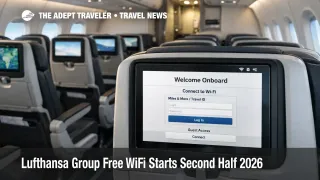
Lufthansa Group will begin rolling out Starlink powered onboard internet starting in the second half of 2026, with free access tied to Miles & More status or a Travel ID login across all travel classes. Travelers who already hold Miles & More status, and travelers willing to use Travel ID, should be the first to benefit as aircraft are retrofitted. If connectivity is a must for work, family logistics, or same day plans, set up your logins now, and keep backup options, because coverage will be uneven until the retrofit program matures.
The Lufthansa Group free WiFi change matters because it shifts onboard internet from a paid, per flight decision to a default perk for a wide swath of travelers, with the biggest caveat being that access is linked to identity and account setup. The group says it will upgrade around 850 aircraft and complete the rollout by 2029, which makes this a multi year transition rather than a single switch that flips across the network.
Who Is Affected
This primarily affects travelers flying on Lufthansa Group airlines where aircraft are being upgraded, including long haul and short haul fleets, because the plan is to equip the group fleet rather than a single flagship airline. In practice, the people who feel the change first will be business travelers, frequent travelers, and families who routinely join loyalty programs, because the free tier is tied to Miles & More status or to Travel ID enrollment.
Travel ID is positioned as a single login for Lufthansa Group digital services, and it can be linked to Miles & More. Lufthansa describes it as a profile where you can store personal data, payment details, and important travel documents to speed up booking and check in, which is a convenience win for repeat travelers but also a personal data decision you should make deliberately. If you prefer not to store those details, you can still decide later, but you should expect the group to keep nudging travelers toward the account based model as more of the travel chain, from booking to onboard services, becomes login based.
There is also a knock on effect for travelers on mixed itineraries and connections. During the rollout window, you might have strong connectivity on one segment and limited connectivity on the next, which changes how you plan remote work, arrival coordination, and last mile transfers. It also shapes airline operations indirectly, because higher bandwidth connectivity encourages more digital self service and realtime disruption handling onboard, but it does not eliminate the basic constraints that drive delays, reaccommodation, and missed connections when the network is stressed.
What Travelers Should Do
If you want the best chance of getting free access when it becomes available, set up Travel ID and confirm it is linked properly to your Miles & More profile, then store only the information you are comfortable storing, and use a password manager and multi factor protections where offered. Do this well before travel, because account recovery can be slow if you are trying to fix it on airport WiFi moments before boarding.
For trips where onboard connectivity is mission critical, treat the second half of 2026 through 2029 as a mixed fleet era. If you can tolerate gaps, wait and see, but if you need reliable access for work deliverables, family medical coordination, or time sensitive ground pickups, choose routings with longer buffers, and avoid planning anything that requires uninterrupted internet in the air until you confirm your specific aircraft is equipped.
Over the next 24 to 72 hours before departure, monitor your operating carrier's app and seat map updates, and look for any mention of upgraded connectivity or onboard internet packages. Even after Starlink begins appearing, the most useful signal will be whether your exact aircraft tail, or at least your aircraft type and cabin product, is part of the early retrofit wave, because the experience will vary by fleet and maintenance scheduling.
How It Works
Starlink uses a low Earth orbit satellite network, which generally reduces latency and increases throughput compared with older satellite systems, and that is why airlines pitch it as good enough for streaming and cloud work rather than just messaging. For travelers, the key practical point is that the onboard internet experience is a chain of dependencies: the aircraft must have the antenna and cabin network installed, the aircraft must be scheduled on your route that day, and your access tier is decided by your account status and login. That is why the group's promise of free access does not automatically translate into free access on every Lufthansa Group flight on day one.
The retrofit timeline is also shaped by how airlines manage downtime. Installing new connectivity hardware usually lines up with planned maintenance visits to avoid pulling aircraft out of service, which stretches the rollout across seasons and across fleets. As the program scales, expect second order ripples beyond the cabin experience, including more travelers shifting work habits to the air, and more pressure on customer support and digital channels as airlines standardize logins and identity driven servicing across brands. If you want a broader view on how technology demand and supply constraints can propagate into airline reliability and product timelines, see AI Data Centers And The Airline Supply Chain, A 2030 Outlook.