

Puerto Rico 2025 Visitor Growth Raises Peak Prices
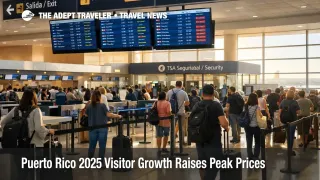
Puerto Rico finished 2025 with another year of higher visitor activity, with Discover Puerto Rico reporting growth across airport arrivals, cruise passenger volumes, and lodging demand. The change matters most for leisure travelers heading to San Juan, beach resorts, and cruise itineraries that use Puerto Rico as a homeport or high volume call. The practical move is to treat 2026 and early 2027 trip planning as a tighter capacity environment, book the parts that sell out first, and pad transfers on arrival and departure days.
In plain terms, Puerto Rico visitor arrivals 2025 rose again, which usually translates into less last minute inventory, more surge pricing on popular dates, and more friction at chokepoints like airport processing, port transfers, and high demand neighborhoods in San Juan.
Discover Puerto Rico said Luis Muñoz Marín International Airport (SJU) recorded more than 6.8 million passenger arrivals in 2025, up about 3 percent year over year. For context, the airport's operator reporting also shows how large the overall flow is, with Luis Muñoz Marín posting 13.6 million total passengers for 2025, which supports the idea that inbound arrival peaks can feel crowded even when the headline growth rate looks modest.
Cruise traffic also increased. Discover Puerto Rico reported more than 1.6 million cruise passengers arriving at Puerto Rico's ports in 2025, nearly 8 percent higher than 2024. Lodging demand, measured as room nights booked across hotels and short term rentals, was reported at about 7.9 million for 2025, an increase of about 8 percent year over year.
Who Is Affected
Leisure travelers booking Puerto Rico for peak season weeks are the most exposed to the knock on effects of higher demand, especially those targeting San Juan weekends, resort heavy corridors, and school holiday windows when families compete for the same flight and room inventory. Couples and solo travelers tend to feel the change through price and availability, while families feel it through fewer large room categories, fewer connecting room options, and less flexibility to shift plans when something sells out.
Cruise travelers are affected in a different way. Higher cruise passenger volumes can concentrate in Old San Juan and the port perimeter on ship call days, which can slow tours, dining, rideshare pickups, and return to ship timing even when the broader island feels normal. Travelers using Puerto Rico as a homeport should also assume that flight disruptions or baggage delays have a higher penalty, because same day hotel backup inventory can be thinner in the exact neighborhoods that are convenient for embarkation.
Meetings and event driven travel also matters because it changes midweek patterns. Discover Puerto Rico reported additional group room nights and economic impact tied to meetings and conventions, which can compress inventory outside the classic weekend leisure pulse. That is when leisure travelers discover that a "random Tuesday" is no longer a safe assumption for cheap rates if a large block is in house.
What Travelers Should Do
Travelers planning Puerto Rico in 2026 should book lodging earlier than they used to, and prioritize refundable rates until flights and activities are locked. If the trip depends on a specific neighborhood, a specific resort, or adjoining rooms, the decision is not whether to book early, it is whether the cancellation terms are acceptable for committing early.
For flights and transfers, the threshold question is how much slack exists on the arrival day. If you have a same day cruise embarkation, a fixed tour check in, or a wedding schedule, choose an earlier arrival or add a buffer night, because crowded peaks at Luis Muñoz Marín and the ground transport layer can turn small delays into missed commitments. If your schedule is flexible, you can tolerate later arrival banks and shop price, but you should still avoid separate ticket connections that leave no recovery options.
Over the next 24 to 72 hours after you book, monitor a short list of signals that predict friction rather than focusing only on weather. Watch your hotel's sellout calendar and minimum stay rules, watch your airline's schedule change emails, and watch cruise port days if you are staying near Old San Juan, because those factors often drive the real on the ground experience when demand is trending higher.
How It Works
Destination growth is not just a single number, it is a set of connected capacity and behavior changes. When air arrivals increase, the first order impact shows up at the airport and in the rental car, rideshare, and taxi layers that move people out of the terminal. The second order ripple is that aircraft, crews, and hotel staff are stretched across more peak days, which reduces the system's ability to recover from small disruptions, and that is when travelers feel longer lines, fewer same day alternatives, and tighter rebooking.
Cruise passenger growth behaves like a surge generator. It concentrates thousands of visitors into a narrow time window, and it pushes demand into tour operators, restaurants, and transfer providers in a way that can be invisible if you only look at the island wide picture. In practice, a traveler can have a calm beach stay in one region and still run into heavy congestion in San Juan on the same day because the demand is spatially and temporally uneven.
Lodging demand growth is also split across hotels and short term rentals, and the traveler experience depends on which segment you choose. When short term rental nights rise, travelers may see more dynamic pricing and fewer last minute quality options, which makes due diligence more important. For travelers considering apartment style stays as a way to manage price and space in a tighter market, What Sonder's Collapse Means for Apartment Hotels is a useful reminder that not all inventory carries the same operational reliability when something goes wrong.
Employment trends are an additional signal, because the leisure and hospitality workforce has to scale with demand to keep service levels stable. U.S. Bureau of Labor Statistics data shows Puerto Rico's leisure and hospitality employment at about 102,000 jobs by November 2025, and those figures can be revised over time. For travelers, the practical takeaway is that staffing pressure can show up as slower housekeeping turns, longer restaurant waits, and more limited on site support during peak demand weeks.
Sources
- Puerto Rico posts record tourism growth in 2025
- 2025 is Poised to be a Fifth Consecutive Record Year for Puerto Rican Tourism
- Discover Puerto Rico Brings the Island's Sounds to Calm in First-Ever Destination Partnership
- Discover Puerto Rico estrena segunda parte de la serie "Return the Love" que resalta el turismo responsable en Puerto Rico
- La estrella de la MLB, Kike Hernández, se une a Discover Puerto Rico
- Luis Muñoz Marín Airport closed 2025 with 13.6 million passengers
- All Employees: Leisure and Hospitality in Puerto Rico (SMU72000007000000001) | FRED | St. Louis Fed