

Ryanair Charleroi Flight Cuts Start April 2026
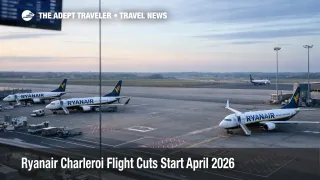
Ryanair says it will reduce capacity at Brussels South Charleroi Airport (CRL) by about 10 percent starting in April 2026, cutting roughly 1.1 million seats from what it describes as a 10.5 million seat annual base at the airport. The carrier ties the move to a planned €3 per departing passenger tax associated with Charleroi from April 2026, and it warns more reductions could follow if Belgium's broader aviation tax increases proceed. For travelers, this is not a one day disruption, it is a forward schedule change that can reshape availability and pricing for spring and summer 2026.
The practical takeaway is that Charleroi's low fare volume is being deliberately trimmed at the exact time many travelers start locking in long weekend city breaks and peak season flights. When supply drops at a low cost base airport, the first order effect is fewer cheap seats on the most popular departures, and the second order ripple is that nearby airports, and rail corridors, absorb spillover demand, which can push up total trip cost even if the airfare looks similar.
If you have been tracking Ryanair's earlier warnings about Belgium route risk tied to taxes, this April 2026 reduction is the first concrete capacity number travelers can plan around. For background on the earlier, broader Belgium schedule threat, see Belgium Aviation Tax Hike Puts 20 Ryanair Routes At Risk.
Who Is Affected
Travelers who rely on Brussels South Charleroi for low cost access to secondary European cities are most exposed, especially anyone traveling on fixed dates such as school holidays, concerts, festivals, or event weekends. A 10 percent cut does not mean every route disappears, but it usually shows up as fewer weekly frequencies, less shoulder day choice, and a higher chance that the weakest performing routes are trimmed first as the schedule is rebuilt.
You are also more exposed if your plan depends on late evening arrivals, or tight, same day ground transfers. With fewer total departures, a single cancellation can strand more passengers into the next day because there are fewer alternative flights to rebook onto. That spills into hotels around Brussels and Charleroi on peak weekends, and it can cascade into rail crowding when travelers pivot to trains for intra Benelux or France connections.
Travelers who can switch airports are in a stronger position. Brussels Airport (BRU) is tightly connected to the national rail network with frequent direct trains to Brussels Central, Brussels North, and Brussels South stations, which makes it easier to rebuild an itinerary when flights change. Meanwhile, Charleroi's access model is more dependent on bus links from Charleroi Central, and on dedicated airport coaches from Brussels, which can become a pinch point if more passengers are competing for fewer flight departures.
What Travelers Should Do
If you have not booked yet for April through October 2026, price your trip from Charleroi and Brussels Airport on the same day, then repeat for a nearby cross border option such as Eindhoven Airport (EIN) or Lille Airport (LIL) if ground access works for you. Lock your ground transport plan as soon as you commit, because airport buses, and some rail legs, become the hidden constraint when demand shifts. For Charleroi specifically, validate the train plus bus combination from Charleroi Central, or your direct coach timing from Brussels, before you buy non refundable lodging.
If you are already booked on a Charleroi itinerary for spring or summer 2026, set a decision threshold now: if your trip is date critical, prioritize the earliest reasonable flight of the day, and be willing to move airports if a schedule change pushes your departure into a thin part of the timetable. If you can tolerate a shift, you can often wait for the airline's final schedule shaping, but you should still hold lodging with flexible cancellation terms, because fewer seats tend to raise the cost of last minute adjustments.
Over the next 24 to 72 hours after any schedule change email, monitor three things: your flight number continuity, your departure time movement, and whether the route remains nonstop from the same airport. If the airport changes from Charleroi to Brussels Airport, or your timing shifts into a misconnection risk window for trains or buses, reprice the whole trip, not just the airfare. When capacity is being reduced, the real cost risk is being forced into a more expensive departure time, plus a last minute hotel night to protect an early morning flight.
Background
Ryanair's announcement matters because Brussels South Charleroi is a high volume low cost engine for Belgium, and a meaningful slice of the region's leisure connectivity is structured around its price point and its frequency pattern. Ryanair says the planned reduction is about 1.1 million seats, roughly 10 percent of what it describes as its annual seat base at Charleroi, and it explicitly links the cut to a €3 per departing passenger tax associated with Charleroi from April 2026, alongside Belgium's broader aviation tax trajectory.
Disruptions like this propagate through the travel system in predictable layers. At the source airport, fewer departures compress passengers into the remaining flights, which increases load factors and raises the penalty for any operational hiccup because reaccommodation inventory is thinner. The next ripple is network substitution: some travelers shift to Brussels Airport because it is rail integrated, while others shift to cross border airports like Eindhoven or Lille if fares, and ground time, pencil out. Brussels Airport's rail connectivity makes last minute rebuilds easier, while Charleroi's train plus bus access model can become a throughput constraint if more travelers are trying to arrive earlier to protect against missed flights.
Finally, the broader capacity environment matters. When airlines are already managing aircraft scarcity, and optimizing bases, localized policy driven cost increases more readily translate into schedule cuts rather than being absorbed. If you want a deeper view on how constrained aircraft supply can amplify fare pressure when seats disappear, see FAA Delays on Boeing 737 MAX 10 Hit Airline Capacity.
Sources
- Ryanair to cut Brussels Charleroi capacity due to passenger tax
- RYANAIR TO CUT BRUSSELS TRAFFIC BY 1M IN 2026 AND 1M IN 2027 AS CHARLEROI COUNCIL AND BELGIUM GOVT RAISE PAX TAXES
- Access & Parking, Brussels South Charleroi Airport
- Train to and from Brussels Airport, Brussels Airport
- By train and bus to Charleroi Airport, SNCB NMBS
- Charleroi Airport warns new aviation taxes could push it into loss making territory in 2026