

Larnaca Airport Closure Feb 10 to 12 Halts Flights
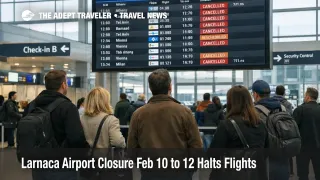
Larnaca International Airport (LCA) in Larnaca, Cyprus, will suspend normal flight operations during specific daytime windows on February 10, February 11, and February 12, 2026, after a published notice to air missions, NOTAM A0026/26, cited military firing activity as the reason. Travelers booked to arrive or depart during the affected windows are most likely to see cancellations or schedule shifts, and the knock on effects can extend beyond the window as aircraft and crews are repositioned. The practical next step is to compare your ticketed departure or arrival time to the closure window, then decide whether to accept a retime, reroute via an alternate airport, or proactively move travel to a different day.
The published NOTAM window details matter because the closure is not an all day shutdown on each date. The NOTAM text lists closures on February 10 from 900 a.m. to 1100 a.m. UTC, on February 11 from 1200 p.m. to 200 p.m. UTC, and on February 12 from 915 a.m. to 1115 a.m. UTC. Cyprus local time in February is typically UTC plus 2, which translates those windows to 1100 a.m. to 100 p.m., 200 p.m. to 400 p.m., and 1115 a.m. to 115 p.m., respectively, unless an operator displays times differently.
Who Is Affected
The most directly affected travelers are those ticketed to depart from or arrive into Larnaca during the closure windows, including travelers on leisure package flights, VFR travel, and regional connections that rely on midday banks. If your itinerary includes a same day cruise embarkation, a fixed time event, or a long prepaid road transfer, the risk is less about the length of the closure and more about the chance your flight is moved earlier or later than planned, or rolled to the next operating day.
Even if your flight is scheduled outside the closure window, you can still be impacted indirectly. Airlines often run tightly sequenced rotations into Cyprus, and a single missed arrival can remove the aircraft that would operate a later departure. That is how a two hour closure becomes an afternoon retime, an equipment swap, or a next day departure in the real system.
There is also a recovery constraint worth flagging for travelers using Larnaca in February. Separate aerodrome notices show overnight runway work periods in early 2026, which can limit how aggressively schedules can be "caught up" late at night after an afternoon disruption. You do not need to read NOTAMs to plan effectively, but you should assume the post window recovery may be less flexible than on a normal day.
What Travelers Should Do
Start by mapping your booking to the published closure window, not just the date. If your scheduled arrival or departure sits inside the window, treat the flight as likely to be canceled or retimed and plan for a different arrival time, an alternate airport, or a different day. If you are outside the window but within a few hours of it, build buffer into ground transfers and lodging because rotation delays and repositioning can still move your departure.
Decide now what outcome you will accept, and what triggers a rebooking. If the airline retimes you to an arrival that breaks a same day connection, pushes you past cruise check in, or forces an overnight you cannot use, move quickly to request rerouting or to shift your trip by a day. If the airline retimes you by a manageable margin and you can absorb it with extra ground time, it can be rational to wait, but only if you have flexible lodging and you are not on separate tickets.
Over the next 24 to 72 hours after your airline updates the schedule, monitor three things: whether your flight number changes, whether the operating aircraft is swapped, and whether you are silently rerouted via Paphos International Airport (PFO) or another gateway. If you are rerouted to Paphos, reprice the full trip including road transfer time and cost before accepting, because the airport switch can turn a short transfer into a materially longer travel day.
Background
A NOTAM is an operational notice used to tell airlines and flight crews about constraints that affect safe flight planning, such as airspace activity, runway work, equipment outages, or temporary closures. In this case, the published notice indicates the aerodrome is closed to all flights except emergency flights during the listed windows due to military firing activity.
For travelers, the key system effect is how an airport closure propagates. First order, flights in the window cannot operate, so carriers cancel, hold, divert, or retime. Second order, the aircraft that should have arrived may be stuck elsewhere, and the crew operating your departure may time out on duty limits, which forces further cancellations even after the airport reopens. Third order, reaccommodation demand spikes, seats on later flights compress, and hotels near the airport or in resort areas can tighten if travelers are stranded overnight. That is why a targeted daytime closure can still create evening disruption, and why accepting a retime without checking downstream commitments can be costly.
On passenger rights, most itineraries touching Cyprus on EU or EU carrier rules are covered by the EU air passenger rights framework. When flights are canceled, airlines generally must offer a choice between reimbursement or rerouting, and they must provide care, such as meals, communications, and accommodation when required, while you wait. In extraordinary circumstances, compensation may not be owed, but the assistance and rerouting or refund obligations generally still apply, and that distinction is useful when you negotiate options with the airline.