

Kruger Flood Closures Expand, Gates and Roads Limited
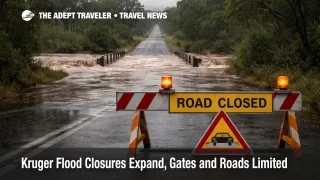
Flooding and road damage are expanding operational closures in and around Kruger National Park, tightening gate access and cutting internal road links that many safari itineraries rely on. Day visitors remain suspended, and entry is now restricted to a narrow set of travelers, including certain overnight guests and airport transfers with proof of confirmed flight bookings. Travelers already in the region should shift plans toward fewer moves, earlier decision points on rerouting, and clear alternates for transfers and flights as conditions evolve.
Kruger flood closures now mean that even when a gate is open, your intended camp to camp routing may not be possible because key internal connectors are flooded or closed. SANParks advises guests to use the most direct gate to reach specific camps, and it has warned that several links between Skukuza, Lower Sabie, Crocodile Bridge, Tshokwane, and Satara are not accessible due to flooded low water bridges, detours, and closed roads.
Who Is Affected
Self drive visitors are most exposed because route flexibility inside Kruger is constrained, and detours may be unavailable when low water bridges and tar links are cut. If you planned a multi camp loop, especially involving Skukuza, Lower Sabie, Crocodile Bridge, Tshokwane, Satara, or the northern sector, assume your original sequence may not be drivable, even if your booking still exists.
Travelers with day visit plans are directly affected because SANParks has kept day visitation suspended until further notice, and it is limiting entry to essential vehicles, airport transfers with proof of flights, essential staff, and guests with overnight bookings at specific camps. That restriction changes how tours stage vehicles, how private transfers time gate entry, and how lodges plan pickup windows.
Guests with cross border routing are also affected because Pafuri and Giriyondo border posts inside Kruger are closed due to severe weather conditions, forcing reroutes outside the park footprint and reshaping drive times. Even if your itinerary stays within South Africa, closures can push demand into the remaining accessible camps and nearby towns, tightening availability for last minute moves.
What Travelers Should Do
If you are arriving within the next 24 to 72 hours, contact your lodge, camp, or tour operator and ask for a gate to camp routing plan that does not rely on internal links that are currently inaccessible. If you are self driving, carry proof of your overnight booking, and if you are transiting to an airport, carry proof of your confirmed flight booking because SANParks has tied entry permission to those documents during the restriction period.
If your itinerary involves multiple camps, set a clear decision threshold now, if your next camp requires crossing the currently cut corridors, rebook to stay put or consolidate into one accessible base rather than attempting a chain of uncertain moves. If SANParks or your operator cannot provide a drivable route that avoids flooded low water bridges and closed segments, treat that as a reroute trigger, not a wait and see situation, because closures can tighten quickly with rising rivers.
Monitor three things on a rolling basis, SANParks operational updates, gate specific guidance for reaching your camp, and regional road conditions outside the park because provincial routes are also impacted by flooding. For flights, plan extra buffer for longer routing that may require exiting via a different gate than planned, and expect schedule reshuffles as travelers shift departure days, which can cascade into missed onward connections.
Background
Kruger's internal network is designed around a mix of tar routes and low water crossings, so when persistent rainfall saturates the system, access can fail in clusters rather than one road at a time. SANParks has warned that road closures can occur at short notice and that rising rivers can quickly change which corridors are usable, which is why it is directing guests to the most direct gate to reach specific camps, and restricting entry categories while day visitors are suspended.
Those first order closures propagate outward. When internal links are cut, guests are forced to exit earlier, hold in place, or relocate, which increases pressure on the limited set of accessible camps, and pushes overflow demand into nearby towns and lodge inventory outside the park boundary. At the same time, altered exit timing affects transfers to the airports that commonly serve Kruger itineraries, including Skukuza Airport (SZK) and Kruger Mpumalanga International Airport (MQP), and it can shift flight demand across days, raising misconnect risk for travelers who planned tight onward legs.
The broader regional weather picture matters because these closures sit inside a wider flood event across Limpopo and Mpumalanga provinces, with reporting indicating evacuations inside the park and significant impacts beyond it. That increases the chance that even if conditions stabilize inside Kruger, external road access, staffing, and recovery logistics remain constrained, slowing the return to normal routing.
Sources
- Persisting Rainfall and Operational Impacts in the Kruger National Park
- Access Gates for Guests Entering Kruger National Park (KNP) and Going to Specific Camps has been Affected by the Persisting Weather Conditions Currently Experienced in the Limpopo and Mpumalanga Provinces.
- Update On Severe Weather Warning: Day Visitors Into The Kruger National Park Temporarily Suspended
- Pafuri And Giriyondo Border Posts In KNP Closed Due To Severe Weather Conditions
- How To Get There, Kruger National Park
- South Africa's Kruger National Park shuts after severe floods
- Floods force evacuations from South Africa's Kruger National Park and leave 19 dead in other regions