

Low Snow in West Cuts Vail Resorts Skier Visits
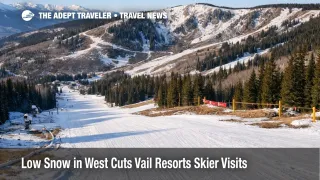
Vail Resorts reported that skier visits across its North American destination and regional mountains dropped sharply early this season as unusually weak snowfall constrained Western terrain openings. Epic Pass holders, day ticket buyers, and destination travelers headed to Colorado, Utah, Tahoe, and British Columbia are most exposed because limited advanced terrain can change the value of a trip even when the resort is operating. The practical next step is to verify what is open by ability level, keep lessons and lodging flexible, and set a clear point where you rebook to a different week or a different region.
In a January 15, 2026, update covering the season through January 4, Vail Resorts said season to date total skier visits were down 20.0%. Lift revenue was down 1.8%, but ancillary categories fell much more, with ski school revenue down 14.9%, dining down 15.9%, and retail and rental down 6.0%.
CEO Rob Katz attributed the visitation hit to "one of the worst early season snowfalls in the western U.S. in over 30 years," saying November and December snowfall at the company's western resorts was about 50% below the historical 30 year average, and the Rockies were nearly 60% below average, leaving roughly 11% of terrain open in Colorado during December.
Who Is Affected
Destination skiers planning Colorado and Utah weeks are affected first because limited natural snow can keep expert terrain, bowls, and glades closed or thin, even when groomers are running and snowmaking is steady. That gap matters most for travelers who picked specific mountains for advanced terrain, iconic zones, or off piste style experiences rather than for village access and beginner progression.
Families and first timers are affected differently. Fewer open trails can concentrate demand on a smaller set of lifts, ski school meeting areas, and base dining, even if the overall resort feels less busy than a typical peak week. If you prebooked lessons, rentals, dining, or childcare, you should treat terrain constraints as a schedule problem, not just a snow problem, since morning choke points become the real risk.
Travelers who built trips around specific on mountain products are also exposed. Vail Resorts' own metrics show ancillary spending dropped far more than lift revenue, which aligns with a pattern where pass based lift access is relatively resilient, but ski school, dining, and retail soften when terrain is limited or the experience mix shifts.
For near term reality checks, the public terrain dashboards show what is open today, not what is "supposed" to be open. Vail Mountain's terrain status showed 155 of 277 trails open, while Park City's terrain status showed 196 of 349 trails open at the time of review.
What Travelers Should Do
If your trip starts in the next seven days, verify open terrain by ability level, not by total trail count, then build buffers into every prebooked component. Keep rentals cancellable where possible, avoid locking in multiple paid lessons before you see what beginner zones are actually open, and plan one off mountain activity option per day so you have a value preserving fallback if winds, temperatures, or thin cover limit lifts.
If you are deciding whether to wait or rebook, set a simple threshold you will follow. For advanced focused trips, if the signature expert zones you care about are still largely closed, or if the resort is relying heavily on a narrow band of groomers, rebooking to a later week, or pivoting to a stronger region can be the better play, even if your lodging is sunk cost. For mixed ability groups, a partial opening can still work if core beginner and intermediate pods are open and connected, but you should expect crowding on the limited lift network.
Over the next 24 to 72 hours, monitor three things: sustained cold nights that expand snowmaking, storm totals that build base depth (not just a quick refresh), and operational notes about terrain expansion and lift openings. For travelers combining skiing with tight air schedules, it is also worth keeping an eye on weather driven transportation disruption elsewhere in the network, since rebook waves can spike demand and degrade connection reliability across hubs and alpine gateways, see Snow To Cause Nordic And Alpine Airport Delays. If you are tracking Colorado operational risk more broadly, see Telluride Ski Patrol Strike Closes Resort Indefinitely.
How It Works
Low snow impacts ski travel in layers. The first order effect is operational: less natural snow means fewer trails can open, expert terrain often lags, and resorts lean more heavily on snowmaking windows and grooming to keep core routes viable. That changes on mountain circulation, concentrates skiers into fewer corridors, and can shift the experience toward lower angle terrain even when the resort is technically "open."
The second order ripple is commercial and logistical. Vail Resorts' numbers show why, lift revenue is cushioned by season pass economics, while ski school and dining are more sensitive to what guests actually do on the mountain day to day. When terrain is limited, travelers shorten ski days, skip lessons, or move meals off mountain, and those choices reduce ancillary spend far faster than they reduce pass based access.
Finally, the broader system effects show up as substitution and compression. When the West underperforms early, travelers shift to regions with better conditions, and the Northeast can see incremental demand that tightens lodging and weekend lift inventory. Federal monitoring also flagged widespread snow drought signals across Western SNOTEL sites around the same early January window that Vail measured, which supports the idea that this is not just a single resort issue, it is a region wide base building problem that can take multiple storm cycles to unwind.