

Spirit U.S. Spring Break Flights Return April 15
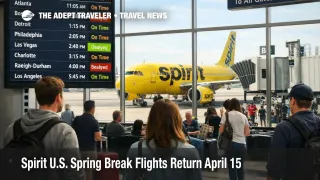
Spirit Airlines says it will restart 15 seasonal domestic routes in time for spring break demand, with service returning on April 15, 2026, and April 16, 2026. The changes bring back nonstop options on a set of short to mid haul city pairs that concentrate around major hubs and a few leisure markets. For travelers, the practical shift is simple, more nonstop seats on specific routes can lower fares, reduce connection dependence, and change the best airport and departure time to choose for late March and April trips.
Spirit's announced restarts span Hartsfield Jackson Atlanta International Airport (ATL) links to Chicago O Hare International Airport (ORD) and Philadelphia International Airport (PHL), Boston Logan International Airport (BOS) links to Baltimore Washington International Thurgood Marshall Airport (BWI) and Detroit Metropolitan Wayne County Airport (DTW), Charlotte Douglas International Airport (CLT) links to Philadelphia and Detroit, and Detroit links to Philadelphia, Raleigh Durham International Airport (RDU), Charlotte, Dallas Fort Worth International Airport (DFW), and Boston. Additional restarts include Harry Reid International Airport (LAS) to Chicago, Los Angeles International Airport (LAX) to Chicago, Miami International Airport (MIA) to Louis Armstrong New Orleans International Airport (MSY), and Myrtle Beach International Airport (MYR) links to Pittsburgh International Airport (PIT) and Arnold Palmer Regional Airport (LBE). Published schedules indicate a mix of daily and multiple times weekly service, including twice daily Los Angeles to Chicago, daily Las Vegas to Chicago, and multiple weekly flights on several Detroit spokes, which matters because lower frequency routes can become "no good same day backup" situations if a flight cancels.
In addition to the domestic seasonal restarts, Spirit also highlighted extra spring options from South Florida, framing it as a way for Fort Lauderdale and Miami travelers to get away as spring break crowds build. Spirit's network planning leadership has positioned the move as a seasonal capacity response rather than a long term network rewrite, which is typical of an ultra low cost carrier trying to match aircraft and crews to the highest demand weeks without carrying excess capacity into slower months.
Who Is Affected
Travelers who will feel this first are people planning spring break, long weekend, and early shoulder season trips that line up with April 15, 2026, onward departures. The relaunch is especially relevant for flyers in Atlanta, Georgia, Boston, Massachusetts, Charlotte, North Carolina, Chicago, Illinois, Detroit, Michigan, Dallas Fort Worth, Texas, Las Vegas, Nevada, and Los Angeles, California, because those airports anchor most of the restored city pairs and often set the fare "floor" competitors have to react to.
Leisure travelers heading to Myrtle Beach, South Carolina, and New Orleans, Louisiana, are also in the direct blast radius, because seasonal service tends to concentrate loads into fewer departures, and the difference between a daily flight and a few times weekly flight can determine whether a short trip is still viable if the outbound or return gets disrupted. Travelers on separate tickets, for example a Spirit domestic segment paired with a separate long haul ticket, face higher risk, because spring break crowding increases the cost of misconnects, and rebooking on peak dates can be expensive or impossible without adding a night.
The second order effects show up beyond the nonstop flight itself. When a carrier adds back nonstops into a hub like Chicago O Hare or Atlanta, it can alter connection flows, gate demand, and baggage throughput at peak times, which can increase irregular operations friction even if weather is fine. When Detroit gains several seasonal spokes, an aircraft that arrives late from one route can ripple into the next rotation, and crew duty limits can turn late arrivals into cancellations later in the day, which is why the operational "real" impact is often felt after the first delay, not at the first departure.
What Travelers Should Do
Travelers who already have spring trips priced should recheck fares now on the exact city pairs Spirit is restarting, because new nonstop capacity can create a short window where pricing drops, then rebounds as loads build. For spring break weekends, it is smart to add buffer on both ends, choose earlier departures where possible, and avoid stacking a late arrival with a prepaid transfer or a hard check in cutoff in small leisure markets.
Decision thresholds matter most on the lower frequency routes. If the restarted route is only a few times per week, and the trip is short, it is usually better to rebook proactively to a routing with more daily backup options once seats start tightening, rather than waiting for day of disruption and accepting whatever inventory is left. If a daily or twice daily option exists, waiting can be rational, but only if the itinerary is on one ticket and the traveler can tolerate a same day delay without losing the core purpose of the trip.
Over the next 24 to 72 hours after booking, travelers should monitor schedule changes, seat maps, and any carrier posted advisories, especially as airlines often fine tune seasonal restarts by minutes or hours to fit airport constraints and aircraft routings. Monitoring is also practical for baggage and connection planning, because a small retime can break a tight self connection, and spring break rebooking lines can be long when multiple carriers are trying to recover at once.
How It Works
Seasonal route restarts are one of the main levers low cost carriers use to chase demand peaks without committing year round capacity. Airlines plan aircraft and crew utilization months in advance, then layer seasonal flying into the schedule where it can produce high load factors, strong ancillary revenue, and predictable turn times. When those routes restart, the immediate benefit is more nonstop seats, but the system impact is that aircraft rotations become more complex, and a delay in one city can cascade through later legs as the same plane and crew work multiple segments in one day.
For travelers, that propagation looks like this, a restored route can reduce dependence on connections, but it can also concentrate demand into specific departure banks at large hubs and into limited inventory at smaller leisure airports. If spring break demand surges, hotels, rideshares, and rental cars can tighten, and late arrivals caused by airborne congestion or gate holds can push travelers into next day logistics, especially in places where airport late night staffing and ground transport options are thin.