

Telluride Ski Patrol Strike Ends, Lifts Reopen
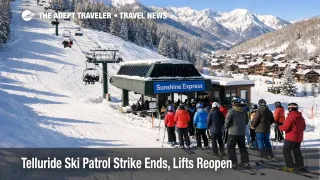
Telluride Ski Resort in Telluride, Colorado, is pushing forward with a phased return to full operations after the Telluride ski patrol strike ended with an agreement announced on January 8, 2026. The change matters most for travelers holding lift tickets, lessons, lodging, and ground transfers built around higher alpine terrain that had been inaccessible during the stoppage. The practical next step is to plan your ski days around what is open now, verify lift status shortly before you head out, and keep a flexible backup plan for at least one day in case terrain expansion pauses.
The resort and local tourism officials have been signaling a quick ramp up, aided by a recent storm cycle and colder weather windows that support snowmaking and safer lift operations. Sunshine Express (Lift 10) and Ute Park Express (Lift 11) are now operating, which expands beginner and intermediate access and helps distribute crowds away from the most constrained learning areas. Prospect Bowl terrain is also in play, with Prospect Express (Lift 12) and Gold Hill Express (Lift 14) listed as open on the resort's lift status reporting as of January 16, 2026.
Who Is Affected
Visitors arriving for long weekends and holiday makeup trips are the most exposed because their itineraries often assume specific lift pods and a fixed number of ski days. If a trip was booked around Prospect Bowl, Gold Hill, or advanced terrain that relies on Lift 12 and Lift 14 circulation, the difference between partial and full reopening can be the difference between an acceptable day and a wasted one.
Ski school families and beginner focused groups are also affected, just in a different way. When a resort reopens in stages, newly available intermediate runs can pull mixed ability groups back onto the mountain, which can reduce pressure on learning zones, but also increase crowding at a small number of lifts that become the only practical connectors. Travelers who prefer quieter slopes should expect the highest density on the newest openings for the first several days as guests chase terrain that was previously off limits.
Local lodging, restaurants, and transportation providers feel the second order effects even after the strike ends. When a mountain closes or runs on a reduced footprint, guests cancel, shorten stays, or shift to other resorts, then reverse those decisions quickly when operations resume. That rebound can tighten hotel availability, increase last minute minimum stay rules, and complicate shuttle schedules across a region that is already constrained by winter driving conditions.
What Travelers Should Do
Start with confirmation, not optimism. Check lift and terrain status on the resort's official reporting shortly before you leave lodging, and build your day around what is actually spinning, not what you hope opens next. If you are arriving the same day you plan to ski, add buffer for winter roads and for gear pickup so you do not lose the best operating window, which is usually the middle of the day when the mountain is fully staffed and conditions stabilize.
Use a clear threshold for when to rebook versus when to wait. If your trip's value depends on a specific pod, such as Prospect Bowl laps, and that pod is not open within 24 hours of your first planned ski day, it is usually smarter to shift dates rather than burn vacation time while terrain comes online unevenly. If you are flexible on terrain and simply want lift served skiing, waiting can make sense, but only if your lodging is refundable or you can accept a shorter ski day without turning the trip into a net loss.
For the next 24 to 72 hours, monitor three things: the resort's lift status updates, any operational messaging tied to staffing or safety holds, and the local weather pattern that determines whether snowmaking and avalanche mitigation can proceed on schedule. The Telluride ski patrol strike may be over, but the recovery phase still behaves like a disruption, meaning openings can be fast, then pause, then jump again, and your plan should assume that variability.
Background
Ski patrol staffing is not just a customer service layer, it is a core safety and operations function that affects what terrain can legally and practically open. Patrol teams support avalanche mitigation, accident response, boundary management, and coordination with lift operations, which is why a labor stoppage can force a resort into staged or minimal operations even when snow conditions are excellent. When a strike ends, a resort does not always flip instantly to full capacity, because mitigation work, route checks, and staffing schedules have to catch up, and that work can be gated by weather.
Those operational mechanics create predictable ripples through the travel system. First order effects hit the mountain itself, meaning fewer lifts, fewer trails, and more congestion on whatever is open. Second order effects hit lodging and transportation, because guests who were displaced by closures either extend stays to salvage ski days or rebook into later weeks, compressing availability in a small market. A third layer lands on dining, lessons, rentals, and off mountain activities, because demand returns sharply when terrain expands, and reservations that were easy to get during the stoppage can tighten quickly once visitors regain confidence in the product.
On the service side, Telluride's on mountain dining is also part of the traveler experience that tends to lag in a disruption. The resort's dining listings include venues such as Alpino Vino, Allred's Restaurant, and Bon Vivant, and recent resort updates have emphasized that food and beverage operations are functioning alongside lift expansion. For travelers, that matters because it changes how long you can comfortably stay on the mountain without returning to base, which affects crowding patterns and the timing of lift lines during a staged reopening.