

UK ETA Enforcement Feb 2026, Avoid Denied Boarding
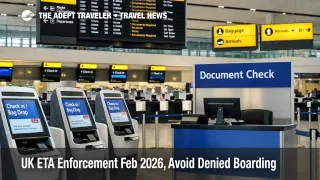
The United Kingdom will begin strict enforcement of Electronic Travel Authorisation requirements for eligible non visa nationals traveling to the UK from February 25, 2026. Most travelers who can visit the UK without a visa for short stays will need an approved ETA before they can legally travel. The practical consequence is simple and blunt, airlines, rail operators, and ferry carriers will check permission to travel before departure, and you can be denied boarding if your documents do not match the UK rules.
The UK ETA enforcement February 2026 shift matters because it moves the failure point from the UK border to the departure gate. During rollout, the UK allowed a softer adjustment period, but the Home Office has been explicit that this ends on February 25, 2026, and carriers will do the policing at check in.
Who Is Affected
If you are a visitor from a nationality that does not need a UK visit visa for short stays, you are in the group most likely to need an ETA. The Home Office says visitors from 85 nationalities will fall under the enforced requirement, and GOV.UK maintains the live eligibility list for who can apply.
The ETA is not a visa, and it does not guarantee entry, but it is required to travel. The official fee is £16, and the Home Office says it allows multiple journeys over two years, or until the passport used for the application expires, whichever is sooner.
Dual British or Irish citizens are a separate, higher risk category for airport surprises because you cannot solve the problem by buying an ETA. GOV.UK states that dual citizens with British or Irish citizenship cannot get an ETA, and must instead prove permission to travel with a valid UK passport, a valid Irish passport, or a foreign passport that contains a certificate of entitlement showing the right of abode. From February 25, 2026, GOV.UK warns you may not be able to board without one of those documents, and you could face extra identity checks before you can use UK passport control.
Transit is where travelers most often guess wrong. The Home Office factsheet says travelers who take connecting flights and go through UK passport control need an ETA, while some passengers transiting through London Heathrow Airport (LHR) and Manchester Airport (MAN) who do not go through passport control do not currently need an ETA. Separate Home Office guidance also describes the airside transit exemption as temporary, and makes clear that landside transit, meaning you pass UK border control, continues to require an ETA when you are otherwise eligible.
What Travelers Should Do
Treat this like a document matching exercise, not a checkbox you can fix at the airport. For each traveler, confirm which passport you will present at check in, confirm whether that passport is on the ETA eligible list, and if it is, submit the ETA application through the official channels, then keep your travel booking aligned to the same passport you used for the ETA.
Use a hard decision threshold for rebooking versus waiting. If you are inside 3 working days of departure without an ETA approval, or if you are a dual British or Irish citizen without the correct passport or certificate of entitlement in hand, assume you are in denied boarding territory and change the trip or route now, before airport queues and call center holds remove your options.
Over the next 24 to 72 hours before travel, monitor two things that actually move outcomes. First, watch for any carrier specific messaging in your booking or app about document checks, because the enforcement mechanism is carrier compliance. Second, recheck your transit plan against whether you will pass UK passport control, because that is the line between some exempt airside connections and an ETA required landside connection, and that exemption status can change.
How It Works
The UK is moving toward a permission to travel model where most visitors must hold a digital permission before boarding, either an ETA for visa exempt visitors, or an eVisa or other immigration status for residents and long stay categories. The Home Office position is that enforcement happens pre departure, with carriers checking status before travel, which shifts disruption from the arrival hall to the airline desk.
That system design is why the ripples travel far beyond UK border queues. First order effects show up at booking and check in, where a missing ETA or the wrong passport for dual citizens can stop travel entirely. Second order effects cascade into the rest of the itinerary, because a denied boarding decision can force reroutes through different hubs, break protected connections, and create unplanned overnight stays that hit hotel inventory and ground transport availability, especially when multiple flights in a departure bank are affected by the same rule change. A third layer often appears in nearby routing choices, where travelers try to shift entry paths through the Common Travel Area, including Ireland, but the Home Office still ties requirements to immigration rules and specific exemptions, so you should not assume a workaround without checking your exact residency and transit facts.
If you want a deeper, traveler oriented walkthrough of UK entry documents, including how ETA sits alongside visitor visas and right of abode proof, use UK Entry Requirements For Tourists In 2026.
Sources
- No permission, no travel: UK set to enforce ETA scheme
- Electronic Travel Authorisation (ETA) factsheet, November 2025
- Electronic travel authorisation (ETA): guide for dual citizens
- Check if you can get an electronic travel authorisation (ETA)
- Electronic Travel Authorisation Guidance
- Can a British citizen travel to the UK using a non-British passport?