

Adamuz Spain Train Crash Shuts Madrid Andalusia Rail
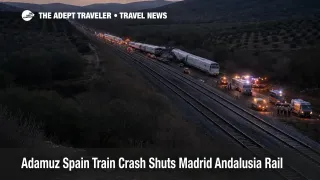
A high speed passenger train derailment near Adamuz, Spain, led to a collision with an oncoming train, leaving at least 39 people dead and more than 120 injured. Travelers moving between Madrid, Spain, and Andalusia, Spain, are the most affected because Adif suspended high speed services on major corridors that feed Cordoba, Seville, Malaga, Huelva, and other destinations. If you need to travel in the next one to three days, the practical move is to reroute by air, bus, or car, or to shift dates until rail service and capacity stabilize.
The core disruption is that Adif has suspended high speed rail between Madrid and multiple Andalusian cities for at least Monday, January 19, 2026, as investigators and recovery crews work at the site. Adif said a Malaga to Madrid service derailed at Adamuz and entered the adjacent track, where it affected an oncoming Madrid to Huelva service, which also derailed. Spain's transport minister, Óscar Puente, said the cause was not yet known and described the incident as unusual given the track condition and location, while officials cautioned that casualty and injury totals are still preliminary as rescue and identification work continues.
Who Is Affected
Passengers booked on high speed rail services between Madrid and Andalusia on Monday, January 19, 2026, are directly affected, especially itineraries that depend on through service via Cordoba and Seville to reach Malaga and the broader Costa del Sol, or westbound toward Huelva. Adif's suspension language also matters for travelers bound for Cadiz, Algeciras, and Granada, because those markets typically depend on the same trunk corridors and station flows even when the final leg is a different service pattern.
Travelers who built mixed mode itineraries are the next group at risk. Many visitors land in Madrid and plan to continue by rail to Seville or Malaga for short stays, then return north, and those plans can fail in two places, first at the point of departure when seats vanish on the limited alternatives, and second at the return leg when the rail system is still recovering and trains are retimed or consolidated. This is the same basic failure mode that shows up in other rail disruptions, where the immediate cancellation is only the first hit, and the real pain arrives when capacity tightens for the next day or two. For a recent example of how rail capacity shocks change traveler options quickly, see Eurostar Disruption London Paris Trains Late January.
Air travelers can also feel second order impacts, even though the event is a rail incident. When a major intercity rail corridor goes offline, some demand shifts to domestic flights, which can raise fares and reduce availability on the same day and next day, particularly on city pairs that usually compete with high speed rail. That shift can also create missed connections for travelers who planned rail as a reliable feeder into a long haul departure, and it can push more travelers into last minute hotel stays near stations and airports when the replacement plan breaks into multiple legs. The UK rail example is different geography, but it illustrates the mechanism, when a trunk line closes, airport access can become multi step and less predictable, as described in Brighton Main Line Closure Hits Gatwick Trains.
What Travelers Should Do
Start by reducing the chance of being stranded. If you are scheduled to travel between Madrid and Andalusia in the next 24 hours, treat rail as unavailable until your operator confirms your specific train is running, then price out a flight, a long distance bus, or a one way car rental as a true fallback, not a theoretical option. If you have a fixed event, consider arriving the day before and staying overnight near your destination, because recovery capacity can remain tight even after trains restart.
Use clear thresholds for rebooking versus waiting. If your trip is discretionary, or if you can shift by a day or two without major penalties, rebooking away from Monday, January 19, 2026, is usually the lower risk choice, because the system needs time to reposition equipment and crews and rebuild a stable timetable. If you must travel within 48 to 72 hours, prioritize itineraries with fewer moving parts, avoid separate tickets, and choose routings where a missed connection does not trigger a full overnight cascade.
Over the next 24 to 72 hours, monitor three signals that predict whether the rail network is tightening or recovering. First, Adif updates on corridor status and reopening timing. Second, your operator's specific train status and any published waiver terms for changes and refunds. Third, seat availability on the next two departures around your preferred time, because shrinking inventory is the fastest indicator that the system is absorbing stranded demand and that same day improvisation will be expensive.
Background
High speed rail disruptions propagate differently than a single train cancellation because the system is tightly scheduled and optimized for high utilization. The first order effect is obvious, a segment shuts down, trains are canceled, and stations fill with rebooking demand. The second order effects are where travelers lose time and money, because trains and crews that would normally cycle between Madrid and Andalusia are now out of position, and timetables that depend on those rotations can degrade for days even after the track is cleared.
This incident also creates a predictable cross system ripple. When high speed rail between Madrid and Andalusia is suspended, travelers shift to flights and long distance buses, compressing inventory and pushing more people into last minute hotel stays near Madrid Puerta de Atocha and key Andalusian stations. Road transfers can also become less predictable as more passengers try to hire cars on the same day, and as bus operators fill. For travelers, the practical takeaway is that the disruption is not only about whether the rail line reopens, it is also about whether capacity returns to normal levels quickly enough to support the volume of passengers who still need to move.
Sources
- Comunicado de prensa sobre el accidente ferroviario ocurrido en Adamuz - Adif
- Comunicado de prensa. Accidente de Adamuz (Córdoba)
- Spain's high-speed train crash: what happened? | Reuters
- Spanish train collision death toll rises to at least 39 | AP News
- Descarrilan dos trenes de alta velocidad en Adamuz, Córdoba, y se suspende la circulación entre Madrid y Andalucía | RTVE