

Barons Court London Trains Not Stopping, Cutty Sark Closed
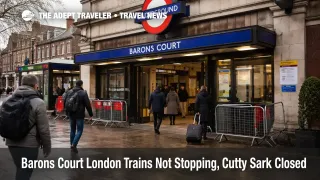
Barons Court station closures begin affecting day to day routing in West London because Transport for London says eastbound District and Piccadilly line trains will not stop at Barons Court from Monday, January 19, 2026, until mid June 2026. Travelers who were counting on Barons Court as a simple interchange, or as the closest Tube access for nearby hotels and venues, will now see trains pass through and will be pushed to walk or transfer elsewhere. The practical move is to plan alternates before you arrive and to avoid tight, single path plans, especially if your London day ends with a timed entry, a theatre curtain time, or an airport departure.
TfL's planned closures list also confirms a separate pinch point across the river, Cutty Sark DLR station remains closed until spring 2026, with TfL pointing customers to nearby Greenwich DLR station. That closure matters for Greenwich stays and day trips because Cutty Sark sits in the middle of the visitor footprint, so the default "DLR to Cutty Sark" plan is not available for now.
Who Is Affected
Visitors staying around Barons Court, West Kensington, Hammersmith, and Earl's Court are the most exposed because the closure changes the nearest, most convenient eastbound access into central London. Travelers arriving with luggage are disproportionately affected because the best substitute may require an extra walk, an extra set of stairs, or an extra transfer step that is easy to underestimate after a long flight.
Anyone using London Heathrow Airport (LHR) and assuming an "arrive on the Piccadilly line, switch at Barons Court, then continue" pattern should treat that plan as broken for the eastbound direction during this window. TfL's own station works guidance effectively shifts the interchange logic toward Hammersmith or Earl's Court, which changes both walking and platform transfer expectations.
Greenwich travelers are affected in a different way. The Cutty Sark closure does not reduce DLR service across the network, but it removes the closest DLR stop to the historic core, and forces either a longer walk from Greenwich station or a local bus or river connection depending on where you are heading. The Royal Borough of Greenwich has been explicit that visitors should use Greenwich station during the closure period.
What Travelers Should Do
For Barons Court, decide in advance which substitute you will use based on your exact start and end points. TfL's works guidance calls out West Kensington and Hammersmith as primary pivots, and it also explains how to finish an eastbound trip by alighting at West Kensington or Earl's Court and doubling back if you need to reach Barons Court itself. If you are arriving with luggage, test the route in TfL Journey Planner or TfL Go before you leave your hotel so you are not improvising in a corridor at rush hour.
Use a clear threshold for rebooking or rerouting versus waiting, especially on airport days. If your plan includes a hard cutoff, for example bag drop, a cruise check in window, or a timed tour, treat any unexpected "train did not stop" moment as a trigger to switch to the preselected alternate rather than waiting on the next train and hoping. For London Heathrow departures, build an additional buffer beyond your normal comfort level because the Barons Court change can add both walking time and transfer uncertainty on top of normal London variability.
For Greenwich, do not anchor your day on arriving at Cutty Sark by DLR. Route to Greenwich station instead, then plan the last mile by walking, bus, or river service, and add margin if you have a timed museum entry or a booked tour. Over the next 24 to 72 hours, monitor TfL status for any additional station access issues, and keep an eye on rail variability that can stack with local Tube constraints, including the rail access patterns covered in Brighton Main Line Closure Hits Gatwick Trains and cross Channel variability if your London itinerary includes Eurostar Disruption London Paris Trains Late January.
Background
The reason these changes feel bigger than the words "trains will not stop" is that London's transport network is built on predictable interchange habits. Barons Court is a common swap point between the District and Piccadilly lines, and when one direction cannot board or alight, passengers are forced to re distribute across nearby stations, which concentrates demand into a smaller set of platforms, corridors, and escalators. TfL's station works page also flags that some interchange walking routes can be closed during works, and that the practical detour can require street level exits and re entry, which is exactly the kind of detail that turns a "short transfer" into a missed slot if you did not plan for it.
Second order effects show up quickly in traveler behavior. When a favored station stop is unavailable, more people walk to the same substitutes, more people crowd the same interchanges, and more people default to taxis or rideshares at peak times, which can inflate trip times and costs. That ripple is strongest when the Tube plan is only one leg of a larger travel chain, for example a West London hotel to London Heathrow, or a central London day ending with a Greenwich dinner reservation. For Greenwich, the Cutty Sark closure is specifically tied to escalator replacement work, and local messaging has emphasized Greenwich station as the main alternative, which subtly shifts foot traffic patterns and can change how long it takes to reach the riverfront core at busy times.
If you are planning a first trip to the city and choosing neighborhoods based on "closest Tube stop" logic, it is worth validating the current state of your nearest station before you book, and building your plan around robust interchanges rather than a single, perfect stop. London Travel Guide: The Ultimate 7-10 Day Itinerary for First-Time Visitors is a useful baseline for neighborhood flow, then these station constraints help you pressure test the last mile.
Sources
- Planned line closures & service changes - Transport for London
- Stations, lifts, escalators, works & closures - Transport for London
- Cutty Sark (for Maritime Greenwich) DLR Station - Transport for London
- Temporary closure of Cutty Sark DLR station until spring 2026
- Closure of Cutty Sark DLR Station - Visit Greenwich