

Lufthansa Power Bank Ban on Flights Starts Jan 15
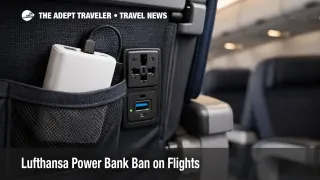
Lufthansa Group flights now prohibit passengers from using power banks in the cabin, and from charging them via onboard power. The change affects travelers who rely on portable chargers to keep phones, tablets, and laptops running on long sectors. Pack for a no power bank flight by starting with fully charged devices, planning for seat power outages, and building a fallback plan for boarding passes and authentication.
The Lufthansa power bank ban is a practical cabin behavior rule, not a full prohibition on carrying portable chargers, and it is designed to keep lithium battery packs accessible to crew and out of overhead bins where heat or smoke can go unnoticed.
The group's published guidance limits travelers to two power banks per person in carry on baggage, and requires them to be kept on the passenger, in the seat pocket, or under the seat, with charging and use prohibited during the flight except for approved medical device needs. The Lufthansa Group approach aligns with a wider industry shift toward "carry on only, within reach, and not in use" policies that reduce the odds of a thermal runaway event developing unseen.
For additional context on how these policies have been tightening across carriers, see Power bank airline rules tighten after battery fires and Australia Flights Ban In Flight Power Banks December 2025.
Who Is Affected
Travelers on Lufthansa Group passenger airlines are the most directly affected, particularly those connecting through major hubs where short misconnect windows leave little margin for gate level enforcement delays. Flyers who carry multiple small chargers for different devices, photographers traveling with higher capacity packs, and travelers with older power banks that do not clearly show watt hour ratings face the highest friction.
Long haul travelers feel the change most because portable chargers are commonly used to bridge broken or shared seat power ports. Overnight flights are another pressure point, because passengers often charge devices under blankets or inside bags, and the new rules are aimed at preventing hidden heat buildup while also ensuring a crew response is fast if something overheats.
This is not only a Lufthansa Group issue. Qantas prohibits use and charging of power banks on board and limits passengers to two units. Singapore Airlines bans usage and charging of power banks throughout the flight and also caps passengers at two pieces. Cathay Pacific bans using a power bank to charge devices and bans charging the power bank from in seat power. Emirates has also moved to a no use approach on board. In the United States, Southwest does not ban carrying portable chargers, but it requires any in flight use to be visible, not inside a bag or an overhead bin, which is another way to keep heat and smoke detectable early.
What Travelers Should Do
Before travel, check your specific carrier's battery policy and then pack like you expect zero power bank usage in the air. Bring no more than two clearly labeled power banks, protect the terminals from shorting, keep them undamaged, and place them where you can reach them without opening the overhead bin. Charge everything before boarding, and download offline copies of boarding passes, hotel details, and maps in case your phone battery drains faster than expected.
If your itinerary depends on device uptime, decide upfront when you will rebook versus wait. If you have a tight connection, a critical meeting on arrival, or you need your phone for two factor authentication, do not gamble on seat power working, and avoid planning that assumes a mid flight top up from a portable charger. In that situation, pick flights with longer connection buffers, and consider daytime routings that let you recharge in airports and lounges.
Over the next 24 to 72 hours before departure, monitor for last minute airline updates, because power bank rules are changing carrier by carrier, and enforcement details can tighten without much notice. Recheck your charger's watt hour rating, replace any swollen or damaged pack, and if your battery only shows mAh, calculate watt hours using the voltage listed on the device so you are not arguing with staff at the gate.
Background
Power banks are treated as spare lithium batteries, and aviation safety guidance has long focused on keeping spares out of checked baggage so a crew can respond quickly if something vents, smokes, or ignites. Industry guidance commonly allows power banks up to 100Wh in carry on baggage without approval, allows 100Wh to 160Wh only with airline approval, and prohibits anything above 160Wh for passengers. Airlines are now layering on cabin behavior rules, not just carriage rules, because a battery event in an overhead bin or inside a bag can grow before anyone sees it.
When a carrier bans in flight power bank use, the effects propagate beyond your seat. First order, more passengers shift to in seat USB and AC outlets, raising the stakes when ports fail and increasing cabin crew workload when people try to improvise. Second order, gate agents and cabin crew spend more time on announcements and spot checks, which can slow boarding and create small delays that ripple through banked connections, crew legality limits, and aircraft rotations later in the day. Third order, airports and lounges see higher competition for outlets, which changes how travelers stage before departure, especially on long haul itineraries where devices are essential for e visas, hotel access, ride hailing, and onward journey management.
Sources
- Power banks on board: updated regulations starting 15 January 2026, Lufthansa Group
- Electronic devices and batteries, Lufthansa
- SWISS introduces new rules for power banks on board, SWISS
- Spare batteries and power banks, Qantas
- Baggage Restrictions, Singapore Airlines
- Power bank usage is now restricted on Cathay Pacific flights, Cathay Pacific
- Safe Travel with Lithium Batteries, IATA
- PackSafe, Lithium Batteries, FAA
- Power Banks, TSA
- Traveling with Lithium Batteries, Chargers, E-Cigs & Lighters, Southwest