

Ryanair Charleroi Flight Cuts Begin April 2026
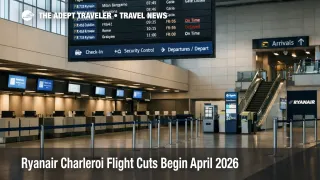
Ryanair says it will cut capacity at Brussels South Charleroi Airport (CRL) from April 2026, reducing flights and seats by about 10 percent. The airline says the change removes about 1.1 million seats from its current annual total of about 10.5 million seats at Charleroi. Ryanair links the reduction to a new €3 per passenger tax that it says takes effect from April 2026, and it has signaled that more reductions are possible if Belgian passenger taxes rise further in 2027.
The practical traveler takeaway is that Charleroi becomes a little less forgiving as a low fare gateway for Brussels and for onward rail trips across Belgium and Northern France. When an airport loses frequencies, travelers do not just lose choice, they lose recovery options during irregular operations, and that is when costs jump fastest.
Who Is Affected
Travelers departing from or connecting through Brussels South Charleroi Airport are most exposed, especially those who pick Charleroi because it is the cheapest way into Brussels, Wallonia, or nearby cities reached by rail. Ryanair is the dominant carrier at Charleroi, so even a 10 percent trim can be felt as thinner schedules on specific city pairs, fewer time of day choices, and fewer alternative flights on the same route when something goes wrong.
Price sensitive routes are usually the first place capacity changes show up as higher fares, because the lowest inventory buckets sell out sooner when there are fewer seats across the week. This also matters for travelers building self connections, for example flying into Charleroi and then taking rail onward, because a thinner flight schedule can turn a manageable delay into an overnight problem.
Secondary effects spill into Brussels Airport (BRU) and into nearby cross border options, because travelers who cannot find the timing or price they want at Charleroi often comparison shop other airports. Charleroi Airport has already warned that new aviation taxes can affect its finances and traffic outlook, which is another signal that schedule changes could remain a live issue as 2026 planning firms up.
What Travelers Should Do
If you plan to travel from April 2026 onward, start monitoring your exact route now, not just the airport. Look for frequency cuts that turn a daily route into a few days per week, because that is where flexibility disappears first. Once your dates are set, buy earlier than you would for a typical low cost trip, because fewer seats often means fewer cheap fare buckets left close in.
Use a clear threshold for switching airports: if your preferred Charleroi flight is no longer nonstop on your travel day, if total travel time grows enough to add an overnight, or if the fare gap to Brussels Airport narrows to the point where the train and time costs erase Charleroi's savings, then re price the entire trip via Brussels Airport. Brussels Airport has frequent rail links into Brussels stations, which can reduce the ground transport uncertainty that matters most when schedules tighten.
Over the next 24 to 72 hours, watch for three things: Ryanair schedule reloads for the 2026 summer timetable, any clarifications on how the €3 local tax will be applied in practice, and whether the broader Belgian passenger tax trajectory changes ahead of 2027. If you already hold a booking for April 2026 or later, set a calendar reminder to recheck your flight time and day of week a few times, because capacity cuts can come with retimes that break tight hotel, rail, or meeting plans.
Background
Ryanair says the Charleroi reduction is driven by a new €3 per passenger tax that it says takes effect from April 2026, and it has paired that message with warnings about broader Belgian passenger tax increases. Reuters reported Ryanair's plan as roughly a 10 percent reduction in flights from Charleroi starting in April 2026, with the airline describing the tax as the trigger.
For travelers, the disruption mechanics are straightforward. First order effects happen at the source: fewer scheduled departures at Charleroi means fewer departure waves, fewer same day alternates, and more pressure on the remaining flights during peak periods. Second order effects appear across at least two other layers of the travel system. Airline recovery gets harder because a thinner schedule reduces aircraft and crew recovery options on short notice, and that can amplify cancellations after weather, ATC constraints, or technical delays. Ground connections absorb spillover as more travelers shift to Brussels Airport or try cross border airports, increasing demand for rail seats, shuttle buses, and last minute hotels when late changes strand people overnight.
The airport access layer matters because many Charleroi travelers rely on the Brussels Midi shuttle bus, or on combined rail and bus itineraries via Charleroi Sud station. If more travelers begin comparing airports, those surface transport legs become a bigger part of the trip's risk profile, especially late at night or early morning when frequencies are lower.
Sources
- RYANAIR TO CUT BRUSSELS TRAFFIC BY 1M IN 2026 AND 1M IN 2027 AS CHARLEROI COUNCIL AND BELGIUM GOVT RAISE PAX TAXES
- Ryanair to cut Brussels Charleroi capacity due to passenger tax
- Charleroi Airport warns new aviation taxes could push it into loss-making territory in 2026
- Access & Parking
- By train and bus to Charleroi Airport
- Train to and from Brussels Airport