

Sargassum Blooms Cost Florida and Puerto Rico Beaches
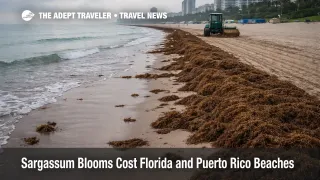
A new economic analysis from Woods Hole Oceanographic Institution and the University of Rhode Island puts a hard number on a problem many beach travelers already recognize, recurring sargassum landings are no longer a minor nuisance. The researchers estimate that sargassum inundation events are costing coastal destinations in Florida, Puerto Rico, and the U.S. Virgin Islands millions of dollars per year, and in the most disruptive years could approach $1 billion in combined losses. The findings elevate sargassum from a seasonal beach quality issue to a planning risk that can reshape where travelers book, how long they stay, and how much they spend.
The study focuses on impacts to three sectors that matter directly to travelers and coastal economies, tourism and recreation, plus commercial and recreational fishing. Researchers paired economic modeling with shoreline and satellite based indicators, then linked those measures to real world indicators such as hotel cancellations, visitor spending changes, and reduced fishing activity when coastlines and nearshore waters are affected. Their conclusion is blunt, the financial hit is already large, and it is likely to persist without better resourced monitoring and response.
Sargassum itself is not new, offshore mats provide habitat and can be ecologically valuable in the open ocean. The traveler problem begins when large volumes reach land, pile up on the wrack line, and start to decompose. Beyond the visual mess and the "brown tide" effect in the shallows, decomposition can create strong odors and release gases that aggravate eyes and airways, especially for sensitive travelers.
Who Is Affected
Beach travelers to Southeast Florida, Puerto Rico, and the U.S. Virgin Islands are the most exposed when seasonal conditions align, particularly during the months that typically see higher regional bloom activity, often spring through fall. The research ties the biggest economic vulnerability to places where beach access and water clarity are central to trip value, and where a bad week can quickly translate into cancellations, shorter stays, or travelers switching destinations.
Cruise passengers and resort guests can feel the effects even when their ship still calls and their hotel stays open. A sargassum heavy shoreline can compress usable beach time, alter tender and water sport plans, and shift demand toward pools, inland excursions, and paid attractions that were not in the original budget. For travelers building itineraries around snorkeling, shallow water swimming, and beachfront photography, sargassum can behave like a moving disruption, one beach looks passable while another, a short drive away, is not, and conditions can change in hours with wind shifts.
The second order effects ripple beyond the sand. When cleanup capacity is overwhelmed, local governments divert staff and equipment, and disposal logistics can strain roads near resort corridors. When fishing activity is reduced or access points are fouled, that can cascade into fewer fresh seafood options, disrupted charter operations, and changed excursion offerings. In hotel heavy markets, a sudden drop in beachfront satisfaction can also shift demand into last minute room changes, refunds, and rebooking pressure, which shows up as higher variability in nightly pricing and availability for travelers trying to salvage a trip midstream.
Travelers heading to the Mexican Caribbean often track the same offshore bloom system because it is part of the wider Great Atlantic Sargassum Belt that can feed landings across the Caribbean and into the Gulf. Recent Adept Traveler reporting on Late Season Sargassum Returns to Cancún Beaches and Quintana Roo moves toward first sargassum biogas plant is useful context for how quickly conditions can shift, and how destinations are investing in mitigation when beach reliability becomes an economic issue.
What Travelers Should Do
Start with booking and positioning choices that assume beach conditions can vary within the same destination. For trips planned between March and October, prioritize refundable lodging, pick properties with strong pool alternatives, and choose neighborhoods where you can easily shift to different beaches or inland activities if the shoreline is impacted. In the week before departure, check regional sargassum outlooks and local updates, then screenshot or save any hotel beach service notes, so you have a reference if conditions change after you arrive.
Use clear decision thresholds once you see local conditions, rather than waiting and hoping. If your trip value depends on swimming off the beach, shallow snorkeling, or long beach days, and multiple nearby beaches show heavy, decomposing accumulation for more than a day, it is usually rational to pivot to an inland plan, a different coastline, or a different island day trip, depending on where you are staying. If the seaweed is present but cleanup is active and the odor is limited, waiting 24 to 48 hours can be reasonable, because wind direction and tides can improve a shoreline quickly, and many destinations focus cleanup at first light to keep daytime access usable.
Monitor the next 24 to 72 hours for three specific signals. First, whether offshore winds are forecast to persist, which can reduce new landings. Second, whether local authorities or hotels report changes in cleanup tempo or disposal constraints, which often predicts how beaches will look later in the morning. Third, whether air quality and odor complaints are rising near thick piles, because decomposing sargassum can emit hydrogen sulfide and ammonia, and travelers with asthma or other respiratory sensitivity should treat that as a reason to avoid the most affected stretches.
Background
Sargassum surges that reach beaches in the Caribbean, Florida, and the Gulf are tied to a large offshore system often described as the Great Atlantic Sargassum Belt, a vast, recurring belt of floating seaweed that can stretch thousands of miles across the Atlantic and feed landings as currents and winds push mats westward. Satellite monitoring and regional forecast tools have improved in recent years, including NOAA and university led bulletins that translate offshore abundance into shoreline inundation risk. That matters for travelers because the best predictor of a bad beach day is often what is offshore now, plus what winds are likely to do next.
The new research matters because it connects that ocean process to measurable, repeatable economic outcomes. The analysis links sargassum inundation events to drops in tourism and recreation activity and to constraints on fishing, then layers in the direct costs of response and cleanup, which are often borne by local governments and private beachfront operators. Those first order impacts, degraded beaches and nearshore access, then propagate into second order travel system effects, weaker booking confidence, more last minute changes, and a higher premium on flexible trip components.
Health and environmental concerns amplify the traveler relevance. U.S. Environmental Protection Agency guidance notes that gases produced during decomposition, including hydrogen sulfide and ammonia, can cause mild to serious health effects for some individuals, and the agency also flags broader ecological harms when large mats smother habitats or alter nearshore conditions. Researchers continue to debate the relative role of warming, nutrients, and circulation changes in driving the scale and persistence of these blooms, but the practical travel takeaway is stable even amid that debate, sargassum seasons can be longer, and coastal disruption can arrive earlier than many travelers expect.
Sources
- New study quantifies sargassum's multi-million dollar hit to U.S. coastal economies
- Economic impacts of sargassum events in Puerto Rico, USVI, and coastal Florida
- New Study Calculates Sargassum's Multi-Million Dollar Hit to Coastal Economies
- Sargassum Inundation Events (SIEs): Impacts on Human Health
- Weekly Sargassum Inundation Risk (SIR v1.4)
- An invasion of smelly seaweed is costing US beach communities millions
- A Massive Seaweed Bloom in the Atlantic