

Solar Storm Australia New Zealand GPS Disruption Risk
A powerful geomagnetic storm triggered by a major solar flare on January 18 is producing severe space weather conditions over Australia and New Zealand. The event is among the strongest seen in decades and is strong enough to interfere with satellite operations, GPS navigation, and high frequency communications. While no widespread outages have been confirmed, authorities say system anomalies are possible as charged particles interact with Earth's magnetic field. Travelers using GPS dependent transport should prepare for potential knock on effects over the coming days.
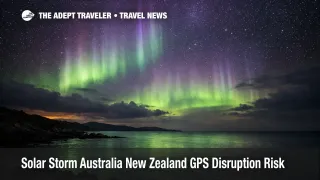
The storm is also generating unusually strong aurora australis displays, with southern lights reported visible across much wider areas of both countries than normal. The visual spectacle underscores the intensity of the geomagnetic disturbance affecting near Earth space.
Who Is Affected
Air travelers, ferry passengers, and tour customers across Australia and New Zealand are the most exposed groups, particularly where operations rely heavily on satellite navigation and timing. Aviation systems use GPS not only for navigation but also for precise timing that supports air traffic management and aircraft separation. Marine operators depend on satellite positioning for routing and port approaches, especially in coastal and remote regions.
Tour operators and ground transport providers using GPS based routing in rural or backcountry areas may also see brief positioning inaccuracies. While modern systems have redundancy, even small timing or accuracy degradations can ripple through tightly scheduled operations.
National agencies including Australian Bureau of Meteorology and MetService are monitoring conditions and publishing space weather updates. At this stage, they emphasize awareness rather than alarm.
What Travelers Should Do
Travelers with tight flight connections or time critical ferry transfers should add buffer where possible, especially on regional routes and services operating in remote areas. Allowing extra connection time reduces exposure if operators need to adjust schedules or routing.
If deciding whether to rebook or wait, the threshold should be reliance on precise timing. Separate ticket itineraries, small charter flights, and niche tours are more sensitive than large trunk routes with built in redundancy. If plans are flexible, waiting for updated guidance over the next 24 to 72 hours is reasonable.
Over the next several days, monitor advisories from national meteorological agencies and transport providers. Watch for notices from airlines, ferry operators, and tour companies regarding navigation or timing adjustments, even if operations remain largely normal.
Background
Geomagnetic storms occur when solar flares or coronal mass ejections send charged particles toward Earth. When these particles interact with the planet's magnetic field, they can disturb satellites, radio communications, and GPS signals. The first order effect is potential signal degradation or timing drift at the satellite and receiver level.
Second order impacts propagate through the travel system. Aviation and maritime operators may switch to backup procedures or increase separation margins, which can lengthen block times and reduce schedule precision. Those adjustments can cascade into missed connections, delayed vessel turnarounds, and tighter crew and asset rotations, even without any single dramatic failure. Ground transport and tours operating in remote regions may face navigation uncertainty that prompts slower travel or rerouting.