

Ecuador Protest Alerts, Road Blockages Risk
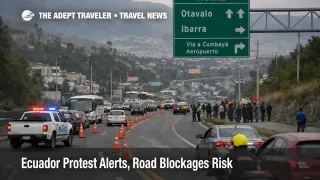
Demonstration related disruption risk is back on the operational radar in Ecuador after a U.S. Embassy demonstration alert warned travelers to avoid large gatherings, prepare for possible road blockages, and consider limiting interprovincial travel. The guidance matters most for visitors building itineraries around Quito, Ecuador, day trips north into Imbabura Province, and long overland transfers that depend on a small number of mountain corridors. Travelers should treat this as a readiness signal and plan for fast moving closures by building extra transfer time, staging closer to airports, and checking official road status before committing to same day connections.
The Ecuador protest alerts road blockages risk can turn a normal two to three hour road plan into an open ended wait, which is why the practical move is to shift from fixed timing assumptions to corridor based contingency planning.
Who Is Affected
Travelers moving between Quito and nearby highland destinations are the most exposed, because intermittent blockages often target the same strategic choke points that link the capital region to the north and to the coast. When closures concentrate north of Quito near Otavalo and Ibarra, typical day trip and multi stop tour loops can fail even if conditions look calm inside the city.
Air travelers are also affected when surface access becomes unreliable. On first mention, Mariscal Sucre International Airport (UIO) is the main gateway for Quito area arrivals and departures, and Jose Joaquin de Olmedo International Airport (GYE) is the primary gateway for Guayaquil. Even if flights operate normally, unpredictable road conditions can shift the real risk to curbside arrival timing, missed bag drop cutoffs, and missed domestic onward flights that do not have generous reaccommodation.
Organized tours, private drivers, and intercity bus travelers take a second hit because vehicles and crews can be stranded on the wrong side of a closure. That propagates into delayed tour starts, canceled pick ups, and forced hotel extensions in Quito or Guayaquil when travelers cannot move onward as planned.
What Travelers Should Do
Act now on the parts you can control. If your itinerary includes long road segments or same day airport connections, build a buffer that survives a sudden closure, and consider repositioning to stay closer to the airport the night before departure rather than relying on an early morning drive. Before any interprovincial departure, check official road status, and confirm your driver or operator has at least one viable alternate corridor in mind, not just an alternate departure time.
Use a clear decision threshold for rebooking versus waiting. If the route you need is shown as closed on the official road status feed, or if your operator cannot give a credible alternate routing, waiting on the shoulder is usually a losing bet for anything tied to a flight, a timed entry, or a tour that cannot hold the group. In that case, switch to a plan that reduces dependence on the blocked corridor, for example, move your overnight location, shift the tour start, or rebook flights to later in the day when you can verify access conditions closer to departure.
Monitor the right signals over the next 24 to 72 hours. Watch for updated embassy messages, and use official road closure and traffic channels before you commit to leaving the city. In Quito, the municipal traffic authority also publishes real time mobility information, which can help you avoid routing straight into a controlled area when demonstrations concentrate near government districts or major arterials.
Background
Ecuador's disruption pattern during protest cycles is often less about broad national shutdowns and more about targeted movement constraints that exploit geography. The highlands concentrate long distance traffic onto a limited set of corridors, so even a small number of blockages can sever access between Quito and key day trip destinations, and can also reduce the reliability of airport transfers that depend on predictable travel times.
That first order road impact then cascades through the travel system. When vehicles cannot reposition, scheduled tours miss start times, hotel check in and check out plans break, and airline connections become fragile because travelers arrive late to the airport even when flights are on time. When travelers are forced to pause in Quito or reroute through Guayaquil, nearby lodging demand can tighten quickly, which raises last minute room prices and reduces choice in well located properties. Monitoring matters because conditions can shift quickly, and the difference between a smooth day and a forced overnight is often whether you checked road status right before departure.
Sources
- Alerts Archives, U.S. Embassy and Consulate in Ecuador
- Demonstration Alert for U.S. Citizens, U.S. Embassy and Consulate in Ecuador
- Ecuador International Travel Information, U.S. Department of State
- Revise aquí las vías del país que presentan novedades, ECU 911
- Información y movilidad en tiempo real, AMT Quito