

France ATC Delays Raise CDG, Orly Connection Risk
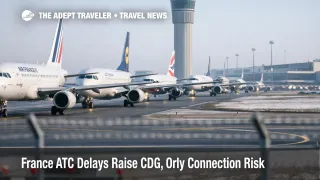
Air traffic control capacity pressure over France is keeping delay risk elevated for travelers connecting through Paris Charles de Gaulle Airport (CDG) and Paris Orly Airport (ORY). The travelers most affected are anyone booked on peak bank departures, or on tight same terminal, or cross terminal connections where a single ATC slot can erase the schedule cushion. The practical move is to bias toward earlier departures, add connection time, and set a decision point for when to rebook versus ride out a delay.
France air traffic control delays matter because flow management measures reduce the number of movements the system can safely accept in a given hour, so queues form quickly when demand peaks.
EUROCONTROL's Network Operations Report for December 2025 shows Paris Charles de Gaulle among Europe's busiest airports, and it also flags that Paris Orly saw double digit traffic growth versus December 2024, a combination that tightens recovery margins when the network is capacity constrained. At the European level, the structural driver is not weather alone. Industry analyses and EUROCONTROL performance reporting point to staffing and capacity constraints as a major source of delay minutes, which is why the risk shows up repeatedly across seasons rather than only on disruption days.
Who Is Affected
You are most exposed if your itinerary relies on minimum connection times at CDG, especially when you must change terminals, clear an additional document check, or switch carriers with separate ticketing. You are also exposed if you are departing Paris during the morning departure bank or the late afternoon, early evening wave, when demand concentrates and there is less slack for ATC metering to absorb.
Short haul flights that feed Paris hubs, and then connect onward to Spain, Italy, the UK, and Ireland, are the most likely to feel the compounding effects, because they sit inside the densest rotation chains. When an inbound arrival to Paris is metered, the same aircraft often departs again within a narrow turnaround window, and that lateness can propagate to the next country pair even if local conditions there are fine. That is how a France centered capacity squeeze becomes a multi country delay story without a headline disruption.
If you are combining air and rail in the same day, treat airport to station transfers as part of the same risk envelope. Capacity limits can shift your arrival time enough to miss a reserved Eurostar, or a timed regional connection, which forces expensive same day changes when inventory is already tight.
What Travelers Should Do
Start with buffers that actually change outcomes. For same day connections through CDG, prioritize longer legal connection times than the bare minimum, and prefer itineraries that keep you inside one terminal complex when possible. If you are building a Paris stopover, or you need ground transfer guidance between the airports and the city, use Paris Travel Guide: The Ultimate 7-10 Day First-Timer's Itinerary to sanity check airport, RER, and taxi timing before you lock in fixed reservations.
Decide in advance when you will rebook versus wait. A simple threshold is whether your projected delay still preserves at least one later same day onward option that you would accept, and whether your airline has published a waiver that lets you move preemptively. If your onward flight is the last departure you can use that day, or your trip depends on a cruise embarkation, a wedding, or a protected rail reservation, you should treat moderate delays as a trigger to move earlier rather than hoping the system recovers late.
Over the next 24 to 72 hours, monitor for patterns, not single events. Look for repeated ATC slot delays on the same city pairs, and watch whether your carrier is quietly padding block times, swapping to larger aircraft, or consolidating frequencies, all of which are tells that reliability is under pressure. If France is your connecting spine, keep an eye on network wide constraints that combine with ATC capacity, such as winter weather, or cross border congestion, because that is when delay minutes stack fastest.
Background
The European network is managed like a single interconnected system, even though each country runs its own air navigation services. When traffic demand exceeds what can be safely handled, EUROCONTROL's Network Manager meters flows using ATFM regulations, which can assign departure slots and cap arrival rates to prevent overload. EUROCONTROL's December 2025 network report shows the scale of demand at Paris Charles de Gaulle, and it also documents how ATFM delay minutes accumulate across the network even in winter, a sign that the system is often operating close to its capacity edge.
Staffing is a key reason this persists. EUROCONTROL's Summer 2025 performance briefing notes that the highest levels of ATC staffing delays were recorded at French and Greek ACCs, which aligns with the broader industry view that staffing and capacity shortfalls are now dominant contributors to delay minutes over time. France's own DSNA annual reporting also describes the need for a capacity increase plan through modernization and operational changes, which is consistent with a multi year pressure narrative rather than a transient issue.
For travelers, the propagation mechanism is predictable. First order effects show up as longer taxi out times, delayed departures, and misconnected itineraries at the source hubs, especially during peak waves. Second order effects show up when late aircraft and crews miss their next rotations, which pushes delays into downstream airports in Spain, Italy, and the UK, and it can also stress airline rebooking channels because later flights are already heavily sold in winter schedules. In that environment, a conservative connection and earlier departure strategy is not just comfort, it is a reliability hedge.
Sources
- Network Operations Report, December 2025, EUROCONTROL
- Network Operations Report, December 2025, EUROCONTROL publication page
- Air Traffic Control Delays in Europe, IATA
- Special Flash Briefing, Overview of the performance of the European aviation network in Summer 2025, EUROCONTROL
- DSNA Annual Report 2024, French Ministry for Ecological Transition
- France Air Traffic Control Strike Update: Travel Impact, The Adept Traveler
- Eurostar cancellations, Eurocontrol caps squeeze travel, The Adept Traveler