

Nairobi Airport Security Delays After System Outages
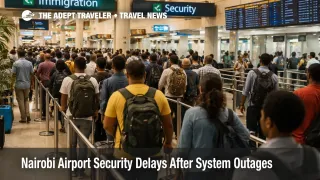
Intermittent processing slowdowns at Jomo Kenyatta International Airport in Nairobi, Kenya can translate into long queues at immigration and security, especially when passenger processing systems degrade or staffing is stretched at key checkpoints. For travelers, the operational problem is not only the wait itself, it is the knock on effect on tight connection plans, including onward regional flights and time boxed safari departures that do not flex easily once a day's rotations start moving.
The Nairobi airport security delays matter most when you are arriving on a long haul flight and trying to connect onward the same day, or when you are departing Nairobi with a short buffer before check in closes. The practical takeaway is to add landside time buffers and treat same day onward plans as conditional until you have cleared immigration and security and you know your real time position in the queue.
Who Is Affected
Travelers connecting through Jomo Kenyatta International Airport (NBO) are most exposed, particularly those on separate tickets and those with a same day handoff to safari operators. If you must transfer between airports in Nairobi, for example from JKIA to Wilson Airport for charter style departures, any additional dwell time at immigration or security can compress ground transfer margins and push you into a missed cutoff scenario.
Visitors arriving during peak arrival and departure waves tend to see the biggest queue risk because demand piles into the same processing lanes at once. Business travelers can be affected too, especially when a late arrival triggers missed morning meetings, or when a departure bank is congested and security queues become the binding constraint rather than traffic on the way to the terminal.
This is also a risk story for tour operators and lodges because delays at the gateway propagate into missed aircraft rotations and forced replans. When small aircraft schedules slip, the recovery options are often limited to the next day, which can add an unplanned hotel night near the airport and may require itinerary reshuffling.
What Travelers Should Do
If you have a same day onward connection, build buffers in two places, extra time to clear immigration and security at JKIA, and extra time for any ground transfer to your next departure point. Put your safari operator or driver on notice before you land so they can adjust pickup timing, and ask for the latest cutoff times that matter for your onward flight or lodge transfer.
Use a simple decision threshold. If your plan relies on a short connection window or a separate ticket onward flight, rebook to a later departure, or shift the connection to the next day if you cannot tolerate an overnight risk. If you are on a single protected itinerary and the onward flight is on the same ticket, it is often reasonable to wait and let the airline handle rebooking, but only if you have enough buffer that a missed connection does not cascade into lost nonrefundable safari components.
Over the next 24 to 72 hours, monitor three signals: airline service alerts for your specific flight, airport or government updates when published, and your operator's ground truth on queue conditions and charter cutoffs. If you see repeated reports of delays or disruptions, treat it as a day to travel with extra slack, carry essentials in hand luggage, and plan your first night near Nairobi as a flexible pivot point rather than a hard commitment deep in the bush.
How It Works
At a major hub like JKIA, immigration and security are throughput systems with hard chokepoints. When a processing system slows, a workstation goes offline, or staffing is constrained, the queue grows nonlinearly because arrivals continue while service rate drops. Once lines build, recovery can be slow even after systems return because passengers arrive in waves tied to flight banks, and backlog must clear before conditions normalize.
The first order effect is longer landside dwell time and increased stress on connection windows. The second order effects spread outward, missed domestic connections reduce seat availability on later flights, crews and aircraft rotations can be displaced, and tour operators may need to reshuffle lodge sequencing. That cascade then hits hotels, because forced overnights near the airport tighten last minute inventory, and it hits ground transport, because driver schedules and road transfer plans are built around predictable arrival times.
Separately, officials and media have pointed to infrastructure challenges and service disruption history at JKIA, which is why conservative connection planning is rational even when you do not have a confirmed outage notice for your exact travel day.