

Southern Cone Heatwave Raises Repeat Travel Disruption Risk
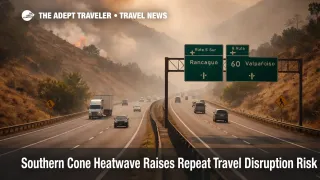
Extreme heat conditions across parts of the Southern Cone are no longer a short lived weather event but an ongoing operational risk for travelers. Sustained high temperatures, combined with dry fuels and periodic strong winds, are amplifying wildfire behavior in central and southern Chile and parts of western Argentina. These conditions are creating repeated, short notice disruptions to road networks, aviation operations, and local services rather than a single contained impact window.
For travelers, the shift that matters is persistence. Instead of assuming a one day delay followed by recovery, current conditions support a pattern of rolling closures, smoke related visibility reductions, and service interruptions that can recur over several days or weeks. This raises the odds that an itinerary disrupted once may face additional disruptions later in the same trip.
The Southern Cone heatwave travel disruptions now function as a system wide stressor rather than an isolated hazard, affecting how reliably people and equipment can move across borders and between cities.
Who Is Affected
Travelers moving through Chile and Argentina, particularly those relying on long road transfers or regional flights, are the most exposed. This includes self drive travelers, bus passengers, and those connecting through secondary airports near wildfire zones. International visitors on multi country itineraries that assume normal intercity mobility are also at higher risk, especially when plans depend on same day ground transfers to catch onward flights.
Airlines, airports, and ground transport providers are operating under constraints that limit their ability to recover quickly. When smoke reduces visibility or heat stresses infrastructure, even brief suspensions can ripple outward, delaying inbound aircraft, displacing crews, and reducing spare capacity for rebooking. Travelers transiting through affected hubs may experience knock on delays even if their final destination is not directly threatened by fires.
Local communities are also affected, and when evacuations occur, competition for lodging can increase suddenly. This dynamic matters for travelers who expect to extend a stay after a disruption, only to find limited availability or rising rates.
What Travelers Should Do
In the immediate term, travelers should treat extreme heat and wildfire conditions as a continuing risk rather than a resolved event. If your itinerary includes long drives or mountain corridors, monitor local road authority updates daily and be prepared for last minute reroutes or overnight holds. Carry water, fuel buffers, and offline maps if driving, because closures can occur faster than digital systems update.
Decision thresholds matter. If smoke is already affecting visibility near your departure airport or along a critical road segment, rerouting or delaying by a day may reduce overall risk compared with attempting to push through. When flights are involved, prioritize itineraries with fewer segments and avoid separate tickets that leave you exposed to missed connections without protection.
Over the next 24 to 72 hours, watch forecasts for wind shifts and heat spikes, not just fire perimeter maps. Wind increases can rapidly change fire behavior and smoke dispersion, triggering new closures even when conditions appeared stable. Travelers with flexible plans should be ready to hold position temporarily rather than leapfrogging between disrupted nodes.
Background
Extreme heat acts as a multiplier in the travel system. At the source, high temperatures dry vegetation and increase wildfire intensity, while winds spread smoke across wide areas. Roads close first, either because of direct fire threat or because visibility and safety thresholds are breached. This immediately affects buses, rental cars, and private vehicles.
Second order effects move into aviation. Smoke can reduce runway visibility below operational minimums, force aircraft to divert, or delay departures while crews wait for conditions to improve. Those delays then propagate into aircraft rotations and crew duty limits, increasing the chance that later flights cancel even after conditions partially improve.
A third layer hits lodging and local services. When travelers cannot move onward and residents are displaced, hotel inventory tightens, prices rise, and availability becomes unpredictable. This feedback loop can turn a weather driven delay into a multi day logistical problem for visitors who planned tight schedules across the Southern Cone.