

American Airlines App Update Adds Delay Rebooking Tools
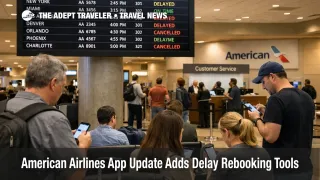
American Airlines has updated its mobile app and aa.com disruption experience so customers can make faster decisions when a flight is delayed or canceled. The changes target passengers who would otherwise need to stand in airport customer service lines, call support, or hunt across multiple pages for vouchers and rebooking options. The practical move is to enable app notifications, keep an eye on the new disruption banner for your trip, and rebook early if your connection, lodging, or onward plans cannot absorb a long slip.
The American Airlines app disruption tools change the recovery process by putting rebooking, bag tracking, and eligible vouchers into one guided workflow tied to your reservation.
American's January 20, 2026 rollout centers on a dedicated disruption view that appears as soon as a problem hits a trip. Instead of only showing a delay code or a generic notice, the app is designed to present what is happening and what actions are available, including self service rebooking when eligible, guidance on next steps, or a confirmation that the airline is already working on alternatives. American also says the same experience is available on aa.com, which matters for travelers whose phone battery, connectivity, or device access becomes the limiting factor at the airport.
A second part of the update is support consolidation. Travelers can track checked bags during disrupted itineraries, and eligible customers can pull digital hotel, meal, and transportation vouchers directly in the app or on aa.com when American offers them. Ground transport links to Uber and Lyft are integrated so travelers can move onward without leaving the disruption flow, which is useful when a late arrival turns into an unplanned overnight, or when rerouting forces a different airport.
American says more expansion is planned later in 2026, including self service standby options, more flexible rebooking choices, and enhanced hotel, meal, and transportation support. Those promises matter, but the immediate traveler value is simpler, fewer steps between learning about a disruption and locking in a workable Plan B.
Who Is Affected
Any traveler flying American is in scope, but the benefits skew toward three groups. First are connection heavy itineraries where a single delay can collapse an entire day, especially when the next flight is near full and seats disappear quickly. Second are families, groups, and travelers with accessibility needs who are disproportionately harmed by standing in long lines for paper vouchers, hotel instructions, and rebooking help. Third are business travelers and frequent flyers who are already comfortable making rapid tradeoffs, such as swapping to a later nonstop, accepting a longer layover, or choosing an alternate airport to protect a meeting, a cruise embarkation, or a tour departure.
The update also affects travelers indirectly, even if they never open the app. When more passengers can self serve, airport customer service desks, phone queues, and gate agent workloads can ease slightly, which can improve outcomes for the people who truly need human help, such as those with complex itineraries, partner airline tickets, irregular baggage cases, or special service requests. That is the intended system effect, fewer bodies concentrated in one bottleneck.
There is also a reliability caveat. Digital first recovery only helps if the app, identity systems, and rebooking engines hold up during peak demand, such as major winter storms or hub wide air traffic constraints. When those systems slow or fail, the same crowd dynamics reappear, and the traveler advantage shifts back to whoever can reach a human agent first.
What Travelers Should Do
When a disruption hits, act early and pick your priority, time, cost, or certainty. If the app offers a guided rebooking flow, compare options quickly, and select a flight that preserves your most brittle constraint, such as a last nonstop, a cruise departure, or a prepaid tour start. If you are traveling with checked bags, confirm you can see baggage status after any change, and keep baggage claim tags accessible in case you need agent help.
Use a simple decision threshold for whether to rebook or wait. If your delay erases the buffer you built for a connection, or if the remaining options are trending toward overnight travel, rebook as soon as you see seats that work, because inventory and hotel availability typically deteriorate as more flights fall behind. If you can still make your connection with a comfortable margin, and later flights are plentiful, waiting can be rational, especially if the issue is likely to clear quickly.
Over the next 24 to 72 hours, monitor whether the disruption is localized or network wide. A single delayed aircraft can be fixed by swapping planes, but system stress can trigger rolling misconnects, crew duty time problems, and late day cancellations that wipe out recovery capacity. For a broader view of conditions that drive those cascades, travelers can compare daily pressure signals in Flight Delays and Airport Impacts: January 20, 2026, and the way airline technology issues can propagate through schedules is illustrated in American Airlines tech glitch triggers nationwide delays.
How It Works
Airline disruptions spread through the travel system in layers, and the app update is aimed at the handoff points where travelers lose the most time. The first order problem is a delay or cancellation that breaks the original itinerary, which immediately creates demand for seats on later flights, plus demand for hotel rooms, meal coverage, and ground transport when an overnight becomes unavoidable. If those decisions are slow, airport queues swell, gate areas get crowded, and agents spend more time repeating the same instructions, which reduces overall recovery speed.
The second order ripple is operational. When passengers miss connections, bags miss connections, too, and aircraft rotations fall out of sync. As the day goes on, crews can run out of duty time, and a late inbound can become a canceled outbound, which increases the number of stranded travelers competing for the same limited alternatives. Centralizing rebooking, vouchers, and bag visibility into one workflow is intended to reduce friction at exactly those moments, so more travelers can lock in a viable reroute before the network runs out of slack.
The practical implication is not that disruptions will be rarer, but that the cost of a disruption, measured in time lost and uncertainty, can be lower for travelers who move quickly and who understand their thresholds. The app improvements are a tool, not a guarantee, and their real test will be performance under heavy load.
Sources
- Turning disruptions into decisions: American Airlines empowers customers with new app enhancements
- American Airlines beefs up its mobile app with new rebooking, bag-tracking tech
- American Airlines Closes Tech Gap With New In-App Flight Disruption Tools
- American Airlines Rolls Out App Upgrades Focused on Rebooking
- American Expands Mobile App With Rebooking Options