

Bangkok PM2.5 Forecast Worsens Jan 22 to 28
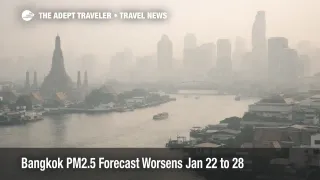
Air quality authorities in Thailand are signaling another near term buildup of fine particle pollution across much of the country, and Bangkok is on the sharper end of the curve. The current 7 day outlook flags the January 22 to 28 window as a period when PM2.5 can accumulate again, with Bangkok and surrounding areas specifically trending worse from January 24 to 28. For visitors, that forward time box matters more than the general haze narrative because it changes how to schedule outdoor landmarks, how to choose lodging, and how much buffer to add around airport days.
The practical takeaway is that Bangkok travel plans should treat outdoor exposure as a constrained resource for several days, not as an unlimited default. Recent readings and official messaging show Bangkok PM2.5 can move into levels that trigger mask guidance and reduced outdoor activity, and the government education system has issued guidance that contemplates temporary closures or shifts to online learning when conditions spike.
Who Is Affected
Travelers with asthma, COPD, cardiovascular disease, pregnancy, or who are traveling with young children face the tightest decision margins because PM2.5 exposure can become a health limiter rather than a comfort issue. Visitors planning temple circuits, floating markets, long walking itineraries, riverfront days, rooftop views, and cycling tours are also directly exposed because these plans concentrate time outdoors and often include higher breathing rates from heat and stairs.
Business travelers are not immune. The disruption moves indoors through meeting commutes, street level transfers, and the cumulative effect of multiple short outdoor exposures each day. Travelers staying in older buildings, or in properties without strong filtration and well sealed windows, take on higher night time exposure, which can turn a multi day stay into a compounding fatigue and irritation problem.
The travel system ripple is predictable. When haze builds, travelers shift demand toward indoor malls, museums, and enclosed attractions, which increases crowding and raises the odds of last minute tour changes. Operators running outdoor activities must adjust timing, shorten routes, or cancel, which creates churn in reservations and transport planning. On airport days, road transfer timing becomes less reliable because persistent haze often coincides with stagnant conditions, heavier traffic, and a higher share of travelers changing plans at once, which increases pickup demand and wait times.
What Travelers Should Do
Immediate actions should focus on reducing exposure without losing the trip. Travelers should monitor conditions each morning and midday using Bangkok Metropolitan Administration monitoring and Thailand's Air4Thai ecosystem, then schedule outdoor anchor sights for the cleanest part of the day. A tight, well fitting particulate respirator suitable for PM2.5 can be a meaningful control during transfers and short outdoor blocks, and lodging choices should favor rooms that can stay closed and comfortable with effective filtration.
Rebooking versus waiting is about persistence and category, not a single bad hour. If Bangkok conditions move into sustained unhealthy levels for sensitive groups, or worse, and the forecast continues to show accumulation through January 28, then sensitive travelers should treat that as a decision threshold to shorten the stay, reorder the itinerary toward lower exposure destinations, or shift the Bangkok segment to later dates. If conditions remain moderate or fluctuate around the threshold, most travelers can hold the trip by compressing outdoor time into shorter sessions, prioritizing indoor alternates, and keeping a mask option for commutes and queues.
Over the next 24 to 72 hours, travelers should watch the forecast trend line and ventilation drivers. The Thai Meteorological Department is explicitly flagging weak convection and weak wind as a setup for higher dust concern in Upper Thailand during January 25 to 27, which aligns with the Bangkok window where accumulation is expected. If morning conditions deteriorate across multiple days, travelers should assume the afternoon will not reliably improve, and should move major outdoor commitments earlier, add transport buffers, and keep cancellation flexibility for outdoor tours.
On flight days, travelers should build extra margin for transfers to Suvarnabhumi Airport (BKK) and Don Mueang International Airport (DMK). PM2.5 haze is primarily a health constraint, but it can also coincide with lower visibility and operational conservatism, and it reliably increases ground side timing uncertainty when many travelers adjust plans at once. The simplest risk control is to treat airport transfers as a timed appointment, leave earlier than usual, and avoid stacking multiple fixed time commitments on the same day.
Background
Bangkok's PM2.5 episodes are a mix of emissions and meteorology. The pollutant itself is fine particulate matter small enough to penetrate deep into the lungs, and Bangkok authorities and national systems track it using both micrograms per cubic meter and color based public health categories. Bangkok Metropolitan Administration monitoring references a 24 hour PM2.5 standard of 37.5 µg/m³, and recent reporting shows citywide averages can move above that line during winter episodes.
The reason the forecast matters is that PM2.5 behavior is nonlinear. When wind is weak and convection is limited, pollutants do not disperse efficiently, so a normal day of traffic and regional sources can translate into a sharper accumulation curve. That is why the same city can swing from tolerable to problematic in a short period, and why the forecast window, not just the current reading, should drive itinerary design. The Thai Meteorological Department's current seven day messaging explicitly links weak atmospheric mixing to higher dust concern, which is consistent with a multi day buildup pattern rather than a single spike.
The disruption then propagates through travel layers. At the source layer, travelers reduce outdoor tolerance, shorten walking days, and shift to private vehicles more often, which increases congestion and ride hail demand. At the connections layer, tour operators face route constraints, and timed entry plans become brittle because travelers avoid long queues outdoors and compress activities into fewer hours. At the lodging layer, filtration and building tightness become a differentiator, and travelers are more likely to extend stays in a single property to avoid repeated exposure from moving around, which can tighten availability during a concentrated episode. These are not abstract effects, they are the operational reason Bangkok haze can create itinerary churn even when flights are running normally.
Sources
- PM2.5 over safe limits in many areas; Central-West worst
- เตือนทั่วไทย 'ฝุ่น PM2.5' พุ่งสูง ปภ. เร่งประสานจังหวัดยกระดับคุมเข้ม 'งดเผา'
- Weather Forecast 7 days
- Bangkok Air Quality
- Self-care guide from PM 2.5 dust
- OBEC issues urgent PM2.5 order; schools can close or go online
- Bangkok PM2.5 update: Pathum Wan records the city's highest level