

Delhi Airspace Closure, Delhi Airport Midday Delays
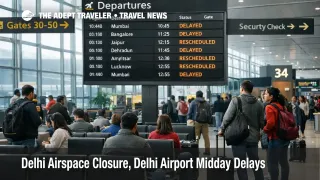
Airspace restrictions over Delhi are set to disrupt flight operations around midday on multiple days as Republic Day flypast rehearsals and security arrangements temporarily limit commercial movements. Travelers using Indira Gandhi International Airport (DEL) are the core group affected, especially anyone booked near late morning departures, early afternoon arrivals, or tight same day connections. The practical move is to retime flights away from the closure window when possible, then add buffer for transfers and connections if you must travel on the affected days.
The reported daily restriction window is roughly 1020 a.m. to 1245 p.m. IST from January 21, 2026, through January 26, 2026, and multiple outlets are citing aviation notices indicating that hundreds of flights could be delayed, rescheduled, or canceled as airlines work around the pause. Estimates cited by aviation reporting put the total number of impacted flights at more than 600 across the restriction period, with the largest effects showing up when the suspension overlaps one of the airport's heavier movement waves.
Several reports also flag that timings can vary by day because more than one notice may be in effect, and that Republic Day itself can carry additional or longer suspension windows beyond the standard midday pause. For travelers, that matters because a longer stoppage changes the math from "expect a delay" to "expect a broken rotation," which is where cancellations and missed onward banks become more common.
Who Is Affected
Travelers booked to depart or arrive close to the late morning and early afternoon window are most exposed because even modest holding, ground stops, or late gate pushes can spill across a tightly scheduled bank. This is especially risky for itineraries that connect in Delhi from domestic routes into long haul international departures, or for same day domestic connections that depend on a short turn at Delhi.
Short haul and regional flights can take the first hit when airlines need to protect aircraft rotations, and some routes may see repeated cancellations if the aircraft cannot be positioned legally around the restricted time. Reporting from Uttarakhand, for example, described disruptions on the Delhi to Pantnagar sector, including cancellation of an early IndiGo service through January 26, 2026, with later flights continuing on schedule.
Delhi's winter operating environment can amplify the disruption. Dense fog and low visibility procedures already slow arrival rates and departure sequencing at Delhi in January, and that background constraint can make a planned airspace suspension feel sharper because there is less recovery room in the schedule once the midday window ends.
Finally, travelers who are not even flying can still be affected if they are trying to reach the airport during central Delhi traffic restrictions tied to Republic Day parade rehearsals. Delhi Police advisories have described restricted crossings and closures around Kartavya Path rehearsal periods, which can push road traffic onto alternate corridors and create transfer time uncertainty during late morning windows.
What Travelers Should Do
Start with immediate retiming decisions. If your flight is scheduled to depart near the late morning window, or to arrive close enough that holding could push you into the restricted period, look for earlier morning, or later afternoon options now, while seats still exist. If you are connecting, treat anything that relies on a tight handoff in Delhi as a candidate for a longer buffer, ideally on a single ticket so the airline owns the rebooking.
Use a clear decision threshold for rebooking versus waiting. If a missed connection would break a hard commitment, for example a long haul departure, a tour start, or a same day onward flight that is the last one you can reasonably take, switch to a safer timing even if it costs more. If you have slack, a protected connection, and multiple later flights, it can be reasonable to hold, but only if you are comfortable with the chance of a day of travel turning into an overnight.
Over the next 24 to 72 hours, monitor the day specific advisory, not just the headline window. Check your flight number in the airline app before leaving for the airport, watch for schedule change messages, and track the inbound aircraft if you are on a later departure because late inbound arrivals are a strong predictor of late outbound departures. If you are traveling into central Delhi the same day, factor in parade rehearsal traffic controls so your airport transfer plan does not assume normal late morning road speeds.
How It Works
Airspace suspensions propagate through a hub airport in layers. The first order effect at Indira Gandhi International Airport (DEL) is a hard reduction in movements during the restriction window, which forces controllers and airlines to compress departures and arrivals into fewer available minutes on either side of the pause. That compression shows up as longer departure queues, increased holding for arrivals, gate conflicts, and last minute swaps that can be invisible until the day of travel.
The second order ripple is network timing. Delhi's schedule is built around banks, so when inbound aircraft arrive late, they miss their next assigned departure, and the disruption carries forward through the day as aircraft and crews fall out of sequence. On domestic networks, that can translate into missed connections and reduced same day rebooking options. On international itineraries, it can force longer layovers, missed long haul departures, and hotel demand spikes near the airport when travelers are rolled to the next day.
A further ripple is multimodal friction. When parade rehearsals create road restrictions in central corridors, airport transfer times become less predictable right when the terminal is under pressure from retimed flights and passenger surges. The combination matters because even if a flight ultimately operates, a late arrival to the terminal can turn a manageable delay into a missed check in cutoff or a missed gate time.
Sources
- Delhi airspace to remain closed from January 21 for Republic Day rehearsals: All you need to know
- Flying to Delhi next week? What to know about airspace restrictions
- Republic Day Airspace Closures May Affect 600+ Flights At Delhi IGIA For 6 Days
- Republic Day airspace curbs disrupt Delhi-Pantnagar flights
- Republic Day rehearsals: Know the routes to avoid, diversions and closures
- Delhi weather: Fog, low visibility disrupt flight ops at IGI Airport, IndiGo issues travel advisory for North India