

Kilauea Summit Eruption Window Jan 22 to 26
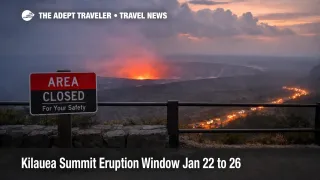
Kīlauea's summit eruption is paused, but the U.S. Geological Survey says the next lava fountaining episode could begin within a January 22 to 26, 2026 window at Halemaʻumaʻu inside Hawaiʻi Volcanoes National Park. Visitors planning a park day on Hawaiʻi Island, especially anyone aiming for summit overlooks or night glow viewing, should expect conditions to shift quickly with limited notice. The practical move is to treat your Volcanoes day as a flexible block, check official updates twice, and build buffer time for congestion, air quality swings, and temporary access controls.
The Kilauea summit eruption window matters because a restart can trigger immediate crowd surges and park management actions that change which overlooks, roads, and trails work for your itinerary, sometimes within hours.
Who Is Affected
Day trippers from Hilo, Hawaiʻi, and Kailua Kona, Hawaiʻi, are the most exposed because the forecast window overlaps typical "one big park day" itineraries that do not have much slack. If you are connecting a Volcanoes visit to a flight out of Hilo International Airport (ITO) or Ellison Onizuka Kona International Airport at Keahole (KOA), the risk is less about the airport itself and more about time loss on the ground from traffic backups, parking constraints, and slow moving viewpoint loops when activity resumes.
Guided tours, cruise shore excursions, and small group itineraries can also be affected because operators may retime, substitute stops, or cancel if access is constrained or if air quality conditions become unfavorable for long outdoor viewing. Even during pauses, USGS reports ongoing summit unrest, including earthquake swarm activity, and it notes that the forecast is subject to change, which is why operators often keep plans conditional until the day of service.
Travelers with asthma, COPD, heart or lung disease, older adults, and young children should plan more conservatively. Hawaiʻi health officials warn that vog conditions and related pollutants can change quickly with emissions and winds, and short term exposures can cause irritation and respiratory symptoms, especially for sensitive groups.
What Travelers Should Do
Treat January 22 to 26, 2026 as a "check then commit" window. The night before your park day, review the USGS Kīlauea update and the park's current eruption viewing guidance, then check again the morning you drive in, because an episode can start and end within a short span and crowds build fast when webcams show fountains or strong glow. If your itinerary depends on a specific overlook, assume you may need a fallback stop if parking fills or access is rechanneled.
Use a simple threshold for rebooking versus waiting. If you have a fixed commitment the same day, like a flight, a timed tour, or a long inter island transfer, do not "hang around" the summit area hoping for a restart, because parking, traffic control, and entrance delays can soak up the slack you thought you had. If you have two consecutive days on the island, consider putting your Volcanoes visit on the more flexible day, then keep the other day as the one you protect for fixed reservations and long drives.
Over the next 24 to 72 hours, monitor three inputs. First, the USGS forecast language, because it can move as inflation patterns and seismicity evolve. Second, park operations signals about where to stage, because the park explicitly warns to expect congestion during eruptions and to keep backup plans if your first stop is full. Third, air quality conditions, because the Department of Health and AirNow both emphasize vog variability and the need to follow official guidance, especially if you are sensitive.
Background
Kīlauea's current summit activity has been behaving in an episodic pattern, with eruptive bursts separated by pauses. In its January 20, 2026 daily update, USGS explains that the eruption at Halemaʻumaʻu is paused, but signs like continued glow, tremor, and inflation support the expectation of another fountaining episode, and it places that next onset in a January 22 to 26 window, while stressing the forecast can change.
For travelers, the disruption is rarely limited to "can I see lava." When activity ramps up, the first order effects tend to be access management at the summit area, including crowd control, parking constraints, and pressure on the most popular overlooks. The National Park Service notes that viewing demand spikes, congestion is common during eruptions, and you should be ready to pivot if your intended stop is full, which is why late afternoon and evening can become particularly time expensive even if the eruption itself is short lived.
The second order ripple is a systems problem across the island's visitor economy. A sudden surge in park visitation can stretch road travel times, compress tour schedules, and push cancellations or retimes when groups cannot hold a safe, workable viewing plan. Separately, the park's two year construction program at Kīlauea's summit adds friction even on "normal" days, with the park warning about entrance delays, temporary closures, and limited parking, and noting that severe delays are possible during high visitation periods like eruptions and busy winter weeks.
Air quality is the other major propagation pathway. Even when lava is confined to closed areas, volcanic gases can react and travel downwind as vog, and Hawaiʻi health officials emphasize that conditions can change quickly with emissions and weather, sometimes reaching unhealthy levels in parts of the state. That can turn an outdoor heavy park plan into a health and comfort decision, and it can also shift demand toward indoor alternatives, shorter stops, or different sides of the island depending on wind and readings, which is why checking an air quality source should be part of your pre drive routine during this window.
Sources
- USGS Volcano Notice - DOI-USGS-HVO-2026-01-20T182621+00:00
- Kīlauea - Volcano Updates | U.S. Geological Survey
- Eruption Viewing Caldera - Hawaiʻi Volcanoes National Park (U.S. National Park Service)
- Construction Closures and Delays - Hawaiʻi Volcanoes National Park (U.S. National Park Service)
- DOH URGES CAUTION WITH ELEVATED VOLCANIC GAS EMISSIONS
- Air Quality Information for Hawaii Residents and Visitors