

Oceania Sonata Inaugural Cruises 2027 Bookings Jan 28
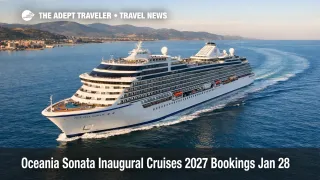
Oceania Cruises has published the first itineraries for Oceania Sonata, the lead ship in its new Sonata Class, ahead of reservations opening on January 28, 2026. The announcement matters most for luxury cruise travelers who want first season sailings in 2027 and 2028 and who tend to book early to secure preferred cabin locations, dining patterns, and shore time in marquee ports. The practical next step is to decide whether you are buying a specific sailing, or simply buying the ship debut, then match your booking strategy to how flexible you can be on dates, cabins, and embarkation cities.
The Oceania Sonata Inaugural Cruises schedule covers 22 voyages from August 2027 through April 2028, ranging from seven to 16 days, and touching more than 90 destinations across Europe, the Caribbean, Mexico, and Central and South America. Oceania says the 1,390 guest ship will begin in the Mediterranean, then cross the Atlantic to start a Caribbean and Americas season out of Miami, including a daylight Panama Canal transit on at least one itinerary. The published sample voyages also highlight an itinerary mix that includes longer days ashore and some overnight stays, which can materially change what you can do without a ship sponsored tour.
Oceania Sonata's maiden voyage is scheduled to depart Rome (Civitavecchia), Italy, on August 7, 2027, and arrive in Trieste, Italy, after 14 days. The route includes calls such as Catania, Italy, Valletta, Malta, Katakolon, Greece, Bar, Montenegro, and Zadar, Croatia, and the line's sample itinerary list shows additional stops like Athens (Piraeus), Greece, and Split, Croatia, within the same sailing.
Who Is Affected
This update is most relevant for three traveler groups. First, repeat Oceania guests and luxury cruisers who care about being on an inaugural season, because early booking typically yields the best choice of cabin position, dining time flexibility, and sometimes better control over pre cruise and post cruise hotel costs in gateway cities. Second, travelers building multi stop Europe and Mediterranean itineraries who want to stitch a cruise between land segments, because embarkation and disembarkation cities like Rome, Trieste, Barcelona, and London (Southampton) can be used as anchors for rail and city stays. Third, travelers who want a warm weather winter itinerary that combines the Caribbean and Latin America, because the Miami based portion of the season includes ports in the Caribbean and a Panama Canal daylight transit on a longer route to the U.S. West Coast.
The first order effects of an inaugural season are cabin availability and schedule rigidity. Once prime categories sell, the remaining choices can force compromises such as less favorable deck placement, fewer connecting stateroom options for families, or higher priced suites as the only remaining inventory. The second order ripple is how a ship launch concentrates demand into specific ports and weeks, which can raise prices for hotels near the pier, tighten airport to port transfer capacity, and reduce the number of easy same day fallback options if weather, delays, or airline schedule changes hit your travel day. In practical terms, a "ship debut" decision quickly becomes an "airfare plus hotel plus transfer" decision, especially when your cruise starts in Europe and ends elsewhere, or when your itinerary is open jaw.
What Travelers Should Do
Start by choosing what you are actually trying to buy. If your priority is the exact maiden voyage on August 7, 2027, or a specific holiday sailing, treat January 28, 2026, as a choice set moment and book early with terms that preserve flexibility. If your priority is simply sailing Oceania Sonata in her first season, you can often wait for pricing cycles, but only if you are comfortable with different dates, different ports, or a different cabin tier than your first choice.
Use a decision threshold for rebooking versus waiting that is based on constraints, not optimism. If you need a specific cabin type, such as a particular veranda category, a midship location for motion sensitivity, or adjacent cabins, it is usually rational to book early, then monitor for promotions that might let you reprice under Oceania's rules. If your constraints are light, for example you are fine with any veranda and you are flexible on month, the better play can be to track fares and wait for a value trigger, while accepting that the most in demand sailings may sell out first.
Over the next 24 to 72 hours after booking opens, monitor the details that most often change the real cost and the day to day experience. Watch the embarkation and disembarkation ports for the sailings you care about, because those determine airfare patterns and hotel nights. Watch which itineraries include overnights or late departures, because those improve independent exploring and can reduce the pressure to buy ship excursions. Finally, watch for deposit rules, final payment dates, and cancellation terms, because those determine how safely you can book early without turning the trip into a sunk cost trap.
Background
A new ship class debut is not just a hardware milestone, it is a network event. The cruise line has to position the ship, staff it, provision it, and lock in port windows, then synchronize those pieces with embarkation day guest flow. When a new vessel launches in Europe and then shifts to the Americas, the operational chain includes pilotage scheduling, port slot coordination, crew rotation timing, and the logistics of stocking food and beverage for a product that markets itself as culinary focused. Those systems constraints are why inaugural seasons tend to be less forgiving of tight travel days, and why the cost of a missed embarkation can be higher when the ship is in a high demand, limited inventory window.
For Oceania Sonata's first season, Oceania is signaling a two region arc, Mediterranean into a transatlantic crossing, then a tropical season out of Miami that includes Caribbean and Latin America calls and a Panama Canal daylight transit on at least one itinerary. That mix creates second order impacts across the traveler journey, including airport and hotel demand in gateway cities, plus itinerary planning complexity when a sailing ends far from where it started. It also means you should treat the cruise as one leg in a broader trip system, where flights, hotels, transfers, and tour timing are all coupled to the ship's arrival and departure schedule.
If you are comparing this debut to other new ship announcements and upgrades, it can help to benchmark how early you want to commit. Atlas Adventurer Asia Cruises Debut In 2028 is an example of a future launch where waiting for pricing and booking rules may be rational, while Westerdam Singapore Dry Dock Upgrades For 2026 Sailings shows how product changes can matter most when you are already booked and need to validate what actually changed.