

FAA Boeing MAX 10 Certification Still Pending in 2026
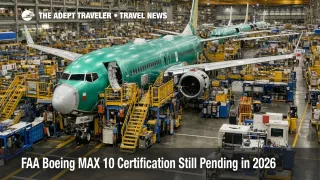
The Federal Aviation Administration says it is not the bottleneck in certifying Boeing's 737 MAX 7 and 737 MAX 10, and that the agency has been actively supporting the manufacturer's efforts. FAA Administrator Bryan Bedford told Reuters that the regulator can help, but Boeing still has to complete the remaining work, adding that he does not see the FAA as "the roadblock" for certification. Airlines and travelers are affected because the two aircraft sit at the center of near term fleet plans, and delayed approvals can translate into tighter seat supply and fewer replacement options when schedules break.
The FAA Boeing MAX 10 certification update matters because it signals the regulator's posture during a period when airlines are already short of new aircraft deliveries. Boeing has told investors and customers it expects the MAX 7 and MAX 10 certification process to conclude in 2026, and Reuters reported the MAX 10 has moved deeper into flight testing, but key technical items still need to be closed out before either model can enter service.
Who Is Affected
Travelers are affected indirectly, but meaningfully, through airline capacity and schedule resilience. Carriers that planned growth, or planned to retire older planes, around incoming MAX 7 and MAX 10 deliveries can end up flying fewer frequencies, delaying new routes, or keeping older aircraft longer than intended. That tends to show up as fuller planes during peak weeks, faster sell outs on popular nonstop flights, and fewer same day rebooking options after disruptions.
Airlines with large MAX 10 positions have been especially vocal because the aircraft is a high capacity narrowbody that many carriers view as a workhorse for busy domestic, transcontinental, and short international sectors. Boeing has said it has more than 1,200 orders for the MAX 10, and Alaska Airlines publicly tied a major order to long range fleet planning even as certification remains pending. The broader context is not limited to Boeing, IATA says the global aircraft order backlog surpassed 17,000 aircraft, which stretches delivery timelines across the industry and limits how quickly airlines can add seats even when demand is strong.
There is also a maintenance layer to the same constraint. When airlines cannot take delivery of planned aircraft, they often extend the life of existing fleets, which increases maintenance visits and parts demand. U.S. lawmakers and industry groups have warned that certified mechanic supply is already tight, and ATEC's pipeline data has highlighted an aging technician population, which can amplify operational fragility when disruptions hit and aircraft need to be returned to service quickly.
For readers who want deeper context on how certification delays translate into capacity decisions, this earlier analysis is a useful reference, FAA Delays on Boeing 737 MAX 10 Hit Airline Capacity.
What Travelers Should Do
For trips you know you will take in peak periods, book earlier than you did in 2019, especially on routes that tend to sell out, like leisure corridors, hub to hub flights, and Friday and Sunday peaks. If you need flexibility, prioritize fares that allow changes, or pair tickets with points or credits strategies that give you options if the airline trims schedules later.
Use a simple threshold for rebooking versus waiting when a schedule change hits. If the airline moves your departure or arrival by 90 minutes or more, adds a connection, or breaks a tight same day onward plan, treat it as a prompt to reprice alternatives immediately, including nearby airports and earlier departures. If the change is small and you have buffer on both ends, waiting can be reasonable, but only if there is still seat inventory on the same flight number or same day alternatives.
Over the next 24 to 72 hours, monitor three signals rather than headlines. First, look for FAA and Boeing updates that indicate a certification milestone, such as progress in test phases or closure of known technical items, because that can influence airline delivery confidence. Second, watch airline schedule changes for your route, including aircraft swaps and frequency reductions, which are often the first traveler visible sign of fleet constraint. Third, keep an eye on maintenance and staffing pressure indicators, because tighter mechanic capacity can reduce recovery speed after weather, air traffic control constraints, or irregular operations.
How It Works
Aircraft certification is a stepwise process where the regulator reviews design, testing evidence, and compliance findings before approving a model for passenger service. When a manufacturer and regulator agree that a design has met requirements, the aircraft can be certified, then delivered to airlines, but any open technical issue, such as systems performance in specific conditions, can extend the timeline while additional tests and documentation are completed.
Production caps and delivery backlogs interact with certification in a way that matters to travelers. After the January 2024 Alaska Airlines door plug incident on a 737 MAX 9, the FAA imposed additional oversight that included a production limit, and Reuters and the Associated Press later reported the agency approved Boeing to increase production to 42 aircraft per month. Even with that higher rate, a global backlog measured in years means airlines are competing for finite delivery slots, and delays to new variants like the MAX 7 and MAX 10 can keep planned capacity from arriving when airlines need it.
Finally, the mechanic shortage is a force multiplier. As fleets age, airlines need more maintenance labor and parts to keep reliability stable, and a constrained technician pipeline can slow return to service times after heavy checks or unscheduled repairs. Reuters reported lawmakers have questioned FAA grant delays tied to addressing the mechanic shortage, and ATEC's published pipeline data frames the challenge as both a near term staffing gap and a retirement wave problem, which is why delivery delays and maintenance labor constraints often show up together in airline planning.
Sources
- US official says FAA not the roadblock to Boeing MAX 7, 10 certification
- Boeing wins FAA approval to hike 737 MAX production to 42 planes per month
- Aerospace Supply Chain Bottlenecks Continue to Impact Airlines
- Alaska Airlines announces largest fleet order in airline's history
- US lawmakers probe FAA grant delays over aircraft mechanic shortage
- Pipeline Report