

Spirit Castlelake Takeover Talks Put 2026 Flights at Risk
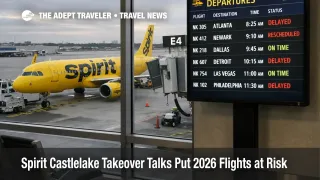
Spirit Airlines is in discussions with investment firm Castlelake about a potential takeover while the carrier remains under Chapter 11 protection in the United States. Travelers holding Spirit tickets, credits, or loyalty balances are the most directly exposed to near term uncertainty, because ownership talks often coincide with additional network trimming and schedule reshuffles. The practical next step is to treat spring and summer 2026 itineraries as "watch closely," keep backup routings in mind, and avoid tight same day connections that depend on Spirit having multiple later flights.
The Spirit Airlines Castlelake takeover talks matter because they raise the odds of an outcome that looks different from the airline's earlier path, either a sale, a smaller standalone Spirit, or a sharper wind down scenario if financing breaks down.
Who Is Affected
Travelers booked on Spirit in 2026 are affected first, especially those on routes with only one or two daily frequencies where a single cancellation can strand passengers until the next day. Travelers using separate tickets are also at higher risk, because a Spirit delay or cancellation can break an onward itinerary that another airline will not protect.
Airports and local markets that rely on Spirit's low fare capacity are exposed to second order effects. When a large ultra low cost carrier reduces flying, competitors may add some replacement capacity, but usually not with the same frequency patterns or price floor, which can push up last minute fares and reduce same day recovery options across a region.
Travel advisors and corporate bookers are affected by the extra management overhead, more schedule change notifications, more time spent reaccommodating clients, and a higher need to document refund eligibility and payment method protections.
What Travelers Should Do
In the next 24 to 72 hours, review any Spirit booking that you cannot miss and price a realistic backup on another carrier, even if you do not buy it yet. If you are traveling for an event, a cruise, or a wedding, prioritize routings with multiple later flights, and consider arriving the day before rather than gambling on same day recovery.
If your itinerary changes, use a simple decision threshold: rebook immediately if the change breaks a connection, removes a critical flight, or pushes arrival past your "must be there" time. If the change is only a modest time shift and you still have multiple fallback flights the same day, it can be reasonable to wait a short window for additional schedule updates before you reissue, because airlines sometimes post multiple edits in a tight batch.
Over the next 24 to 72 hours, monitor three signals: formal statements from Spirit about the restructuring timeline, any announced route or frequency cuts, and court or creditor developments tied to financing. The biggest traveler facing disruptions typically show up as fewer frequencies, aircraft swaps, and sudden reductions in marginal markets, which then cascade into longer airport stays and forced overnight hotels when reaccommodation options thin.
How It Works
A takeover discussion during Chapter 11 can take several forms, and early headlines do not guarantee a deal. A buyer can pursue a full acquisition, provide financing that reshapes the restructuring plan, or bid for select assets if the process shifts toward liquidation. Reuters reported Castlelake entered talks after a Frontier offer in late 2025 was considered unviable by sources, and it framed the moment as a renewed chance for a sale rather than a much smaller Spirit or a liquidation outcome.
Spirit's ability to keep operating day to day has depended on debtor in possession financing and court approved agreements with key counterparties. Spirit said the bankruptcy court approved up to $475 million in DIP financing, with $200 million available immediately, and approved an AerCap agreement that includes a $150 million payment to Spirit and the rejection of 27 aircraft leases. Those tools help keep flights running, but they also often come with a mandate to shrink to a size that can survive on higher yield flying, fewer underperforming routes, and lower fixed obligations.
The timing is also awkward for travelers because Spirit has pointed investors to 2027 as its target year for returning to profitability, implying more transition churn in 2026 before any steady state arrives. Meanwhile, Castlelake has been building aviation specific lending capacity through its Merit AirFinance platform, which it says can deploy more than $1.8 billion in committed capital into aviation financing structures. That is why the takeover talks are not just a branding story, they intersect with the financing plumbing that decides whether schedules stabilize or keep tightening.
For additional context on how Chapter 11 typically affects tickets, loyalty balances, and day of travel protections, see Airline bankruptcy explained: what Spirit's Chapter 11 means. For Spirit's own earlier profitability framing and what it implies for network breadth, see Spirit Airlines profitability forecast: profit in 2027.
Sources
- Castlelake enters talks to buy bankrupt Spirit as Frontier bid deemed unviable
- Spirit Airlines Receives Court Approval for $475 Million Debtor-in-Possession Financing and Key Agreement with its Largest Aircraft Lessor
- Spirit Airlines projects profit return in 2027 after restructuring
- Spirit and Frontier Airlines eye merger, Bloomberg News reports
- Castlelake Launches New Aviation Lending Entity: Merit AirFinance