

Amsterdam Ocean Cruise Ban Proposal Targets 2035
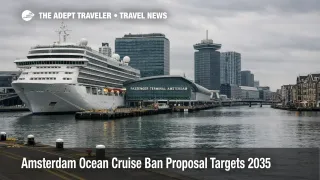
Amsterdam, Netherlands is weighing an Amsterdam ocean cruise ban that would end ocean going sea cruise port calls by 2035. The proposal was outlined by the city's municipal executive as part of a broader effort to reduce tourism pressure and ship emissions near dense neighborhoods. Cruise passengers booked on Northern Europe itineraries, plus travelers planning pre and post cruise stays in the city, are the most exposed to long lead time uncertainty because the next municipal administration would make the ultimate decision after local elections on March 18, 2026. The practical move now is to treat Amsterdam calls as potentially changeable in the next few years, and to plan lodging, rail, and flights with flexible terms.
The Amsterdam ocean cruise ban proposal is a shift from relocation planning to a phaseout path, and it could change how ocean cruise itineraries use Amsterdam as a port of call or turnaround city.
The city's municipal executive framed the phaseout option as preferable to moving sea cruise operations to a different part of the port area, a project the city has estimated at about €85.00 million (EUR), about $99.81 million (USD). City materials also estimate that stopping sea cruises would mean foregone direct and indirect revenue of about €46.00 million (EUR), about $54.01 million (USD), over 30 years, and they say the municipality will further develop the consequences, including job impacts, in the coming months with national government and other partners. The city's stated rationale includes both environmental impacts and tourism crowding, with officials pointing to emissions such as carbon dioxide, particulate matter, and nitrogen compounds generated during approaches and transits on the North Sea Canal and the IJ.
Who Is Affected
Ocean cruise passengers are affected in two distinct ways, port of call schedules, and turnaround logistics. For port of call visits, the risk is not that a ship suddenly disappears from the schedule next week, it is that cruise lines may gradually re optimize itineraries as policy direction hardens, especially once post election governance clarifies whether the city will set binding limits or an end date for sea cruise calls. For turnaround operations, where guests embark and debark and where ships take on provisions, the stakes are higher because a port change can cascade into flight planning, hotel nights, baggage handling, and transfer timing.
Travel advisors and independent travelers building do it yourself cruise packages are more exposed than guests on bundled air and hotel programs. A change from an Amsterdam embarkation plan to an alternate gateway typically forces a new flight city pair, new hotel inventory, and different rail or coach transfers, all of which become expensive when booked close in. Travelers connecting via Amsterdam Airport Schiphol (AMS) also need to think in systems, because if cruise operations are displaced to a different port, the friction often shows up first in ground transfers and hotel availability, not in the cruise fare itself.
Local tourism and transport layers feel the second order effects as well. When a cruise port is constrained, shore excursion providers and canal tour operators can lose predictable peaks, while hotels may see a different pattern of one night stays if passengers start arriving through alternate ports. Rail and road corridors can see pulsed demand when large ships arrive, and if those pulses move to a different gateway, the pinch points move with them. The city is also in a year long 750th anniversary program tied to October 27, 2025, which adds another variable for visitors, because major civic programming can increase baseline demand for rooms, museums, and city transport even without cruise impacts.
What Travelers Should Do
If you are booked on an ocean cruise that includes Amsterdam in 2026 or later, pull the itinerary details you actually bought, including whether it is a port of call day or a turnaround day, and confirm what the cruise line currently lists as the berth or terminal area. Then match your flights and hotels to that reality, using refundable rates where the price difference is reasonable, and avoid prepaid transfers that cannot be moved, especially for early morning departures or late evening arrivals.
If your cruise uses Amsterdam as an embarkation or debarkation point, set a decision threshold now for when you would rebook versus wait. A sensible line is whether the cruise line formally changes the port, or whether it begins offering a no fee change window tied to port planning, either of those signals usually means the line expects meaningful schedule adjustments. If you are on separate tickets, or you have a tight same day connection onward by rail or air, treat that as a reason to add at least one buffer night, because the most common real world failure mode is not the cruise itself, it is missing a flight or rail departure after an unexpected port and transfer change.
Over the next 24 to 72 hours after any major municipal announcement, and again in the weeks after March 18, 2026, monitor three channels, the cruise line's itinerary notices, the port or terminal operator's updates, and municipal statements that clarify whether a phaseout timeline is being converted into binding policy. If you see early signs of port substitutions, price the alternate gateways immediately, because hotel nights and one way rail inventory reprice fast when large passenger volumes shift to a smaller set of options.
Background
Amsterdam has been tightening tourism and cruise policy for years, and the 2035 proposal fits into a layered strategy rather than a single isolated move. At the source, a sea cruise call concentrates emissions and visitor flows in a short window, and it creates sharp pulses of bus and foot traffic near core districts. That first order impact is what city officials cite when they argue that stopping sea cruises can reduce tourist pressure and improve livability, particularly around areas that receive heavy day visitor volumes.
Second order effects propagate through the travel system in predictable ways. When a port tightens access, cruise lines respond by substituting nearby ports, and that substitution pushes workload onto transfer infrastructure, coach staging, and rail corridors. Those changes then spill into hotels and ground handlers, because a different port often means different pre cruise and post cruise patterns, and it can change where passengers overnight, where baggage is handled, and where provisioning happens. Even travelers who never step on a cruise ship can feel the ripple through higher room rates, different congestion patterns, and rebalanced demand at attractions on peak days.
This is also not purely an ocean cruise story. Amsterdam has been managing river cruise volumes and standards on a separate track, which matters because river itineraries are built around frequent dockings and time specific access. For context on how cruise constraints have already been reshaping planning, see Amsterdam river cruise cap reshapes 2026 itineraries and Activists Delay Celebrity Eclipse Docking in Amsterdam.