

Manali Snowfall Road Closures Stranding Tourists
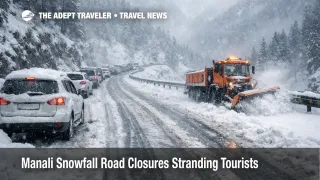
Heavy snowfall around Manali, India, snarled traffic and blocked key roads into and beyond the resort town, leaving some tourists stuck in long highway queues and, in some cases, stranded overnight. The immediate problem has been passability, not just snowfall totals, because compacted snow and black ice forced vehicles to stop, slide, and bunch into gridlock on approach stretches that normally act as the area's main funnel. As crews work through clearance, conditions have stayed volatile because new accumulation and low visibility can erase progress, and reopening often happens in short windows that can close again.
Official and media reporting during January 24, 2026, and January 25, 2026, pointed to large scale road disruption across Himachal Pradesh, with state situation reporting citing hundreds of blocked roads statewide, and specific high altitude national highway segments affected. Reporting also indicated the Manali to Lahaul route via the Atal Tunnel remained closed while snow clearance continued, which matters for travelers planning Sissu, Keylong, or onward circuits that depend on that corridor. Separate reporting described multi kilometer traffic jams near Manali and indicated lodging capacity tightened sharply as travelers were forced into unplanned overnights.
The next weather wave is also part of the story. The India Meteorological Department's Shimla center forecast widespread precipitation from late January 26, 2026, into the morning of January 28, 2026, and flagged the potential for heavier rain or snowfall at isolated places in Kullu and nearby districts on January 27, 2026. That timeline increases the odds that clearance and reopening will be uneven, with recurring closures as crews pivot to keep the highest risk stretches passable.
Who Is Affected
Travelers already in Manali are most exposed, especially anyone staying outside the core town who needs to drive back through steep, shaded segments that ice over early and stay slick even after plows pass. Visitors arriving by road from lower elevation gateways face the highest uncertainty because a closure or traffic hold can strand vehicles far from services, and once congestion forms, turnaround options shrink quickly.
Travelers planning higher elevation sightseeing, including Solang Valley and the Atal Tunnel approach, should assume access can be restricted or suspended without much notice, even if roads look open earlier in the day. That risk rises when authorities limit movement to specific vehicle types, or when traffic is metered to support plows and recovery operations.
Tour circuits are also affected beyond Manali itself. When the main access road stalls, the impacts propagate into hotel check in times, prepaid day tours, private driver schedules, and onward intercity repositioning for travelers trying to catch flights from Kullu Manali Airport (KUU) or connect to longer distance rail and bus links outside the valley. Even if air operations are normal, ground access to the airport becomes the weak link when vehicles cannot move predictably.
What Travelers Should Do
If you are on the road or about to depart for Manali, treat uphill driving as optional until you can verify current movement conditions from local police updates and your lodging, then commit to a single plan. The safest pivot is to hold in lower elevation staging locations and move only when you have a confirmed arrival window, a confirmed room, and daylight, because the road can shift from moving to locked within minutes when a vehicle slides or visibility drops.
If you are already in Manali and your itinerary depends on the Atal Tunnel corridor or other higher elevation excursions, set a clear threshold: if the route is officially closed, if authorities advise against unnecessary travel, or if your driver cannot commit to a safe round trip within daylight, reschedule the day rather than attempting a marginal departure that could strand you between control points. Where operators are offering limited service, assume return timing is the critical constraint, not the departure.
Over the next 24 to 72 hours, watch for three signals that conditions are stabilizing: sustained weather improvement, repeated successful clearance runs that keep roads open for multiple hours, and clear guidance on vehicle restrictions such as chain requirements or four wheel drive only advisories. Also monitor hotel availability and pricing in real time, because occupancy can spike when roads freeze travel in place, and locking lodging early often matters more than chasing the fastest route.
How It Works
Manali winter disruptions are rarely a single closure, they are a cascading system problem. Snowfall and wind reduce traction and visibility first, which forces traffic to slow and cluster on narrow approach roads, then a few sliding vehicles can block an entire lane and stop movement behind them. Plows and heavy equipment need space to work, so authorities often meter traffic or close sections entirely to clear, salt, and reopen, but fresh accumulation can quickly undo that work, especially overnight and on shaded grades.
The ripple effects extend beyond the road itself. When arrivals are delayed, hotels face unpredictable check in surges and unplanned extensions, which squeezes inventory for inbound travelers and pushes prices higher. Tours and private transfers then compress into fewer workable daylight hours, creating cancellations and rebooking backlogs. Finally, missed departure windows propagate into regional flight and rail connections, because travelers can reach a functioning airport or station too late to board, even when those services are operating normally.
Sources
- India Meteorological Department Meteorological Centre Shimla Press Release 25.01.2026
- Tourists stranded, roads blocked, power cut as heavy snowfall cuts off hills
- Snowstorm brings Manali to standstill, tourists stranded overnight
- Manali Nightmare: 8 km jam, hotels 100% occupied, tourists stranded on road
- 8 km highway jam leaves hundreds of tourists stranded in Manali
- Mandi Police RoadUpdate 24.01.2026 (08:00 AM) Road Status Update