

MSP Protest Disrupts Airport Access, Arrests Reported
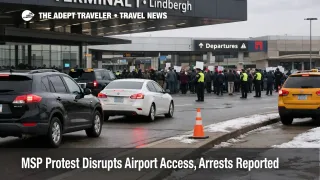
Police arrested about 100 protesters outside Terminal 1 at Minneapolis St. Paul International Airport (MSP) on January 23, 2026, after a permitted demonstration reportedly moved beyond its approved footprint and began interfering with airport access and operations. For travelers, the core risk is not necessarily cancellations, it is ground access and timing. When a crowd shifts from a designated area into curb lanes or roadway choke points, drop off and pick up cycles break, and even "on time" flights can become unreachable inside airline and TSA cutoff windows.
The MSP airport protest access issue matters because it can strand passengers on the wrong side of the terminal, even when gates, crews, and aircraft are otherwise ready to depart. A disruption that lasts an hour at curbside can still trigger missed bag drop deadlines, missed security windows, and missed boarding, which then becomes a seat availability problem, not just a lateness problem.
Who Is Affected
Travelers departing from Terminal 1 are the most exposed, especially anyone checking a bag, traveling with family, or relying on a tight curbside handoff. Even small shifts in traffic flow can add unpredictable minutes because Terminal 1 has limited approach lanes, and merges near the curbs create stop and go waves when vehicles cannot cycle through quickly. Passengers using rideshare are also exposed because rideshare staging, pickup curbs, and police directed routing can change quickly during an active demonstration.
Connecting passengers are affected in a different way. If the first segment out of MSP is missed, downline reaccommodation can be harder than travelers expect because the "miss" is often recorded as a late arrival to the gate or a missed cutoff, not a flight cancellation. That can push travelers into standby, later flights with fewer seats, or same day reissues that require long lines at the airport during the exact window when curbside access is most stressed.
Arrivals are not immune. Pickups can turn into prolonged curbside loops when lanes are constrained, and that increases the chance that drivers stage illegally or get redirected into ramps. The second order effect is a feedback loop, ramp congestion rises, curbs clog, and the terminal front becomes even less elastic. When that happens, some travelers abandon curbside plans and move to parking ramps or off airport meeting points, which shifts demand into shuttles, light rail, and nearby hotels.
What Travelers Should Do
Start with time protection and plan for access friction, not just security time. On days when demonstrations are active or expected, treat the road to the terminal as the variable, and add buffer before you even reach the airport. If possible, use parking ramps or prebooked parking rather than a single shot curbside drop off, because ramps usually remain accessible even when curbs are being managed. If someone is picking you up, consider meeting inside the terminal and walking to a structured pickup option rather than trying to time a curbside curb cut precisely.
Use a decision threshold for rebooking versus waiting before you leave home. If you are within an hour of airline bag drop or boarding cutoffs and traffic conditions are unstable, it is often smarter to move to a later flight proactively than to gamble on a last minute curbside opening. If you are on separate tickets, your threshold should be even stricter because the downstream carrier may treat the missed flight as a no show and price protection may evaporate quickly.
Over the next 24 to 72 hours, monitor the two systems that drive your real risk, terminal access conditions and checkpoint timing. Check MSP posted security wait times close to departure, and pair that with statewide traffic monitoring for sudden roadway incidents or event related closures. Watch for airport and airline updates that signal changes in curbside rules, rideshare pickup locations, or temporary restrictions at Terminal 1. If protests are expected again, consider shifting to Terminal 2 options when feasible, or stage near the airport the night before if the trip has a hard arrival deadline.
How It Works
Airport protests disrupt travel most effectively when they move from visible public areas into the transport spine, roadways, curbs, and entrances. That is because airport throughput is built around predictable vehicle cycling. When vehicles cannot drop and clear, queues back up into approach roads, and the slowdown propagates into parking access, shuttle routing, and even the pace of check in halls as crowds arrive in pulses rather than steady flow. The first order impact is simple, travelers reach the terminal later than planned. The second order ripple is broader, missed departures trigger reaccommodation lines, call center surges, and higher same day hotel demand near the airport, which can raise prices and reduce availability for everyone who gets bumped into an overnight.
This specific event also sits inside a broader, unusually sensitive context at MSP. The Metropolitan Airports Commission has publicly addressed immigration enforcement activity by federal agencies at MSP, including that the airport authority and MSP Airport Police do not coordinate immigration enforcement and cannot restrict federal agency access at a public use airport. That matters for travelers because it explains why protest activity may recur, and why airport operators focus on maintaining access to terminals and public safety rather than adjudicating the underlying federal activity. For travel planning, the operational takeaway is straightforward, expect airport management to permit expression within defined boundaries, and expect enforcement actions when access to Terminal 1 is affected.
Sources
- Edina Police Assist Airport Police During Jan. 23 Protest
- Immigration enforcement by federal agencies at Minneapolis-St. Paul International Airport (MSP)
- Thousands in Minnesota protest immigration enforcement. 100 clergy arrested
- Police arrest clergy members staging anti-ICE protest at MSP airport
- Security Wait Times
- Minnesota 511 Travel Information