

Warsaw Protest March Blocks Central Roads Jan 25
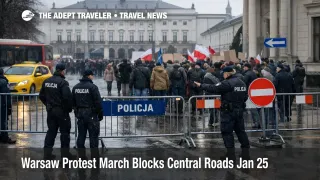
Warsaw protest march road closures are expected Sunday afternoon in central Warsaw, Poland, as a scheduled demonstration is set to move between major government and diplomatic areas. Travelers transiting through the city center, especially those relying on taxis, private transfers, buses, or trams, are most likely to feel the impact. If you have a timed rail departure or an airport transfer during the protest window, reroute around the affected corridor, plan an earlier pickup, and favor Metro or rail where it fits your itinerary.
The Warsaw protest march road closures are time boxed from 200 p.m. to 500 p.m. local time on January 25, 2026, and they can disrupt the most direct surface routes across the center.
Who Is Affected
The demonstration is scheduled to begin with participants gathering at the President's Palace on Krakowskie Przedmieście, then continue past the U.S. Embassy on Aleje Ujazdowskie, and end near Poland's parliament, the Sejm, on Wiejska. Even if you are not attending, the practical traveler problem is that police-managed movement often means rolling closures, controlled crossings, and vehicle restrictions that shift street by street as the march advances.
Visitors staying in central districts, day trippers headed to museums and Old Town area sights, and anyone with pre booked transfers that rely on predictable driving times are the most exposed. A short disruption to a single corridor can propagate quickly because ride hail drivers and taxis cluster on the remaining open streets, buses and trams slow when they are diverted, and curb space around hotels becomes congested when pickups stack. That first order slowdown then ripples into missed train departure windows at major stations, missed airport bag drop or security arrival buffers, and last minute hotel flexibility requests when travelers cannot reach a scheduled check in or tour start on time.
Weather can amplify the same chain. A freezing precipitation advisory for Warsaw beginning early afternoon on January 25, 2026, can increase braking distance for vehicles, reduce walking speed on sidewalks, and turn a detour that is manageable in dry conditions into a schedule breaking delay for tight transfers.
What Travelers Should Do
If you will be moving during 200 p.m. to 500 p.m., treat any surface transfer that crosses the President's Palace, Aleje Ujazdowskie, or the Sejm area as unreliable. Build extra buffer, ask your driver to confirm a pickup point on an open street, and consider switching to Metro or rail for the longest part of your cross town move, then walking the final segment if sidewalks remain passable.
If your plan includes a fixed departure, use a simple threshold. When a missed train or flight would force an overnight stay or an expensive reissue, do not wait for conditions to improve in real time, leave earlier, or rebook to a later departure before the city center locks up. When your plan is flexible, it is usually better to pause for the march window to pass and then travel once streets reopen and vehicle supply normalizes, rather than paying surge pricing for a slow detour.
Over the next 24 to 72 hours, monitor official updates for any changes to the stated timing, any additional demonstrations in the same corridor, and any weather alerts that extend freezing conditions into the evening commute. If you are traveling onward by rail or flying out, recheck your station or airport arrival plan the morning of travel and again a few hours before departure, because controlled streets can shift quickly even when the event remains peaceful.
Background
In Warsaw, demonstrations that move past government buildings and diplomatic sites are typically managed with rolling controls rather than a single static closure. That matters for visitors because travel time variability, not just the closure itself, is what breaks itineraries. A route that normally takes 15 minutes by car can become 45 minutes when vehicles are funneled onto fewer crossings, when public transit is detoured, and when pickup and dropoff points are pushed farther from hotel entrances by police lines or temporary barriers.
The knock on effect spreads beyond the immediate march streets. Airports and rail stations run on cutoff times, staffing patterns, and queueing systems that assume a steady arrival flow. When many passengers arrive late in the same short window, queues spike at check in, security, and platforms, and staff have less flexibility to solve edge cases like name corrections, bag issues, or last minute seat changes. Hotels and tour operators also feel it when arrivals bunch, which can tighten luggage storage capacity, front desk throughput, and the availability of replacement transfers.