

Korean Air Power Bank Use Ban Starts Jan 26
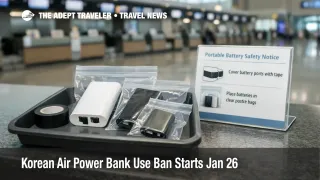
Korean Air and four Hanjin Group airlines will prohibit passengers from using power banks during flights, tightening onboard lithium ion fire prevention across their networks. The change affects travelers flying Korean Air, Asiana Airlines, Jin Air, Air Busan, and Air Seoul on both domestic and international routes. Travelers should plan to rely on seat power where available, and pack power banks so they are easy to present and secure before boarding, because the airlines will require specific storage steps starting January 26, 2026.
The Korean Air power bank ban means you can still carry power banks onboard within existing carry on limits, but you cannot charge a phone or any other device from a power bank, and you cannot charge the power bank itself in the cabin. To reduce short circuit risk, the carriers are requiring passengers to cover exposed metal charging ports with insulation tape, or to place each battery in an individual plastic bag or pouch. After boarding, power banks must stay within personal reach, and they cannot be placed in overhead bins.
Who Is Affected
The policy applies to passengers traveling on flights operated by Korean Air and its Hanjin Group affiliates, including full service and low cost carriers. The practical impact is highest for travelers who routinely top up phones, tablets, cameras, or laptops from a power bank during cruise, because that habit now becomes a compliance issue in the cabin rather than a convenience.
Business travelers and long haul leisure travelers are also more exposed, simply because the temptation to charge mid flight is higher, and because many itineraries stack tight connections on arrival. Even when the rule is clear, compliance friction can slow boarding, trigger repeated announcements, and create small delays that ripple into gate holds, missed boarding cutoffs on separate tickets, and longer lines at transfer desks when misconnects compound.
The risk management angle matters because lithium ion incidents are operationally expensive. A battery event in a cabin can force a diversion, create a crew duty time problem that cancels the next leg, and strand passengers who then compete for limited seats, and sometimes limited hotel rooms, especially at hub airports during peak banks. The "keep it within reach" requirement is designed to make early intervention faster, since an overheating device buried in an overhead bin is harder to detect and isolate quickly.
What Travelers Should Do
Before you leave for the airport, repack your power banks so each one is either in its own clear bag or pouch, or has its ports taped, and place them in an outer pocket you can access without unpacking your entire carry on. At the gate and onboard, keep power banks on your person, in the seat pocket, or under the seat, and do not put them in the overhead bin even briefly, since that is explicitly prohibited under the new policy.
If you need guaranteed onboard charging for work, navigation, medical device support, or time sensitive communications, your decision threshold should be simple: if your aircraft type and seat do not reliably provide power, rebook to an option that does, or plan a conservative battery buffer that does not depend on power bank use mid flight. If you are connecting the same day on separate tickets, treat any boarding delay risk as meaningful, and add time or consolidate onto a single itinerary where reaccommodation is more straightforward.
Over the next 24 to 72 hours, monitor each carrier's website and app notices for any updates to enforcement steps at check in and boarding, because airlines sometimes adjust the "how" quickly after launch. Watch for airport specific messaging at major hubs where compliance checks can be more structured, and pay attention to onboard announcements on your first segment, since crews may emphasize slightly different handling depending on aircraft configuration and available seat power.
How It Works
Power banks use lithium ion cells, and the failure mode airlines worry about is thermal runaway, where a damaged or short circuited cell overheats and can ignite nearby materials. Taping ports and separating batteries reduces the chance that metal objects bridge contacts in a bag, and keeping devices within reach speeds detection and containment if heat or smoke appears. Airlines are pairing the rule with onboard response gear such as fire containment bags, and with crew training that focuses on isolating a battery event fast before it grows into a larger cabin fire risk.
This kind of cabin rule also propagates through the travel system beyond the aircraft. It changes passenger behavior at the gate, it can slow boarding when reminders and compliance checks increase, and it can drive more travelers to seek seats with reliable power outlets, which shifts demand patterns on long haul and premium heavy routes. When a cabin issue does happen, the downstream effects can include diversions, aircraft swaps, missed connections, and recovery waves that pressure airport hotels and rebooking inventory, especially when multiple flights arrive into the same bank and crews are nearing duty limits.
Sources
- 한진그룹 소속 5개 항공사, 오는 26일부터 '보조배터리 기내 사용 전면 금지' 시행 - 대한항공 뉴스룸
- Korean Air and four other airlines toughen power bank rules on flights
- Korean Air and Hanjin Group Ban In-Flight Power Bank Due to Fire Safety Concerns
- Korean Air, Asiana and other Hanjin Group airlines ban inflight use of portable batteries starting Monday
- Korean Air, Sister Airlines to Ban In-Flight Use of Power Banks