

Spain SEMAF Rail Strike Feb 9 to 11 Train Disruption
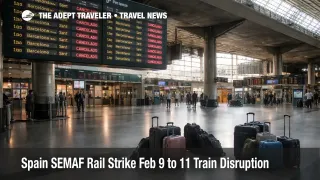
A nationwide rail work stoppage has been called in Spain after the train drivers union SEMAF announced a three day strike across the sector. Travelers are most exposed on February 9, 10, and 11, 2026, when cancellations and reduced timetables can affect high speed, long distance, regional, commuter, and freight operations depending on the minimum services that are set and how different operators staff trains. If you have a fixed departure, treat rail as capacity constrained rather than simply delayed, and be ready to switch modes or move travel dates.
The Spain rail strike Feb 9 matters because it is scheduled, broad, and tied to safety concerns following recent fatal incidents, which increases the odds of knock on operational measures such as inspections and speed restrictions that can linger after trains start running again.
In practical terms, this is not only about the trains you cannot board. Once a national timetable is thinned, passenger flows concentrate onto fewer departures, station staffing gets stretched, customer service queues lengthen, and intermodal substitutes, especially short haul air and intercity buses, can sell out quickly on popular city pairs.
Two recent Adept Traveler updates track how this story has escalated from risk to confirmed strike dates, see Spain Rail Strike Risk For Trains February 9 To 11 and Spain Rail Strike To Disrupt Trains Feb 9 to 11.
Who Is Affected
Anyone relying on Spain's intercity rail spine should assume disruption, especially travelers using high speed or long distance services for timed arrivals, day trips, and same day flight connections. The highest consequence itineraries are those where a missed arrival cascades, including cruise embarkation days, conference start times, and tours that require check in windows.
Travelers in and between Madrid, Barcelona, Seville, Valencia, Malaga, and other major gateways face a second layer of risk because these stations anchor airport transfers and onward regional connections. Even if your specific train operates under minimum service, the surrounding network can be brittle, which raises the chance that feeder legs, crew positioning, or rolling stock rotations fail and force last minute substitutions.
Independent operators and brands can also be affected because the strike is called across train drivers in the sector, not only one company. In Spain's current market, that can include Renfe services such as AVE, Avlo, Alvia, and Media Distancia, plus private high speed operators such as Iryo and Ouigo on overlapping corridors, with different customer communication channels and rebooking rules.
What Travelers Should Do
If you have rail travel planned for February 9 to 11, 2026, start by deciding whether your trip is timing critical. If you must arrive the same day, shift to the earliest feasible departure, build a buffer that survives a cancellation plus one missed alternative, and line up a second mode, usually a short haul flight or an intercity bus, before seats tighten. If your plan is flexible, moving travel outside the strike window is the cleanest risk reduction, because it avoids both cancellations and the station congestion effects that make recovery messy.
Use a decision threshold rather than waiting for the last update. If your train is not confirmed as operating under the published strike timetable within the final 24 to 48 hours, treat it as a likely cancellation and rebook proactively, especially on Madrid to Barcelona, Madrid to Seville, Madrid to Valencia, and Barcelona to Valencia markets where alternatives sell out first. If you can tolerate a same day slip, you can hold longer, but only if you have lodging flexibility and you are not chaining onto another fixed departure.
Over the next 24 to 72 hours before you travel, monitor three things in parallel, your operator's strike page and customer notifications, the published minimum service timetable once released, and any infrastructure notices that reduce line capacity such as temporary speed limits or inspection related slowdowns. Also watch airport load factors and bus inventory, because the substitution wave often hits before the strike begins, as other travelers preemptively shift modes.
Background
SEMAF has framed the strike as a safety driven response after deadly rail incidents, and Spanish media have reported the action as a sector wide call scheduled for February 9 to 11, 2026. Government and operator messaging has also emphasized ongoing investigations and infrastructure checks, and reporting has highlighted concerns that can translate into operational constraints, including precautionary speed limits on certain corridors.
Minimum service levels are central to how disruptive these days become. In Spain, authorities can mandate a portion of service to protect mobility, and operators then publish which specific trains will run. The practical traveler implication is that "minimum service" still means a much thinner timetable, so peak demand is forced onto fewer trains, which raises sell out risk and makes missed trains harder to replace. Historical minimum service resolutions published on operator sites have commonly set commuter peak service around three quarters of normal levels and off peak around half, with medium distance and high speed or long distance service often in the two thirds to three quarters range, but the exact percentages and the train by train list for February 9 to 11, 2026 can differ and must be checked when published.
The disruption then propagates through the travel system in predictable layers. First, cancellations and reduced frequencies increase dwell time at major stations because passengers arrive for trains that do not run, then compete for rebooking and customer service. Second, corridor capacity constraints, whether from strike staffing or precautionary slow orders, disrupt rolling stock and crew rotations, so a problem on one trunk line can ripple into later departures on a different corridor. Third, mode shift pushes pressure onto short haul flights and highways, which can create airport substitution surges, longer security lines, tighter same day seats, heavier intercity bus loads, and rapid depletion of car rentals, especially around Madrid, Barcelona, Seville, and Valencia.
Sources
- Los maquinistas convocan huelga el 9, 10 y 11 de febrero para exigir medidas de seguridad ferroviaria
- Los maquinistas convocan una huelga general tras los accidentes de Adamuz y Gelida
- España, maquinistas de trenes convocan huelga tras accidentes
- Los sindicatos de Renfe volverán a reunirse para decidir si convocan una huelga conjunta
- RESOLUCIÓN de servicios mínimos, ejemplo de porcentajes usados en huelgas previas