

Sydney Protest Marches Limit CBD Access January 26
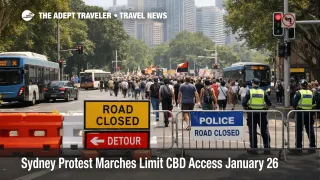
Sydney, Australia will see multiple marches and rallies on January 26, 2026, with police restrictions narrowed but still active across parts of the city. Travelers are most affected if they need predictable street access in the central business district (CBD) for airport transfers, hotel check ins, and timed tours. The practical move is to avoid driving into the CBD during the march window, build larger buffers for any fixed appointment, and switch to rail earlier if pickup zones or road corridors become unreliable.
The Sydney January 26 marches matter for travel because authorized march routes and crowd control can still produce rolling road restrictions, transit detours, and short notice cordons that break normal transfer timing between Sydney Kingsford Smith Airport (SYD), Central, and hotel districts.
Who Is Affected
Travelers staying in the CBD, Haymarket, Surry Hills, Darling Harbour edges, and inner south neighborhoods are the most exposed because movement controls tend to appear first where crowds assemble and then radiate outward as traffic is diverted onto parallel streets. Visitors moving between hotels and key transport nodes, especially Central, Town Hall, Wynyard, Circular Quay, and the Hyde Park area, should expect localized access issues that can change block by block.
The largest planned First Nations rally and march is expected to begin at Hyde Park in the morning and move toward Victoria Park, Camperdown, with police signaling that it will be managed through the College Street corridor. Even when a march is peaceful, the effect on travelers is logistical, streets close, buses divert, and rideshare pickup points can be pushed several blocks away from where an app expects to meet you. A separate anti immigration rally is also planned around midday starting near Prince Alfred Park, which can add friction near Central and surrounding corridors depending on crowd size and police routing.
Airport bound travelers are a special risk group because the surface trip is the weak link that feeds the flight. When CBD road access tightens, missed bag drop cutoffs and missed boarding windows become the real cost, not the delay itself. Travelers on separate tickets, cruise passengers positioning for an embarkation day, and anyone trying to protect an intercity train departure from Central should treat January 26 as a higher buffer day.
What Travelers Should Do
If you have a flight, a timed tour, or a ticketed attraction on January 26, 2026, treat late morning through mid afternoon as a disruption window and leave earlier than you normally would. Use rail as your default backbone for cross city movement, then walk the last stretch when cordons compress pickup zones, because short road closures can strand cars while pedestrians keep moving.
Use decision thresholds instead of waiting for conditions to improve. If rideshare ETAs start swinging, if drivers repeatedly cancel, or if your route time doubles for a short inner city trip, switch modes immediately or reposition to a pickup point outside the CBD. For airport runs, it is usually cheaper to arrive early at Sydney Kingsford Smith Airport (SYD) than to miss a departure and get stuck with limited same day rebooking during a high demand holiday period.
Over the next 24 to 72 hours, monitor three signals. First, police updates about march management and any last minute boundary changes. Second, live traffic conditions and transit service alerts for bus diversions and light rail interruptions in the afternoon. Third, your hotel's access notes, because curbside arrivals and valet access can change quickly when clearways and closures activate around precincts.
How It Works
A march creates disruption in layers. The first order effect is at street level, police establish control points, then close or meter intersections, which forces vehicles and buses onto narrower parallel routes and breaks normal pickup and drop off patterns. The second order ripple hits connections, travelers who reroute at the same time crowd rail stations and platforms, and delayed arrivals cascade into missed tour departures, dining reservations, and timed ticket windows. A third layer is price and capacity, when road access becomes unreliable, rideshare supply thins and prices can spike, while hotels see a higher rate of late check ins and requests to hold rooms.
For January 26, that street level effect is compounded by large city events and precinct management around Sydney Harbour, with published road closures and clearways across the CBD, The Rocks, Dawes Point, Millers Point, Barangaroo, and Milsons Point, plus transit operators warning that buses may divert and light rail can be affected during the afternoon. In parallel, police have described a narrowed but still significant restriction footprint, extending across key precincts from Darling Harbour through parts of the CBD and outward through Oxford Street and the eastern suburbs, which is why travelers should plan as if access conditions can change fast even when a march is authorized.
Sources
- Invasion Day and anti-immigration marches to proceed in Sydney on 26 January after protest ban scaled back
- NSW Police commissioner extends Sydney protest restrictions with 'significantly limited' scope
- Australia Day in Sydney
- Road closures and clearways
- Invasion Day 2026, Find an event near you
- March for Australia